Mon 11 Jun 2018, 13:01 GMT

Designing fuel-efficient ships with today's CFD tools


Deltamarin explains how it is using state-of-the-art technology to optimise hull form and performance.


Image credit: Deltamarin
By Deltamarin

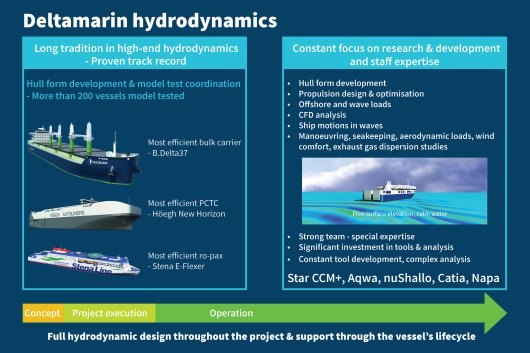
Deltamarin has a long history in energy-efficient ship designs where hull form development has always been one of the spearheads. Nowadays, hull form and performance optimisation with computational fluid dynamics (CFD) is a standard procedure in Deltamarin's ship projects. State-of-the-art tools combined with our vast experience enable us to optimise vessels for real operating conditions and to the ultimate level of efficiency.

Model testing is the traditional way of comparing different hull designs. Due to long experience of model basins, the test can give relatively accurate predictions of vessel performance. However, for an optimisation task, the model test approach is very heavy and does not always provide clear indications of the optimum design. In terms of cost and schedule, model testing is also not the most efficient way; additional tests and model modifications all cost money, and test slots must be booked months before the tests.

Model test evaluations are based on ITTC 1957 or 1978 methods, in which the William Froude hypothesis is still applied to wave-making resistance. Froude's hypothesis assumes that the coefficient of wave-making resistance is the same for similar hull forms in model scale and full scale at the same Froude number. In addition, each test basin uses its own experience-based correlation allowances to correct the model-scale result into a full-scale trial prediction.

For powering prediction, this method is still very applicable, and the results are reliable. However, when it comes to optimising underwater appendages, the model test approach is not perfect. It is possible to perform model-scale experiments for optimising appendages, such as bow thruster openings, bilge keels and shaft lines, but it must be kept in mind that, due to the different boundary layers in model-scale and full-scale and complex scaling effects, the results are mainly indicative, and in some cases may even be incorrect.

The added value that we at Deltamarin want to offer our clients is to provide the most efficient ships by minimising operating costs, not only in normal trial conditions, but also taking into account the actual operation profile of the vessel. With today's numerical tools, the vessel's performance at different loading and environmental conditions can be calculated with reasonable ease. At Deltamarin, we believe that this should be self-evident in every ship project today.

The latest development and validation of CFD boost the efficiency of vessels. We are able to test innovations easily and rapidly with CFD, and our optimisation work reaches a highly detailed level. At Deltamarin, we use the state-of-the-art RANS CFD solver STAR-CCM+ and our own computer cluster to solve the flow field around the vessel. Moreover, to overcome the above-mentioned challenges in the scaling procedure, the CFD simulations can be done in full scale.

In addition to standard bare hull resistance simulations, we do simulations with detailed appendages and as a self-propulsion simulation. Shallow water effects and resistance in waves can also be studied and taken into account in the optimisation. All this allows us to optimise hull form and appendages to minimum propulsion power and the lowest possible fuel costs.

CFD is very much an all-purpose tool for fluid flow. This opens up aerodynamics for us. Primary reported work is typically engine exhaust design, but issues related to air resistance, with or without wind, whether running forward or crabbing, can be understood better.


CMA CGM Notre Dame vessel at Singapore Port. Singapore 12-month bunker calls hit all-time high in July  

TTM calls at world's largest bunkering hub reach record levels despite softer sales volumes.

Cargo port in Singapore. Singapore T3M bunker sales stay below 14m tonnes for fourth month running  

Rolling three-month volumes remain subdued despite modest month-on-month recovery in July.

Shore power system launch at Port of Callao. Peru’s Port of Callao launches first shore power system in Latin America  

DP World Callao’s onshore power supply system could cut over 6,300 tonnes of CO₂ annually.

Aristodimos vessel. New Times Shipbuilding delivers LNG dual-fuel crude oil tanker to Capital  

Chinese yard hands over 155,500-dwt vessel in ceremony attended by owner’s representative.

MSC Sabrina and Alice Cosulich ship-to-ship (STS) bunkering operation. Shell completes maiden LNG bunkering operation in Valencia  

Delivery to MSC vessel facilitated by Fratelli Cosulich said to be first-ever LNG bunker supply at Spanish port.

Marina Bay Sands, Singapore. PIL hiring senior marine fuels executive to manage global bunkering operations  

Singapore-based role includes oversight of fuel procurement and delivery operations, covering PIL's fleet of container and multi-purpose vessels.

Steel-cutting ceremony of vessels with builder's hull nos. CHB2083 and CHB2084. Changhong International Shipbuilding cuts steel on two more 3100-teu boxships for Costamare  

HSFO-fuelled vessels feature scrubbers, SCR systems and shore power connections to meet emissions requirements.

Decab Hub and MMMCZCS logos. Lloyd’s Register and Maersk Mc-Kinney Møller Center launch ammonia safety and training resources for shipping  

New tools aim to help operators build the safety management and competency frameworks needed for ammonia-fuelled vessels.

Kevin Dohmen, IBT Bunkering & Trading. IBT Bunkering & Trading appoints Kevin Döhmen to manage new Singapore office  

Döhmen tasked with developing IBT’s operation in the Asian city-state.

Peak Skarv 3 vessel. Peak takes delivery of third S-class vessel and cuts steel for ammonia-fuelled ship  

Norwegian operator marks two events at Chinese yard as ammonia-powered newbuild programme advances.