Quebec-headquartered
Groupe Desgagnes says it expects to begin operating the
M/T Damia Desgagnes during the autumn of 2016. The vessel will be powered by dual-fuel engines, allowing the use of liquefied natural gas (LNG), marine diesel oil (MDO) and heavy fuel oil (HFO): a first for merchant vessels in Canada.
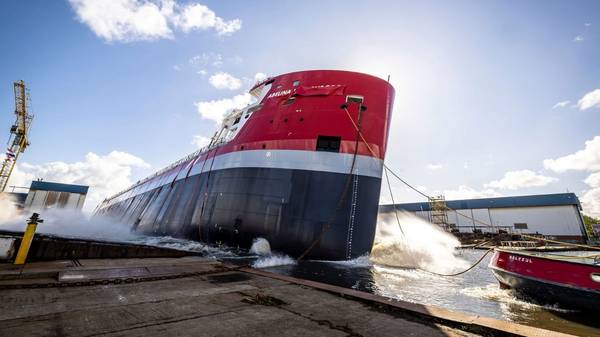
The Damia Desgagnes was successfully launched on June 11th, 2016, at the Turkish shipyard Besiktas. This next generation asphalt-bitumen-chemical tanker forms part of the company's four-vessel fleet renewal program.
The M/T Damia Desgagnes will have a deadweight of 15,100 tons and be able carry 13,350 tons of asphalt with a draft of 7.8 metres; its tanks will offer a carrying capacity of 14,950 cubic metres at 98 percent. It will be equipped with a Wartsila 5RT-flex 50DF propulsion engine with a power output of 5,540 kilowatts (kW), and have a POLAR 7 certification, allowing it to navigate in ice-laden waters.
The tanker will hold a CLEANSHIP SUPER notation, meaning that the ship has equipment that complies with strict environmental standards, including ballast and grey water treatment systems, as well as being able to operate at least seven consecutive days with no discharge of effluents or residues.
The Damia Desgagnes will also hold a GREEN PASSPORT notation, certifying that certain specific materials used during the construction of the ship are identified and noted in a record updated annually and re-certified every 5 years, to ensure safe manipulation and disposal of those materials during the vessel's maintenance and repair, as well as during its dismantlement upon the end of its useful life.
When using natural gas as its primary source of energy, the Damia Desgagnes will achieve several environmental objectives, including: the reduction of carbon dioxide (CO2) emissions by approximately 25 percent due to a lower carbon content in natural gas compared to liquid fuels; the reduction of nitrogen oxide (NOX) emissions by over 85 percent due to the lean-burn combustion process achieved by the ship's engine; the near-complete elimination of sulphur oxide (SOX) emissions since natural gas contains very little sulphur; and air particle emissions will be practically non-existent due to the efficient combustion of natural gas.
"The Damia Desgagnes is part of an extensive investment program for the renewal and expansion of the Desgagnes fleet with vessels fitted with cutting-edge technology, which demonstrates Desgagnes's commitment and confidence in its future," remarked
M. Louis-Marie Beaulieu, chairman of the board and chief executive officer of Desgagnes, back in June.