Fri 31 Oct 2008, 08:02 GMT

K-Sea profit drops on higher expenses


Barge operator records loss on the carrying value of diesel fuel.


Barge operator K-Sea Transportation Partners L.P. has announced operating results and net income for the first fiscal quarter ended September 30, 2008. The company reported operating income of $9.9 million, a decrease of $2.1 million, or 18 percent, compared to $12.0 million of operating income for the same period last year.

K-Sea also announced that its distribution to unitholders for the first quarter will remain at $0.77 per unit, or $3.08 per unit annualized.

Commenting on the results, President and CEO Timothy J. Casey said "Our first quarter results were satisfactory in light of the exceptional developments in the energy markets which disrupted demand in certain of our markets. There were also several factors that affected us which we believe are transitory in nature and which should ease as we progress in fiscal 2009.

"Our results for the first quarter reflected certain higher operating costs that will be increasingly offset by built-in contractual revenue escalators in our charter contracts which will go into effect at various times during the year.

Casey pointed out that the value of the marine fuel used on its tugboats had had a negative effect on the company balance sheet during the quarter ended September 30, 2008.

"The sharp decline in the price of oil in September resulted in our recording a loss on the carrying value of the diesel fuel used to power our tugboats. We also had a negative swing, compared to last year's first quarter, on the disposition of equipment. The total of these items approximated $3.5 million."

K-Sea's President said the vessel utilization and average daily rates remain solid, aided by the large percentage of long-term charter contracts which have an average remaining duration of approximately 2.5 years.

The company also expects to take delivery in November of two new 80,000 barrel tank barges that are committed to long-term contracts. Casey noted that "distribution coverage ratio is negatively skewed this quarter because we will pay the full distribution on the two million new units we issued in the middle of the quarter; however, we did not receive the benefit of a full quarter's reduction in interest expense."

"We believe our balance sheet and liquidity remain solid and the structure of our debt is a major advantage. Debt maturities total only $17 million for the next twelve months, and $19 million in fiscal 2010, which will be covered by availability of over $70 million under our various loan agreements. Our bank revolver is non-amortizing and does not mature until 2014," Casey added.

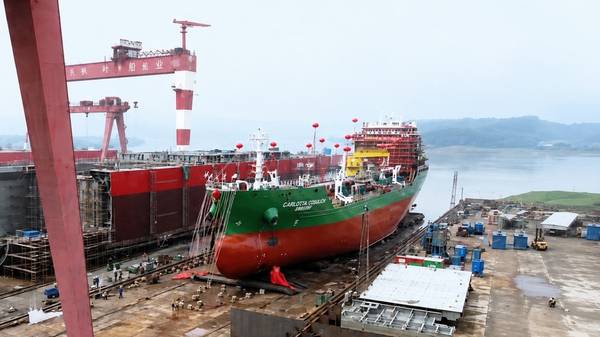
K-Sea said the decrease in operating income had resulted from increased labor, insurance, and general and administrative expenses, and from higher depreciation and amortization resulting from the acquisition of the Smith Maritime Group in August 2007, the delivery of four newbuild tank barges since September 30, 2007, and the acquisition of eight tugboats in June 2008.

"The higher costs more than offset the impact of continued strong rates and solid vessel utilization," the company said.

Utilization was positively impacted by a smaller number of scheduled drydockings compared to the prior year's quarter. Earnings before interest, taxes, depreciation and amortization (EBITDA) increased by $0.3 million, or 1%, to $22.7 million for the three months ended September 30, 2008, compared to $22.4 million for the three months ended September 30, 2007.

Net income for the three months ended September 30, 2008 was $3.9 million, or $0.26 per fully diluted limited partner unit, a decrease of $2.1 million compared to net income of $6.0 million, or $0.56 per fully diluted limited partner unit, for the three months ended September 30, 2007.

Earlier this month, K-Sea annnounced the withdrawal of the proposed initial public offering of K-Sea GP Holdings LP due to 'the current state of the financial markets'.

Commenting at the time of the announcement, Timothy Casey said "The fundamentals of our business remain solid and we are confident in our prospects. The possible general partner IPO would have had no impact on our results of operations or financial condition, and its withdrawal also has no impact on us."


Areion vessel. Dorian LPG takes delivery of dual-fuel VLGC capable of carrying ammonia  

The 93,000-cbm Areion can run on LPG or fuel oil and transport ammonia cargoes.

FSRU Toscana alongside Green Zeebrugge vessel. RINA awards ISCC EU certification to OLT Offshore LNG Toscana for bio-LNG supply  

Certification enables bio-LNG use in the EU as a renewable fuel under RED II and RED III directives.

World Shipping Council at IMO meeting. WSC calls for safe maritime corridor as 20,000 seafarers remain trapped in the Persian Gulf  

Industry body urges IMO member states to establish safe passage and supply access.

Graphic promoting Auramarine webinar titled 'Sustainable Fueling Part 3: Ammonia - next alternative fuel in marine'. Auramarine to host webinar on ammonia as marine fuel in April  

Finnish firm will explore ammonia’s role in maritime decarbonisation at its third spring webinar.

Front cover of study by WinGD and Envision Energy titled 'Renewable Fuel Economics: An OPEX illustration based on current costs'. Green ammonia could reach cost parity with VLSFO and LNG by 2050, study finds  

WinGD and Envision Energy study projects green ammonia operational costs competitive with conventional marine fuels.

Elenger Marine's LNG bunkering vessel Optimus alongside Brittany Ferries’ Saint-Malo. Bureau Veritas verifies methane emissions on Brittany Ferries’ LNG vessels  

Verification enables ferry operator to report measured methane slip instead of regulatory default values.

Map showing existing and planned Emission Control Areas (ECAs). Alliance calls for urgent black carbon action as new Arctic emission control areas take effect  

Canadian Arctic and Norwegian Sea ECAs now in force, with compliance deadline set for March 2027.

Artistic impression of battery-electric ferry for operation on Perth’s Swan River. Lloyd’s Register to class Western Australia’s first electric ferry fleet  

Echo Marine Group partners with Lloyd’s Register on five battery-electric ferries for Perth’s Swan River.

Thomas Kazakos, secretary general of The International Chamber of Shipping (ICS). ICS condemns Middle East shipping attacks as 20,000 seafarers remain trapped  

Industry body calls for urgent state action to resupply vessels and enable crew changes.

Molslinjen ferry illustration. Molslinjen order propels Australia to top of battery vessel production rankings  

Danish ferry operator’s three-catamaran order at Incat Tasmania shifts global manufacturing landscape, analysis shows.