Tue 11 Dec 2012, 16:35 GMT

Reduced fuel consumption with 'new generation' ships


New ships are said to offer significant improvements in fuel consumption.


Mitsubishi Heavy Industries (MHI) says it has begun construction of the first ship in its “Sayaendo” Series, which it has developed as a 'new generation' liquefied natural gas (LNG) carrier, at the company’s Nagasaki Shipyard & Machinery Works.

The LNG carrier is one of two ships ordered jointly by Osaka Gas Co., Ltd., and Mitsui O.S.K. Lines, Ltd. (MOL) in October 2011.

The Sayaendo Series has a hull shape that evolved from LNG carriers with Moss-type hemispherical tanks, and is said to offer significant improvements in fuel consumption and maintainability.

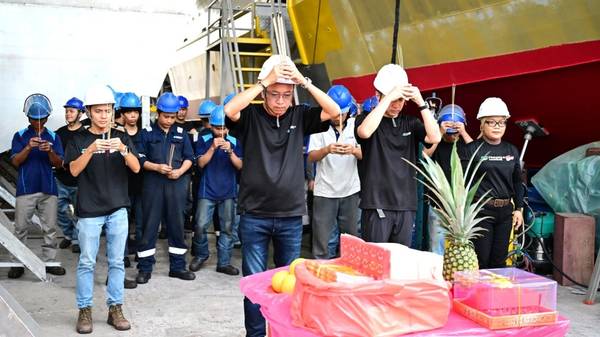
The unit now being built is slated for delivery in the fiscal year 2014 (ending March 31, 2015). At a ceremony held at the shipyard to mark the occasion, a prayer was offered up for safety throughout the vessel’s construction. The ceremony was attended by representatives of the ship’s owners and from MHI.

The LNG carrier will measure 288.0m (meters) in length overall (LOA), 48.94m in width, and 11.55m in draft. The 138,000 gross tonnage (75,000 deadweight tonnage) ship is capable of carrying up to 153,000m3 of LNG (cargo tank total volume: 155,000m3). It will be jointly owned by Osaka Gas International Transport Inc. (OGIT), a wholly owned subsidiary of Osaka Gas handling the operation of LNG carriers, and MOL, which will function as the ship management company.

To protect its four Moss spherical tanks, the Sayaendo features a peapod-shaped continuous cover integrated with the ship’s hull in lieu of a conventional hemispherical cover. This configuration enables reductions in size and weight while maintaining the ship’s overall structural rigidity.

The continuous cover over the tanks also improves aerodynamics by substantially reducing wind pressure, which serves as drag on ship propulsion. For its main power plant the Sayaendo adopts MHI’s “Ultra Steam Turbine Plant” (UST), a new turbine that provides higher thermal efficiency through effective use of thermal energy by reheating steam. Through downsizing, weight reduction and hull line improvement, the new ship is said to achieve a substantial 25% reduction in fuel consumption per unit cargo compared to conventional ships.

With a conventional cover configuration, pipes, wires and catwalks atop the tanks are supported by complex structures. By covering the tanks with an integrated cover and making those supporting structures unnecessary, the new design also improves maintainability. In addition, CO2 emissions are reduced as a result of decreased fuel consumption, and response to environmental issues is further enhanced with installation of a ballast water treatment system, which addresses impact on the marine ecosystem.

To date, MHI has received orders for five Sayaendo Series carriers in total, including another ship ordered by MOL in June.

"The Sayaendo has been drawing great attention in the marine transport industry and is quickly becoming a leading force in the movement to develop energy-saving “eco-ships” offering enhanced environmental performance – an area in which the Japanese shipbuilding industry is actively engaged," MHI said.

MHI sees eco-ships as a key focus of its development of high-value-added products in its shipbuilding and ocean development business sector. At the same time, by developing technologies in this area and further and expanding its product range, the company says it aims to intensify its marketing activities both in Japan and around the world.


Repsol industrial complex in Puertollano. Repsol starts large-scale renewable fuel production at second Iberian plant  

Spanish energy company's Puertollano facility adds 200,000 tonnes per year of renewable diesel capacity.

SD Aisemaht vessel. World's first dual-fuel methanol escort tug receives full class certification  

ABS grants certification to SD Aisemaht, built by Sanmar Shipyards for Canada's Trans Mountain Expansion Project.

CMB.Tech and TFG Marine signing. CMB.Tech raises TFG Marine stake to 15% and consolidates bunker procurement through joint venture  

CMB.Tech increases its equity stake in TFG Marine and commits its entire fleet’s bunker requirements to the joint venture.

XFuel demo plant in Mallorca, Spain. XFuel secures EUR 4.1m Catalonia grant for waste-derived marine fuel plant  

Spanish start-up wins funding to build a modular facility converting waste oils into low-carbon marine gas oil.

Liquefied biogas facility at Port of Gothenburg render. Construction begins on liquefied biogas facility at Port of Gothenburg  

Nordion Energi's new plant aims to open up Swedish biogas supply to shipping and other sectors beyond the gas grid.

Sun Princess ship-to-ship (STS) LNG bunkering operation. Axpo completes first LNG bunkering of cruise ship at port of Naples  

Sun Princess bunkered at Naples, marking the first LNG operation on a cruise vessel at the Italian port.

Ship-to-ship (STS) HVO supply at Keihin Port. Kamei Corporation begins Japan’s first ship-to-ship HVO supply at Keihin Port  

Japanese energy company launches HVO bunkering operation using drop-in biodiesel fuel brand Susteo.

Uni-Fuels Logo. Uni-Fuels posts $376k net loss in Q1 2026 despite 64% revenue jump  

Singapore-based bunker firm attributes loss to communication expenses incurred during the period.

Participants of SSA training course. SSA launches green fuels training course ahead of low-carbon transition  

The Singapore Shipping Association has introduced a course covering alternative marine fuels and emissions frameworks.

The Nautical Institute (NI) logo. The Nautical Institute launches bunkering and engineering assessors course  

New programme targets behavioural competency and human factors in high-risk shipboard operations.