Tue 1 Dec 2009, 12:57 GMT

Wärtsilä launches new dual-fuel engine


'Fuel flexibility' offered by engine that runs on natural gas, marine diesel oil, heavy fuel oil and biofuels.


Wärtsilä, the marine industry’s leading ship power system integrator, has extended its dual-fuel technology to the lower power range with the launch of the new environmentally advanced Wärtsilä 20DF engine.

The new engine offers ship owners and operators a compact unit that brings all the advantages of fuel flexibility to auxiliary applications, such as generating sets or as the prime mover in smaller vessels.

Commenting on the product, Wärtsilä said "The new Wärtsilä 20DF engine is a testimony to Wärtsilä’s ability to successfully utilize gas as a main fuel for marine operations. This makes gas a practical and attractive option at a time when prices for liquid fuels are uncertain, and when environmental requirements are becoming increasingly stringent."

"The tightening emission regulations under the IMO Tier II & III and ECA zone implementations, and volatile fuel prices mean that ship owners and operators are facing serious challenges. Solutions for complying with new environmental rules while maintaining cost-efficient operations vary, but only one - natural gas - appears to fulfil all the requirements," Wärtsilä added.

The Wärtsilä 20DF completes the dual-fuel range

According to Wärtsilä, the launch of the Wärtsilä 20DF means the benefits of dual-fuel (DF) technology have been extended to cover the entire power range.

Based on the Wärtsilä 20 diesel engine introduced in the early 1990s, fuel flexibility means the engine can be optimized for constant speed generating sets, as well as variable speed mechanical drives, for main engine applications.

Installed alongside Wärtsilä 34DF or 50DF main propulsion machinery, Wärtsilä says the 20DF generating set completes the multi-fuel engine room concept. Compact and light, the Wärtsilä 20DF is intended for use in those vessel types where the Wärtsilä 20 is currently installed.

As well as being an ideal mechanical-drive prime mover in smaller applications, such as small cargo vessels, ferries or tug boats, it is also a choice for harbour generating set applications in a wide range of vessel types.

Main fuel flexibility

Fuel flexibility enables owners and operators to opt for the most suitable fuel, taking into account local environmental restrictions, fuel price variations, and fuel bunkering availability. A unique feature of the Wärtsilä DF dual-fuel engines is their ability to run on Natural Gas, Marine Diesel Oil (MDO), Heavy Fuel Oil (HFO) and Bio Fuels, thereby providing maximum flexibility in fuel choice.

In marine applications, fuel flexibility also represents a significant safety feature. In the case of an interruption to the gas supply, Wärtsilä DF engines automatically switch to diesel operation without any loss in speed or power output. Single-fuel installations do not have this additional level of operational safety.

Keeping emissions under control

When a DF engine is running in gas mode, CO2 emissions are reduced by approximately 20% since natural gas has a lower carbon content than liquid fuels, according to Wärtsilä. The lean-burn combustion process employed means that NOX emissions are reduced by approximately 80%, while SOX emissions are completely eliminated as natural gas does not contain any sulphur. The production of particulates is practically non-existent as natural gas has virtually no residuals.

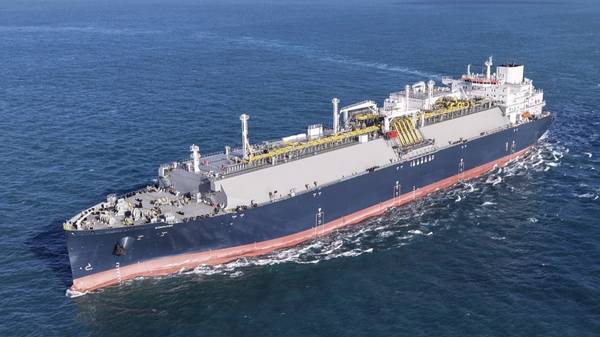
[Pictured: The FLEX LNG Producer. 16 Wärtsilä 50DF dual-fuel engines were ordered in August 2008 to be installed on Floating Production Storage Offloading (FPSO) vessels ordered by FLEX LNG.]


American Bureau of Shipping (ABS) logo. ABS introduces nuclear-ready notation for marine and offshore assets  

The classification society has released what it describes as an industry-first notation to support future nuclear conversion of vessels and offshore assets.

AiP handover ceremony for NEXTGEN Energy Hub (NGEH) design. ABS grants approval in principle for Seatrium’s NEXTGEN Energy Hub design  

The hub concept integrates ammonia bunkering, power generation and electric vessel charging in a single unit.

Jumbo Maritime crew aboard vessel. Jumbo orders two methanol-ready L-Class heavy lift vessels from Dajin Heavy Industry  

Dutch heavy lift specialist Jumbo signs newbuilding contract for two 25,000-dwt vessels.

China flag. Zhoushan completes first bonded bunker operation at Majishan port area  

The operation marks full fuel supply coverage across all general cargo terminals in Zhoushan's port system.

US dollar banknotes. Port of Long Beach launches $1m methanol bunkering challenge for oceangoing vessels  

A $1m prize aims to kick-start commercial methanol bunkering at one of North America's busiest ports.

Core Power, Athlos Energy, Deon Policy Institute and ABS logos. Greece floating nuclear study finds no fundamental barriers to implementation  

A PESTLE assessment of floating nuclear power plants in Greece identifies framework gaps, not feasibility barriers.

Northern Pathliner alongside Bergen LNG vessel. Molgas completes LNG cool-down and bunkering for Northern Pathliner at Northern Lights terminal in Norway  

Operation carried out at Øygarden facility, with K Line and Integr8 Fuels in the supply chain.

Rendering of a G2 Ocean OHGC vessel. G2 Ocean expands fleet with six future-fuel ready gantry crane vessels  

Open hatch specialist adds vessels and jet sail technology as part of a broad fleet renewal programme.

CMA CGM Adventure vessel at Port of Mombasa. LNG-powered CMA CGM Adventure makes first call at the Port of Mombasa  

Kenya Ports Authority receives its first large LNG-fuelled container vessel.

Liam Blackmore, Lloyd's Register. Maritime trio shapes IMO safety guidelines for ammonia as marine fuel  

Real-world operational experience feeds directly into new IMO ammonia fuel safety framework.