Tue 24 Aug 2021, 11:21 GMT

Maersk orders eight large methanol-fuelled boxships


Shipper accelerates fleet decarbonisation in move set to slash annual CO2 emissions by 1m tonnes.


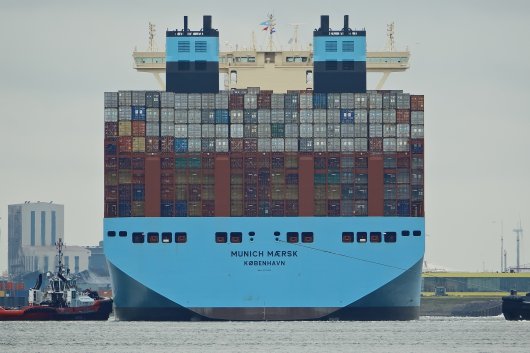
Image credit: Flickr
Maersk has announced that in the first quarter of 2024 it will introduce the first in a series of eight large ocean-going container vessels capable of operating on carbon-neutral methanol.

The vessels, to be built by Hyundai Heavy Industries (HHI), are to have a nominal capacity of approximately 16,000 TEU containers.

The agreement with HHI also includes the option for four additional vessels in 2025.

Maersk estimates that the new ships will lead to a reduction in annual CO2 emissions of around 1m tonnes. They come as part of the firm's ongoing fleet renewal program and will replace tonnage of more than 150,000 TEU which is reaching end-of-life and leaving the Maersk managed fleet between 2020 and Q1 2024.

The vessels come with a dual-fuel engine setup. Maersk notes that additional capital expenditure (CapEx) for the dual-fuel capability, which enables operation on methanol as well as conventional low-sulphur fuel, will be in the range of 10–15 percent of the total price.

Maersk says it aims to operate the vessels on carbon-neutral e-methanol or sustainable bio-methanol as soon as possible. Sourcing an adequate amount of carbon neutral methanol from day one in service will be challenging, as it requires a significant production ramp up of proper carbon-neutral methanol production, for which Maersk says it is engaging in partnerships and collaborations with relevant players.

The ships will be designed to have a flexible operational profile, enabling them to perform efficiently across many trades, and add flexibility regarding customer needs. They will feature a methanol propulsion configuration — developed in collaboration with makers including MAN ES, Hyundai (Himsen) and Alfa Laval — which represents a significant scale-up of the technology from the previous size limit of around 2,000 TEU.

Maersk points out that the new vessels will offer its customers truly carbon-neutral transportation at scale on the high seas. More than half of its 200 largest customers have set — or are in the process of setting — ambitious science-based or zero-carbon targets for their supply chains.

As part of Maersk's ongoing collaboration with clients, companies including Amazon, Disney, H&M Group, HP Inc., Levi Strauss & Co., Microsoft, Novo Nordisk, The Procter and Gamble Company, PUMA, Schneider Electric, Signify, Syngenta and Unilever have committed to actively use and scale zero-carbon solutions for their ocean transport, with more expected to follow.

CapEx for the announced vessels is included in the guidance for 2021–2022 of $7bn. Maersk's current strategy is to maintain a fleet capacity in the 4.0 to 4.3m TEU range, as a combination of Maersk managed and time-chartered vessels.

They newly announced ships are to be classed by the American Bureau of Shipping and sail under the Danish flag.

Soren Skou, Maersk CEO, commented: "The time to act is now, if we are to solve shipping's climate challenge. This order proves that carbon neutral solutions are available today across container vessel segments and that Maersk stands committed to the growing number of our customers who look to decarbonise their supply chains. Further, this is a firm signal to fuel producers that sizable market demand for the green fuels of the future is emerging at speed."

Henriette Hallberg Thygesen, CEO, Fleet & Strategic Brands, Maersk, remarked: "We are very excited about this addition to our fleet, which will offer our customers unique access to carbon neutral transport on the high seas while balancing their needs for competitive slot costs and flexible operations. To us, this is the ideal large vessel type to enable sustainable, global trade on the high seas in the coming decades and from our dialogue with potential suppliers, we are confident we will manage to source the carbon neutral methanol needed."


Rolls-Royce mtu engine test bench. Rolls-Royce Power Systems switches German engine test facilities to HVO fuel  

Company saved 3,200 tonnes of CO2 by end of 2025 after switching to renewable diesel.

MSC Migsan delivery ceremony. Changhong International delivers final LNG dual-fuel container ship 205 days early  

Chinese shipbuilder completes 10-vessel series for MSC with delivery of 11,500-teu MSC Migsan.

Seoul city skyline. Oilmar seeks senior and mid-level bunker traders in Seoul  

Marine fuel firm aims to recruit experienced traders for South Korean operations.

Morten Thomas Jacobsen, GEA. Global Ethanol Association to present on ethanol marine fuel at London shipping expo  

Morten Thomas Jacobsen will discuss ethanol fuel trials and maritime decarbonisation challenges in June.

Adrian Tolson, IBIA. IBIA warns of structural shift in marine fuel market following Middle East tensions  

Association chair says geopolitical disruptions signal lasting changes to bunker supply dynamics and pricing.

HMM Hamburg vessel. Rotterdam bunker volumes plunge 25% in first quarter amid regulatory shifts  

Fossil fuel sales decline sharply while alternative fuels show modest growth in Dutch port.

Camellia Dream vessel. Norsepower completes factory tests for 18 rotor sails bound for Airbus fleet  

Wind propulsion units cleared for installation on LD Armateurs vessels targeting 50% emissions reduction.

Frankie Russ vessel. Ernst Russ acquires four chemical tankers with five-year charters worth $126m  

Hamburg shipowner enters tanker segment with methanol-ready newbuildings delivering from Q4 2026.

Ammonia fuel system component. Wärtsilä boosts ammonia engine power output to match LNG equivalent  

Finnish technology group raises Wärtsilä 25 Ammonia engine output, enabling simpler vessel designs.

Aerial view of a cruiseship at sea. Fincantieri secures order for three LNG-fuelled cruise ships from Princess Cruises  

Italian shipbuilder to construct vessels at Monfalcone yard, with deliveries scheduled through 2039.