Thu 4 Jul 2019, 08:42 GMT

ExxonMobil introduces EMF.5 range of low-sulphur fuels


Supplier highlights proprietary methods for modifying fuel composition to improve quality.


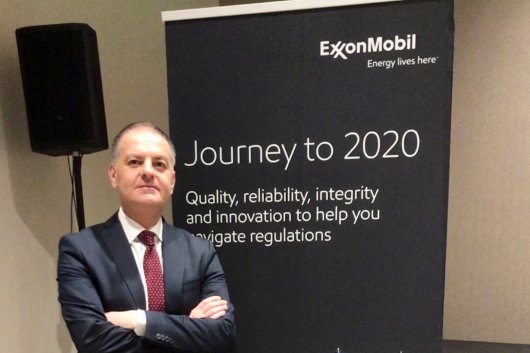
Luca Volta, marine fuels venture manager at ExxonMobil.
Image credit: ExxonMobil
ExxonMobil has announced the introduction of its EMF.5 branded range of engineered marine fuels developed ahead of the International Maritime Organization's (IMO) global 0.50 percent sulphur cap.

As previously reported, the newly named fuels are all residual grades - ranging from RMD 80 to RMG 380, whilst meeting specification levels set out in ISO 8217:2017 - and compatible with each other, provided that bunkering, storage and handling best practice guidance is followed.

The supplier stresses that all the fuels in the range have been specifically engineered to help vessel operators comply with the 2020 regulations without compromising on quality.

ExxonMobil explained: "In addition to meeting the ISO 8217-2017 specification, EMF.5 fuels have also passed ExxonMobil's rigorous fit-for-use assessments, allowing customers to bunker the high quality, compliant options they need ahead of the IMO 2020 deadline.

"This combination of characteristics will help ensure that vessel operators can continue to operate their main engines, auxiliary engines and boilers safely and efficiently when they switch to 0.50 percent sulphur fuels, as the negative, operational and financial consequences of a major product quality problem could be very significant."

Specifications

All ExxonMobil's 0.50 percent sulphur fuels developed to date are residual. The specifications are said to range from RMD 80 to RMG 380, with a density of between 900 and 970 at 15 degrees Celsius.

In terms of catalytic fine (cat fine) content, the bunker supplier notes that the levels meet those set out in the latest ISO 8217:2017 standard.

In ISO 8217:2017, the maximum permissible level of cat fines, measured as aluminium + silicon (al+si), is 60 mg/kg for RMG 180 and RMG 380, whilst for RMD 80 and RME 180 it is 40 and 50 mg/kg, respectively.

"Compliance should not come at the expense of fuel quality, and our EMF.5 range delivers assurances on both to the marine industry," said Luca Volta, marine fuels venture manager at ExxonMobil. "By including our 0.50 percent sulphur fuels in our branded marine offer, we are delivering the additional security that vessel operators want, and need, every time they bunker."

"The increasing variety of fuels entering the market raises the potential of quality and compatibility challenges," said Mike Noorman, head of fuels technology at ExxonMobil Research and Engineering Company. "We have developed proprietary methods for modifying fuel composition to improve quality characteristics, such as combustion, stability, waxing and compatibility. Therefore, purchasing ExxonMobil's EMF.5 fuels can help allay these concerns at a time of great change for the industry."

Mobilgard 540

Back in October, ExxonMobil also announced that it had developed a newly formulated 40BN cylinder oil, Mobilgard 540, which is specifically designed to work with low-sulphur fuels and for vessels operating in 0.1 percent Emission Control Areas (ECAs).

The new lubricant, which replaces Mobilgard 525, is to be made available across the company's global port network and via its distribution network.


IBIA MFM bunkering training course graphic. IBIA announces new date for mass flow meter training course in Rotterdam  

Training scheduled for 12 May follows mandatory MFM implementation at Rotterdam and Antwerp-Bruges ports.

A Maersk vessel, pictured from above. Maersk and Hapag-Lloyd suspend Strait of Hormuz transits amid Middle East security crisis  

Container carriers reroute services around the Cape of Good Hope as military conflict escalates.

Map of Middle East. Operations continue as normal at most Middle East ports  

Most facilities operating normally, with exceptions in Bahrain, Oman and Saudi Arabia.

Photograph of the 93,000-cbm very large ammonia carrier (VLAC) Gaz Ronin. Naftomar takes delivery of 93,000-cbm dual-fuel ammonia carrier  

Gaz Ronin features a MAN dual-fuel engine with high-pressure selective catalytic reduction technology.

Aurora Botnia leaving harbor. AYK Energy completes world’s largest marine battery retrofit on Wasaline ferry  

Aurora Botnia receives 10.4 MWh battery system, bringing total capacity to 12.6 MWh.

Steel cutting ceremony for an LNG dual-fuel 307,000-tonne crude oil tanker with builder's hull no. 113. Dalian Shipbuilding begins construction on LNG dual-fuel crude tanker  

Development is one of a number of milestones reported by parent company over the past few days.

Photograph of Sallaum Lines' Ocean Breeze vessel with 'Introducing The Blue Corridor' overlaid text. Sallaum Lines launches Blue Corridor sustainability initiative for Europe–Africa ro-ro trade  

Company deploys LNG-capable vessels with AI routing and eco-speed protocols on new green shipping corridor.

The platform supply vessel Viking Energy. Eidesvik Offshore signs yard contract for ammonia retrofit of PSV Viking Energy  

Halsnøy Dokk to convert platform supply vessel as part of EU-backed Apollo project.

Vanquish tanker alongside Jette Theresa oil/chemical tanker docked at terminal. North Sea Port completes risk analysis for alternative fuel bunkering operations  

Port authority says LNG, hydrogen, methanol and ammonia can be safely refuelled across its facilities.

Container ship near a port. Ammonia emerges as most feasible alternative fuel for deep-sea shipping in 2050 emissions study  

Research combining expert survey and technical analysis ranks ammonia ahead of hydrogen and methanol.


 Recommended