Wed 5 Dec 2018, 12:21 GMT

Ship design with hydrogen fuel gas system awarded AIP


DNV GL approval in principle 'significant', says MAN Energy Solutions CEO.


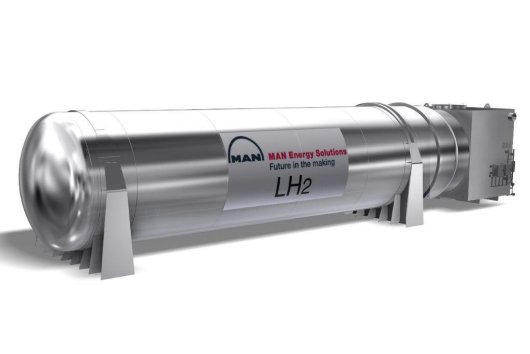
Image credit: MAN Energy Solutions
MAN Cryo, the wholly owned subsidiary of MAN Energy Solutions, has announced that it has developed - in collaboration with Fjord1 and Multi Maritime - a liquid hydrogen marine fuel gas system that has been fully integrated into a vessel design which has been granted approval in principle (AIP) by classification society DNV GL.

Sweden-based MAN Cryo describes the AIP awarded to Multi Maritime's hydrogen vessel design for Fjord1 - which incorporates the hydrogen fuel gas system - as "significant" as it is the first marine system design of this kind to secure such an approval.

Dr Uwe Lauber, CEO of MAN Energy Solutions, remarked: "As a solution for vessels employed on relatively short maritime routes, such as ferries, this technology is a world first and showcases our company's ability to deliver genuinely innovative solutions.

"Furthermore, hydrogen is a clean fuel whose profile fits perfectly with the general desire within the industry to move towards cleaner technology. The possibilities for this technology are varied and exciting."

Louise Andersson, Head of MAN Cryo, said: "To secure this approval in principle shows the determination that MAN Energy Solutions has to advance cleaner shipping solutions."

System development

MAN Cryo developed the liquid hydrogen marine fuel gas system design in-house at its headquarters in Gothenburg in cooperation with Norwegian shipowner Fjord1 and vessel designer Multi Maritime.

The system has a scalable design with easy adaptation in mind for different shipping types, sizes and conditions.

The design is said to be suitable for both above- and below-deck applications, offering ship designers the flexibility to optimise their designs in relation to efficiency, and to cargo or passenger space.

Liquefied hydrogen: challenges and benefits

Liquefied hydrogen has a temperature of -253 degrees Celsius and is one of the planet's coldest cryogenic gases, which places system components and materials under extreme stress.

Another design challenge during development was hydrogen's explosive nature, with MAN Cryo's engineering team therefore putting safety as a top priority.

Once liquefied, hydrogen is reduced to 1/800th of its volume and facilitates a more efficient distribution compared to during the gas phase.

As a fuel, MAN Cryo notes that hydrogen does not release any carbon dioxide and therefore suggests the gas can play an important role in the transition to a clean, low-carbon, energy system, with liquefied hydrogen being used to charge batteries for electrical propulsion via fuel cell technology.

MAN Cryo says it sees a bright future for hydrogen applications as part of the objective to achieve zero fossil emissions within the marine sector by 2050.

The MAN Energy Solutions subsidiary has extensive experience in working with cryogenic gases and solutions for storage and distribution. The company has also developed numerous hydrogen installations over the years on land which - in combination with its experience in marine fuel gas systems for LNG - it says has been invaluable when designing the new Fjord1 system.


MAmmoSS graphic. Mitsubishi Shipbuilding receives order for ammonia fuel handling system  

MAmmoSS system will support shop testing of ammonia marine engines from two licensors.

Neoliner Origin vessel. Kongsberg Maritime to lead EU Horizon project targeting wind-assisted propulsion at scale  

A 15-partner European consortium will use two full-scale vessel demonstrators to validate wind propulsion technology.

Petrobras logo. Petrobras warns of extended MGO and VLSFO supply suspension at Port of Itaqui  

Fuel distributor announces pipeline maintenance shutdowns affecting both MGO and VLSFO supply.

Richard Berkling, PowerCell Group. PowerCell secures SEK 50m marine fuel cell order for two liquid hydrogen cargo ships  

Swedish fuel cell maker wins contract to power two North Sea hydrogen vessels by 2028.

Wärtsilä hydrogen engine. MatH2 consortium launched to tackle hydrogen materials barriers  

New Finnish-led alliance targets materials compatibility challenges holding back hydrogen adoption.

CMA CGM Berenice vessel. CMA CGM takes delivery of fifth methanol dual-fuel boxship in series from Jiangnan Shipyard  

15,000-teu vessel is the penultimate ship in a six-vessel series due for completion in September.

VeriSphere logo. VPS launches VeriSphere Webshop in push to digitise marine fuel services  

Veritas Petroleum Services unveils self-service digital platform giving customers direct access to fuel data tools.

Titus vessel. ExxonMobil and Wallenius Wilhelmsen complete first trial of biofuel blend made from FAME distillation residue  

Vehicle carrier bunkered in Zeebrugge with B30 VLSFO blend.

Chimbusco and Shenergy green methanol agreement signing. 'China’s largest single-order green methanol procurement deal' announced  

Chimbusco and Shenergy seal agreement for 6,000 tonnes of methanol.

Moriond vessel. Exmar takes delivery of third dual-fuel LPG midsize gas carrier in newbuild programme  

Belgian shipping group Exmar takes delivery of the 41,000-cbm LPG carrier Moriond.