Wed 25 Jul 2018, 13:40 GMT

VPS issues high sodium fuel alert for Haifa


Alert is fourth so far this year relating to the supply of residual fuels with high sodium levels.


Image credit: Pixabay
Veritas Petroleum Services (VPS) has issued a bunker alert for Haifa relating to high sodium fuels. It is the first warning issued by VPS for the Israeli port this year.

So far in 2018 there have been four VPS high sodium fuel alerts - the other three being for Cartagena, Singapore, Zeebrugge.

According to the latest ISO 8217:2017 standard for marine residual fuels, the maximum sodium limit is 100.0 mg/kg for RMG and RMK grades (RMG 180, RMG 380, RMK 380, RMG 500, RMK 500, RMG 700 and RMK 700) and also for RMB 30 and RMD 80, whilst for RMA 10 and RME 180 the limit is 50.0 mg/kg.

The International Bunker Industry Association (IBIA) notes in its document 'Vanadium and sodium in marine fuels' that the form in which the sodium is present determines the extent of the possible reduction in the ship's fuel treatment plant.

Sodium associated with water contamination can usually be effectively removed by a well-operated centrifuge system, whilst sodium contamination in the absence of water is probably the most difficult form of this contamination to remove.

High-temperature corrosion and fouling can be mainly attributed to both the sodium content of the oil and vanadium. Both elements oxidise during combustion and, in a series of chemical reactions, form semi-liquid and sticky low-melting-point salts that adhere to exhaust valves and turbochargers. These salts are corrosive and attack the metal to which they adhere.

It is in combination that sodium sulphate and vanadium pentoxide can be harmful to the operation of the engine. They are responsible for fouling and high temperature corrosion on the exhaust valves; also, high sodium levels can result in increased ash deposits in the exhaust gas system and turbochargers.

Last year, there were six VPS alerts related to sodium in residual fuels, with two warnings each for the Americas, Europe and Middle East. It was the fourth most common residual fuel issue to be flagged up in 2017 - after density, cat fines and sediment.

WinGD methanol and ethanol webinar invitation. WinGD to host webinar on methanol- and ethanol-flexible fuel engine technology  

Engine manufacturer will discuss market outlook, regulations and operational experience with alcohol-based marine fuels.

Peninsula graduate programme group photo. Peninsula opens applications for 2026 graduate programmes in marine fuels trading  

Two-year scheme offers positions across six global locations starting in September, combining hands-on experience with structured development.

Collin She, Oilmar DMCC. Oilmar DMCC promotes Collin She to key account manager role  

She will lead strategic customer relationships and drive growth opportunities in Singapore and the wider region.

CM Hong Kong alongside Gang Rong vessel. Hong Kong completes first green methanol bunkering with CCS support  

China Classification Society provides technical oversight for methanol-fuelled vessel's inaugural Hong Kong refuelling operation.

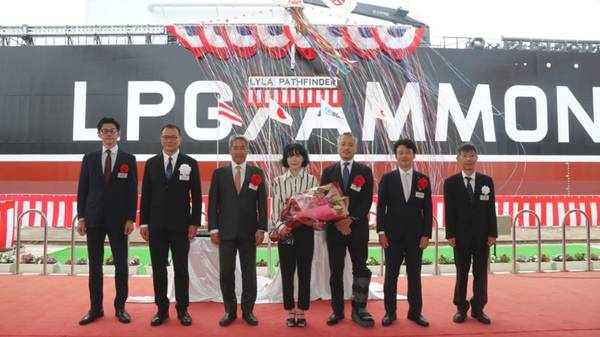
Areion vessel. Dorian LPG takes delivery of dual-fuel VLGC capable of carrying ammonia  

The 93,000-cbm Areion can run on LPG or fuel oil and transport ammonia cargoes.

FSRU Toscana alongside Green Zeebrugge vessel. RINA awards ISCC EU certification to OLT Offshore LNG Toscana for bio-LNG supply  

Certification enables bio-LNG use in the EU as a renewable fuel under RED II and RED III directives.

World Shipping Council at IMO meeting. WSC calls for safe maritime corridor as 20,000 seafarers remain trapped in the Persian Gulf  

Industry body urges IMO member states to establish safe passage and supply access.

Graphic promoting Auramarine webinar titled 'Sustainable Fueling Part 3: Ammonia - next alternative fuel in marine'. Auramarine to host webinar on ammonia as marine fuel in April  

Finnish firm will explore ammonia’s role in maritime decarbonisation at its third spring webinar.

Front cover of study by WinGD and Envision Energy titled 'Renewable Fuel Economics: An OPEX illustration based on current costs'. Green ammonia could reach cost parity with VLSFO and LNG by 2050, study finds  

WinGD and Envision Energy study projects green ammonia operational costs competitive with conventional marine fuels.

Elenger Marine's LNG bunkering vessel Optimus alongside Brittany Ferries’ Saint-Malo. Bureau Veritas verifies methane emissions on Brittany Ferries’ LNG vessels  

Verification enables ferry operator to report measured methane slip instead of regulatory default values.