Wed 19 Nov 2008, 10:13 GMT

US bunker survey findings are announced


Impact of bunker prices on commercial fishermen is revealed.


The Alaska Sea Grant Marine Advisory Program and the United Fishermen of Alaska have completed a survey to explore the impact of high bunker prices on Alaska commercial fishermen during the summer months of 2008.

Some 126 fishermen from across the state responded to the unscientific survey conducted between September and October.

In response to record marine diesel prices last summer, commercial fishermen in Alaska fished less, skipped openings, fished closer to home, and in some cases quit fishing before the season ended, all in an effort to save money on fuel. However, by far the most common belt-tightening step, was to simply slow down.

“Cutting back a little bit on the throttle is the easiest and most immediate way to conserve fuel, and that’s what fishermen did in the short term,” said Mark Vinsel, president of United Fishermen of Alaska, an umbrella group representing 37 Alaska fishing organizations.

“The responses from commercial fishermen across a broad cross-section of the industry confirm that high fuel costs had a significant impact on how fishermen do business,” said Glenn Haight, fisheries business management specialist with the Alaska Sea Grant Marine Advisory Program.

Among the survey’s findings sixty-three percent of respondents said their fuel expenses more than doubled during the past five years. Forty-three percent said that between ten and 20 percent of their gross income was spent on fuel during the past year.

Amongst the most popular techniques fishermen reported using to save fuel were the following:

- Throttling back (76%)
- Maintaining engine and fuel systems (77%)
- Good route planning and timing (68%)
- Keeping a clean hull to reduce drag (56%)
- Properly tuned propeller (53%)

Almost 62 percent said the high price of fuel impacted the crew. The biggest impact was that fewer or no crew were hired, and crew shares were lower.

Whilst 62 percent said they believed fishery management decisions affected their fuel consumption, nearly 52 percent said managers should not make resource decisions based on the price of fuel. Thirty-seven percent said they believed fishery managers should consider fuel costs in their decisions.

Some fishermen received help on their fuel costs. Several fishermen reported buying fuel from seafood processors, who purchased fuel in bulk and passed the savings on to fishermen. The practice is not unusual, according to Cordova MAP agent Torie Baker.

“Fishermen routinely buy fuel from processors and their tenders,” said Baker. “Processors, especially if they are a larger company in a remote location like the Aleutians or Bristol Bay, are in many cases bringing in barged fuel purchased at bulk rates.”

Alaska Sea Grant interim director Paula Cullenberg said she believes the value of the survey will be in helping policy makers and lawmakers design programs to help fishermen weather tough economic times.

“This survey provides them with insights into what fishermen may need, such as loan programs and tax breaks that enable fishermen to upgrade their engines,” said Cullenberg.

Cullenberg said the survey provides Alaska Sea Grant with information to develop training workshops, publications, and other tools aimed at helping fishermen save money and improve efficiencies.

Sunny Rice, the Marine Advisory Program agent in Petersburg, said the survey has given her some good ideas.

“Many fishermen expressed an interest in getting help to compare different engines and how to effectively use energy-saving devices like flow meters,” Rice said.

“We will be looking at developing ways to give fishermen answers to their questions through new publications and workshops in their communities.”

But perhaps the most important finding of the survey is that fuel efficiency is now clearly on the radar of most fishermen. And that, said Sea Grant’s Glenn Haight, is probably a good thing.

“Fuel consumption in the production of food is an increasingly important issue,” said Haight. “It’s easy to see as an environmental issue, through such things as the carbon footprint of the fishing industry, but also through the competitiveness of Alaska as a seafood producer. Bringing down the cost of Alaska seafood production will make our products more attractive around the world.”


American Bureau of Shipping (ABS) logo. ABS introduces nuclear-ready notation for marine and offshore assets  

The classification society has released what it describes as an industry-first notation to support future nuclear conversion of vessels and offshore assets.

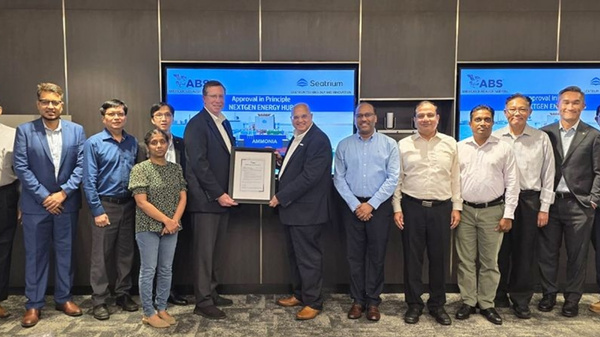
AiP handover ceremony for NEXTGEN Energy Hub (NGEH) design. ABS grants approval in principle for Seatrium’s NEXTGEN Energy Hub design  

The hub concept integrates ammonia bunkering, power generation and electric vessel charging in a single unit.

Jumbo Maritime crew aboard vessel. Jumbo orders two methanol-ready L-Class heavy lift vessels from Dajin Heavy Industry  

Dutch heavy lift specialist Jumbo signs newbuilding contract for two 25,000-dwt vessels.

China flag. Zhoushan completes first bonded bunker operation at Majishan port area  

The operation marks full fuel supply coverage across all general cargo terminals in Zhoushan's port system.

US dollar banknotes. Port of Long Beach launches $1m methanol bunkering challenge for oceangoing vessels  

A $1m prize aims to kick-start commercial methanol bunkering at one of North America's busiest ports.

Core Power, Athlos Energy, Deon Policy Institute and ABS logos. Greece floating nuclear study finds no fundamental barriers to implementation  

A PESTLE assessment of floating nuclear power plants in Greece identifies framework gaps, not feasibility barriers.

Northern Pathliner alongside Bergen LNG vessel. Molgas completes LNG cool-down and bunkering for Northern Pathliner at Northern Lights terminal in Norway  

Operation carried out at Øygarden facility, with K Line and Integr8 Fuels in the supply chain.

Rendering of a G2 Ocean OHGC vessel. G2 Ocean expands fleet with six future-fuel ready gantry crane vessels  

Open hatch specialist adds vessels and jet sail technology as part of a broad fleet renewal programme.

CMA CGM Adventure vessel at Port of Mombasa. LNG-powered CMA CGM Adventure makes first call at the Port of Mombasa  

Kenya Ports Authority receives its first large LNG-fuelled container vessel.

Liam Blackmore, Lloyd's Register. Maritime trio shapes IMO safety guidelines for ammonia as marine fuel  

Real-world operational experience feeds directly into new IMO ammonia fuel safety framework.