Wärtsilä has been awarded a contract to deliver an integrated propulsion system for two additional LNG offshore support vessels (OSV) to
Harvey Gulf International Marine.
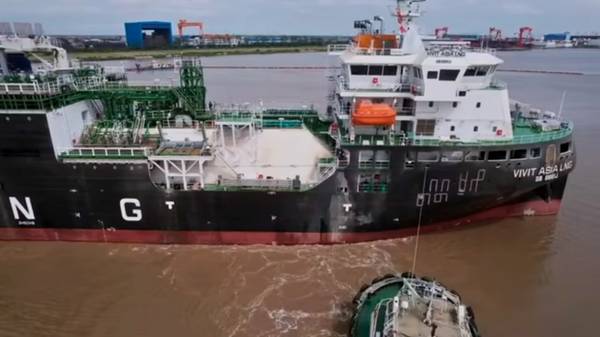
The new order takes Harvey Gulf to a fleet of four LNG OSVs on order, establishing the company as the world's second largest operator of LNG powered OSVs. Wärtsilä will deliver an integrated system that includes the dual-fuel machinery, electrical and automation package, complete propulsion, and also the LNG fuel storage and gas conditioning system. The LNG storage capacity provides for more than a week of vessel operational time.
Commenting on the news, Harvey Gulf CEO
Shane J. Guidry, said: "Harvey Gulf's decision to become the leader in Clean Gulf of Mexico operations has been enthusiastically accepted by oil company executives, and was the impetus for adding two additional LNG dual-fuel vessels to the fleet. These vessels, like their two sisterships, will meet the highest emission standards that exist today - and even higher standards that haven't been created yet. We recognize the strong stance on environmental protection by the administration in the wake of the oil spill, and are doing our part to respond to it and provide our customers support for their environmental commitments."
"Harvey Gulf's original order of complete integrated solutions from Wärtsilä has facilitated the development of an excellent working relationship between Harvey Gulf, STX USA Marine, Trinity Offshore and Wärtsilä. The challenges of bringing a new technology to the US market are being met effectively, and this strong teamwork between suppliers will ensure that Harvey Gulf is delivered state-of-the-art vessels that provide clean, safe, efficient, reliable and competitive operations. This order for two additional LNG powered vessels further demonstrates that Harvey Gulf is an industry leader and that the move to LNG as a marine fuel in the US has begun," stated
Pete Jacobs, Business Development Manager, Offshore at Wärtsilä North America.
"We are witnessing a true paradigm change, and it's a very exciting time for LNG fuelled vessels in the Gulf of Mexico. Millennia ago the shift was oar to sail, two centuries ago it was sail to steam, a century ago steam to diesel, and now it's a new era for gas. We are pleased to continue as a partner with Harvey Gulf as they reaffirm their commitment by adding more safe and clean LNG fuelled vessels to their modern fleet," added
John Hatley, Vice President Ship Power, Wärtsilä North America.
Economy, reliability and winning project strategy in one integrated LNG solution
The dual-fuel capability of the
Wärtsilä 34DF engine means that when running in gas mode, the environmental impact is minimized since nitrogen oxides (NOx) are reduced by some 85 percent compared to diesel operation, sulphur oxide (SOx) emissions are completely eliminated as gas contains no sulphur, and emissions of CO2 are also lowered. Natural gas has no residuals, and thus the production of particulates is practically non-existent.
Commenting on the benefits of LNG, Wärtsilä said: "The shipping industry finds the operational savings that gas offers to be very compelling. When comparing the price levels of various fuels, and especially low sulphur marine fuel, gas is an obvious economic alternative. Similarly, the significant environmental benefits that LNG fuel provides are of increasing importance."
Drawing from decades of experience in the development and application of natural gas engines for both the power generation and marine industries, Wärtsilä is a leader in this advanced technology. Wärtsilä's dual-fuel engines, used in both land-based and marine applications, recently passed the significant milestone of 5 million running hours.
Offshore Service Vessels, performing critical supply services to the offshore Oil & Gas platforms, require a high level of redundancy and operational reliability. The integrated Wärtsilä solution contains its unique
Low Loss Concept (LLC) of electrical distribution and drives architecture. The LLC system provides improved efficiency, redundancy and reliability, all of which are key features for a modern OSV.
The integrated solution also contains the complete LNG fuel storage and gas conditioning system. This is a technology area Wärtsilä quite recently entered, and the company will aim to further strengthen its gas system capabilities following the recent acquisition of Hamworthy.