Tue 8 Dec 2009, 12:27 GMT

Concept design for LNG distribution vessel completed


New vessel could be used to distribute LNG to key bunker supply hubs in the future.


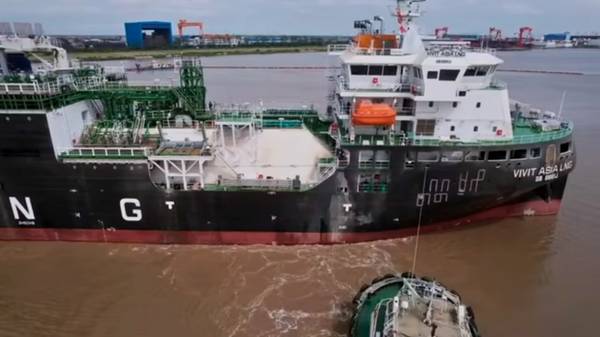
Ship design firm FKAB has released its latest designs for the FKAB L2 - a 16 500 m3 LNG vessel designed primarily for regional distribution of liquefied natural gas (LNG).

The newly-designed vessel follows the company's previous concept design FKAB L1 - a bunker tanker used for the distribution of LNG and light marine oils, which was launched at this year's Nor-Shipping 2009 trade fair in Oslo.

According to Swedish firm FKAB the new vessel form's part of the company's contribution to the development of an efficient and sustainable sea based regional and local distribution system for LNG.

FKAB says the FKAB L2 design is tailor made for the regional distribution of LNG. Speaking to Bunker Index, Johan Algell, Head of Project & Marketing, said that unlike the FKAB L1, which is tailor-made for the delivery of LNG and light marine oils as a bunker tanker, the FKAB L2 will be more suited to the distribution of LNG on a larger scale between regional hubs.

The LNG is stored in three insulated cargo tanks of bilobe type, classified by the International Maritime Organization (IMO) as "Independent Type C". The tanks have spherical heads and a design pressure of 4,1 barg. Each tank is equipped with two submerged deep well pumps for easy discharging. The discharge capacity is 6 x 300 m3/h.

The FKAB L2 main fuel is boil-off gas and regasified LNG from the cargo tanks. FKAB says this will reduce fuel costs when operating the vessel. Despite this the L2 is designed to be as energy efficient as possible with, amongst other features, a slender hull and a heat recovery system.

These measures reduce costs further but will also reduce the environmental footprint of the vessel. To maintain flexibility and for emergency use the machinery is of dual fuel type and the vessel has the capacity to carry MGO as fuel also.

The launch of the FKAB's latest concept design follows several years of research. In 2006 the company identified natural gas in liquefied form (LNG) as a realistic alternative to conventional fuels on ships.

Since then FKAB has closely monitored the development and spent significant resources in the development of various designs using LNG as fuel as well as designs used in the supply chain of LNG for ships.

As a result of FKAB's efforts to evaluate potential LNG solutions, the company presented its FESC (FKAB Environmental Ship Concept) at the RoRo2008 in Gothenburg.

FESC is based on its R13-design and highlights the potential benefits of alternative fuels and emission abatement technologies on ships. Within this concept one of the main topics was the implementation of a LNG propulsion system.

Since the launch of FESC, FKAB has continuously kept up the development and focus on gas-propelled solutions through a number of customer-commissioned projects whilst simultaneously spending in-house resources on research and development.

Areas on which FKAB has focused its attention are:

*Rules and regulations, both present and approaching changes

*Both available, as well as upcoming, engine-options and techniques

*Tank-technologies and handling of fuel

*Ventilation

*Misc safety-aspects on the use of gas on ships

*Fuel-logistics and availability, regionally as well as locally

*Price

*Fuel-economy


NorthStandard logo. NorthStandard publishes biofuel guide as marine insurance claims emerge  

White paper addresses quality issues and compliance requirements as biofuel testing volumes surge twelvefold.

Clean Maritime Fuels Platform (CMFP) logo. Maritime fuel platform calls for EU shipping ETS revenues to fund clean fuel deployment  

Clean Maritime Fuels Platform urges earmarking of national emissions trading revenues for renewable fuel infrastructure.

Seatransport 73m SLV Lloyd’s Register grants approval for hybrid nuclear power design for amphibious vessels  

Classification society approves Seatransport’s concept integrating micro modular reactors with diesel-electric systems.

Everllence ME-LGIE engine. Everllence and Vale partner on ethanol-powered marine engine development  

Brazilian mining company to develop dual-fuel ethanol engines based on ME-LGI platform.

India flag. Emvolon highlights biomethanol as a solution to unlock India’s biogas potential  

Company says distributed biogas-to-biomethanol production could bridge rural feedstock with maritime fuel demand.

Grande Svezia vessel. Grimaldi's Grande Svezia makes inaugural Le Havre call with ammonia-ready design  

Second of 10 new-generation PCTCs features 5 MWh battery system and cold ironing capability.

Cable lay vessel (CLV) render. Kongsberg Maritime to supply integrated systems for LS Marine Solution cable lay vessel  

Norwegian technology provider wins contract for ultra-large vessel being built at Tersan Shipyard in Türkiye.

Maersk Finisterre vessel. Synergy Marine takes on management of methanol dual-fuel container vessel  

The 5,915-teu Maersk Finisterre joins Synergy's fleet under technical management from Synergy Pacific.

Pristine ABP Port Office. Verde Marine Energy appoints Steve Taylor as UK director  

Taylor will be based on the River Humber, working with Vertom Group businesses.

Ammonia Fuel Supply System (AFSS). Mitsubishi Shipbuilding delivers first ammonia fuel supply systems for marine engines  

Systems shipped to Japan Engine Corporation for integration with an ammonia-fuelled marine engine.


 Recommended