Thu 3 Jun 2021, 13:22 GMT

D'Amico to test biofuel's decarbonisation potential


Project involving vessel trials to examine possible reduction in CO2 emissions.


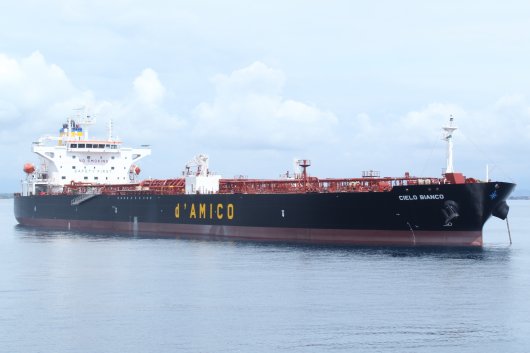
D'Amico's LR1 product tanker, Cielo Bianco, will be involved in trials from mid-June 2021 to test B30 biofuel blends derived from advanced second-generation feedstock.
Image credit: D'Amico Group
A joint industry project (JIP) involving vessel trials has been launched to calculate possible reductions in CO2 emissions from the use of biofuel blends.

Shipping group d'Amico has teamed up with the American Bureau of Shipping (ABS), the Liberian Registry, Lloyd's Register's (LR) Fuel Oil Bunker Analysis Advisory Service (FOBAS), MAN Energy Solutions, the Royal Institution of Naval Architects (RINA) and Trafigura to test B30 biofuel blends derived from advanced second-generation feedstock on board of one of its LR1 product tankers already in EEDI Phase 2.

The JIP will calculate possible CO2 emission reductions through a 'lifecycle strategy' using the so-called well-to-wheel (WTW) analysis, from raw material acquisition to vessel operation, to compare the performance of biofuels against traditional fossil fuels.

Moreover, the project will assess the stability and degradation of the biofuel in relation to storage time and NOx emissions to confirm that the use of biofuel B30 will not affect the Tier II certification of the engines and to measure the effects and improvements on EEXI and CII indices adopted as short-term measures by the IMO.

The tests are to be undertaken on d'Amico's Cielo Bianco and Cielo di Rotterdam vessels, and the low-carbon fuel is scheduled to be supplied in the Amsterdam-Rotterdam-Antwerp (ARA) region by TFG Marine - a joint venture between Trafigura, Frontline and Golden Ocean Group.

The pre-trial phase of the project commenced in March 2021 - when details of the nature and composition of the biofuel blends were made available and protocols relating to fuel testing, inspections, NOx measurement and sea trials were established. It was also necessary to prepare the risk assessment, adapt the swap procedures and develop a consistent crew training program.

The second phase, involving vessel trials, has been scheduled for mid-June 2021 in accordance with planned trade routes. The trial phase will monitor the behaviour of the main engine, diesel generators and boilers whilst burning the biofuel blend, and also evaluate performance, fuel storage capability and NOx levels.

In the post-trial phase, the reported emissions will be processed and analysed with particular focus on CO2 and NOx emissions in relation to existing EEXI and CII guidelines.

The project is planned to run up until mid-July 2021.

A fuel for the transition towards decarbonisation

Discussing the merits of using biofuel, Naeem Javaid, Global Operations Manager – Lloyd's Register FOBAS, explained: "Biofuels are drop-in fuels with no modification to system and equipment being required, making them a potential option as a transition fuel to support the decarbonisation of the maritime industry."

Georgios Plevrakis, ABS Director, Global Sustainability, commented: "Carbon-neutral biofuels could offer significant benefits to the marine sector's drive to decarbonize operations. This trailblazing project will make a vital contribution to our understanding of the potential of biofuels in shipping, its implications for equipment and their impact on decarbonization efforts."

Jamie Torrance, Head of Distillate & Fuel Oil Trading for Trafigura, said: "As one of the world's largest commodity trading and logistics companies we are committed to reduce maritime carbon emissions, including by investing in the development and supply of transitionary fuels such as biofuels. TFG Marine, Trafigura’s joint venture marine fuel supply business with Frontline and Golden Ocean, is already successfully demonstrating the safe and effective use of biofuels in the Amsterdam-Rotterdam-Antwerp (ARA) region through sea trials and laboratory testing, and will take an active role in this joint industry project to test the B30 biofuel blend derived from advanced second-generation feedstock."


IBIA MFM bunkering training course graphic. IBIA announces new date for mass flow meter training course in Rotterdam  

Training scheduled for 12 May follows mandatory MFM implementation at Rotterdam and Antwerp-Bruges ports.

A Maersk vessel, pictured from above. Maersk and Hapag-Lloyd suspend Strait of Hormuz transits amid Middle East security crisis  

Container carriers reroute services around the Cape of Good Hope as military conflict escalates.

Map of Middle East. Operations continue as normal at most Middle East ports  

Most facilities operating normally, with exceptions in Bahrain, Oman and Saudi Arabia.

Photograph of the 93,000-cbm very large ammonia carrier (VLAC) Gaz Ronin. Naftomar takes delivery of 93,000-cbm dual-fuel ammonia carrier  

Gaz Ronin features a MAN dual-fuel engine with high-pressure selective catalytic reduction technology.

Aurora Botnia leaving harbor. AYK Energy completes world’s largest marine battery retrofit on Wasaline ferry  

Aurora Botnia receives 10.4 MWh battery system, bringing total capacity to 12.6 MWh.

Steel cutting ceremony for an LNG dual-fuel 307,000-tonne crude oil tanker with builder's hull no. 113. Dalian Shipbuilding begins construction on LNG dual-fuel crude tanker  

Development is one of a number of milestones reported by parent company over the past few days.

Photograph of Sallaum Lines' Ocean Breeze vessel with 'Introducing The Blue Corridor' overlaid text. Sallaum Lines launches Blue Corridor sustainability initiative for Europe–Africa ro-ro trade  

Company deploys LNG-capable vessels with AI routing and eco-speed protocols on new green shipping corridor.

The platform supply vessel Viking Energy. Eidesvik Offshore signs yard contract for ammonia retrofit of PSV Viking Energy  

Halsnøy Dokk to convert platform supply vessel as part of EU-backed Apollo project.

Vanquish tanker alongside Jette Theresa oil/chemical tanker docked at terminal. North Sea Port completes risk analysis for alternative fuel bunkering operations  

Port authority says LNG, hydrogen, methanol and ammonia can be safely refuelled across its facilities.

Container ship near a port. Ammonia emerges as most feasible alternative fuel for deep-sea shipping in 2050 emissions study  

Research combining expert survey and technical analysis ranks ammonia ahead of hydrogen and methanol.