Wed 24 Oct 2018, 00:03 GMT

Experience-building phase gains support at MEPC 73


Issue set to be debated again on Wednesday before decision is made on whether the EBP is passed on to a working group.


A number of countries - including the Democratic People's Republic of Korea, Panama and the US - are understood to have spoken in favour of the experience-building phase (EBP) during Tuesday's session.
Image credit: Flickr
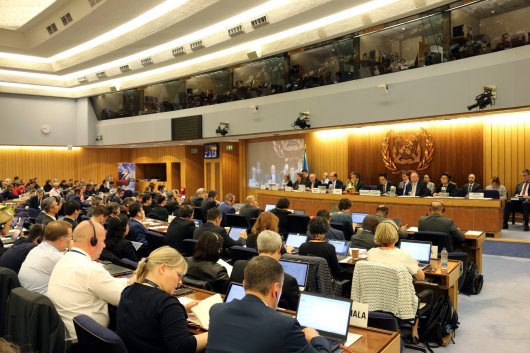
The proposed experience-building phase (EBP) - a data-gathering period with the purpose of providing greater transparency and detailed information on the compliance situation after the implementation of the global 0.5 percent cap on fuel sulphur content on January 1, 2020 - gained support from a number of member states during the second day of the International Maritime Organization's (IMO) 73rd Marine Environment Protection Committee meeting (MEPC 73).

Co-sponsored by the Bahamas, Liberia, Marshall Islands, Panama, BIMCO, Intercargo and Intertanko, the EBP concept was submitted to the MEPC in an August 31 document, MEPC 73/5/14, which last week also received the backing of the Trump Administration after the White House declared that it was throwing its support behind the EBP "in order to mitigate the impact of precipitous fuel cost increases on consumers".

During proceedings at IMO headquarters on Tuesday, a number of countries are understood to have spoken in favour of the EBP, including the Democratic People's Republic of Korea, Panama and the US.

The issue is set to be debated again on Wednesday, with as many as 20 member states set to speak before a decision is made regarding whether the EBP is passed on to a working group to formulate a plan.

Earlier this month, the EBP co-sponsors moved to clarify any "misconceptions" about their proposal. In a statement, they explained that they were "fully committed" to a January 1, 2020 sulphur cap implementation date, and that the EBP was not seeking to delay the adoption of the MARPOL Annex VI amendments prohibiting carriage of non-compliant fuel oil.

Also, rather than delay or weaken the enforcement provisions of MARPOL Annex VI, the co-sponsors said they are seeking to facilitate "a pragmatic approach" by Administrations in situations where a ship is not able to achieve compliance due to fuel non-availability and fuel quality problems, and that their aim is to provide greater transparency so that appropriate enforcement action in non-compliance situations is carried out in a consistent manner.

Furthermore, the EBP backers explained that a possible review of the regulatory framework of MARPOL Annex VI could not delay the implementation of the sulphur cap after it has already come into effect, and that it would only be possible to ascertain whether any improvements to the regulatory framework were necessary after knowing the actual implementation situation after January 1, 2020.

The co-sponsors conceptualize the EBP as a formalized data collection and analysis measure to closely monitor the implementation of the sulphur cap.

They envisage specific details on the plan for the data gathering and analysis to be developed during the period between MEPC 73 and MEPC 74 - either through expansion of the IMO GISIS database, or another separate reporting platform.

Their proposal does not include a fixed time frame, so that there is sufficient flexibility for it to be either shortened or extended to conclude when the fuel oil availability situation "stabilizes" globally.


China flag. Zhejiang’s first methanol-powered container ship launches in Jiaxing  

The 64-teu vessel uses methanol propulsion technology to reduce carbon dioxide emissions by 90%.

TES flag with a model vessel in the background. TES joins SEA-LNG coalition to advance e-methane as marine fuel  

Green energy company targets 1m tonnes annual e-methane production by 2030 for shipping decarbonisation.

Ethanol and methanol workshop graphic. IBIA to host workshop on ethanol and methanol marine fuels during Singapore Maritime Week  

Half-day event will examine alcohol-based fuel pathways and integration into shipping’s multi-fuel landscape.

Steel-cutting ceremony for 13,000-dwt vessel. ROC begins construction of second chemical tanker for Essberger  

Chinese shipbuilder holds steel-cutting ceremony for 13,000-dwt methanol-ready vessel with ice class capability.

Norsepower and CHIC sign agreement. Norsepower and Cosco Shipping Heavy Industry Equipment sign wind propulsion cooperation agreement  

Wind propulsion technology provider partners with Chinese shipyard to scale rotor sail production.

Wärtsilä logo. Shipping firms struggle to prioritise decarbonisation investments amid regulatory uncertainty, Wärtsilä survey finds  

Survey of 225 maritime executives reveals 70% say uncertainty hinders investment decisions despite regulatory pressure.

IMT Isca G-Flex vessel render. Longitude Engineering unveils IMT Isca G-Flex PSV design with alternative fuel capability  

Naval architecture firm launches adaptable platform support vessel design based on the IMT-984 G-Class hull.

Philippos Ioulianou, EmissionLink. Shore power infrastructure is key to cutting ferry emissions in European cities, says EmissionLink  

Port electrification is needed to enable vessels to switch off engines at berth, reducing urban pollution.

Maritime and Port Authority of Singapore logo. Singapore prioritises maritime resilience amid geopolitical uncertainty, eyes digitalisation and green fuels  

MPA chief outlines the sector’s adaptation to supply chain disruptions while advancing automation and alternative fuels.

Aerial photograph of Zhoushan Island. China exports first domestically blended biofuel for marine use from Zhoushan  

A vessel carries 2,600 tonnes of biofuel blend to Qingdao Port for international ship refuelling.