Tue 14 Aug 2018, 13:31 GMT

Suphur cap and MFMs covered in Brightoil's ESG report


Discusses 'great opportunities' for its fuel-efficient VLCCs and the benefits of MFM procedures.


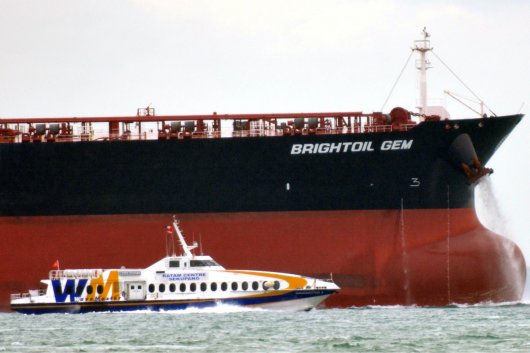
Brightoil Gem and Wavemaster 3, pictured in the Singapore Strait.
Image credit: Flickr
Bunker seller Brightoil Petroleum on Tuesday released its Environmental, Social and Governance (ESG) Report for 2017.

It is the company's first ESG report with reference to the ESG Reporting Guide under Appendix 27 of the Stock Exchange of Hong Kong's (SEHK) Main Board Listing Rules, which requires an issuer to disclose ESG information once a year covering the same period as that documented in its annual report.

In the case of Brightoil, the company's fiscal year runs from July to June, so the ESG reporting period is from July 1, 2016, to June 30, 2017.

The main sections of the document cover operating practices, people, environment, community and regulatory compliance.

Sulphur cap 'opportunities'

On the issue of the environment, Brightoil refers to the upcoming 0.5 percent global cap on fuel sulphur content in 2020, which the company says is expected to encourage the removal of older fleet tonnage before the new regulation comes into effect.

As such, Brightoil predicts that the next few years will offer "great opportunities" in the tanker transportation market for Brightoil's new fuel-efficient VLCCs.

Mass flow meter benefits

Discussing operating practices, Brightoil notes that every one of its supply vessels is fitted with a mass flow meter (MFM) so that bunker consumption can be measured and managed effectively. MFM dispute management guidelines and procedures are also in place.

This, the company says, has enabled it to perform quality controls efficiently and avoid any potential dispute with customers regarding the amount of fuel supplied.

Also, with the adoption of Singapore's TR48 technical reference for bunker mass flow metering, Brightoil notes, when discussing the health and safety of people, that it has eliminated the need for manual fuel tank quantity checks when recording fuel transfers and also "greatly reduced health and safety risks of bunkering crew members by preventing them from exposing themselves to harmful vaporised fuel during the manual check".

Caspar Gooren, Titan. Titan Clean Fuels signs e-methane supply deal with TURN2X for 2028 delivery  

Bunker supplier to receive e-methane from Spanish production plant for distribution across European ports.

Hydrogen-fuelled engine 6UEC35LSGH. Japan consortium achieves hydrogen co-firing in main engine for large commercial vessel  

Engine reaches over 95% hydrogen co-firing ratio, with installation planned for 2027.

BTB bunker truck. Belgian Trading & Bunkering expands DMA 0.89 truck deliveries in ARA region  

BTB extends marine fuel offerings with truck-based deliveries to meet maritime market demand.

Fuel pathway roundtable meeting participants. ABS convenes roundtable on offshore power barge for Great Lakes emissions reduction  

Meeting brought together ports, academia and industry to advance shore power solution under EPA programme.

Lego Ane Maersk video screenshot. Maersk marks 50-year Lego partnership with dual-fuel vessel model  

Shipping company displays an exhibition of Lego sets spanning five decades at Copenhagen headquarters.

Guo Yun Hai vessel. Cosco Shipping takes delivery of 80,000-dwt methanol-ready grain carrier  

Guo Yun Hai features box-shaped cargo hold and methanol-ready design with energy-saving devices.

CMA CGM Innovation ship-to-ship transfer. Algeciras reports record LNG bunkering volumes, claims European top-three position  

Spanish port says it supplied 333,833 cbm of LNG across 78 ship-to-ship operations in 2025.

Additional costs chart. T&E: Iran conflict costing shipping industry €340m a day in fuel costs  

Transport & Environment analysis shows marine fuel price surge has cost the industry €4.6bn since conflict began.

CF 3850 vessel render. Damen delivers second hybrid-ready combi freighter to German shipowner  

The vessel features biofuel capability and will be retrofitted with wind-assist technology with government funding.

Engine retrofit report 2026 graphic. Retrofit capability expands as regulatory uncertainty slows alternative-fuel conversions  

Lloyd’s Register warns delayed conversions could compress demand into a narrower, costlier timeframe as the fleet ages.