Wed 20 Jun 2018, 11:04 GMT

Hydrogen-powered ferry project secures EU funding


EUR 9.3m awarded by the EU's Horizon 2020 research and innovation fund.


Image credit: Pixabay
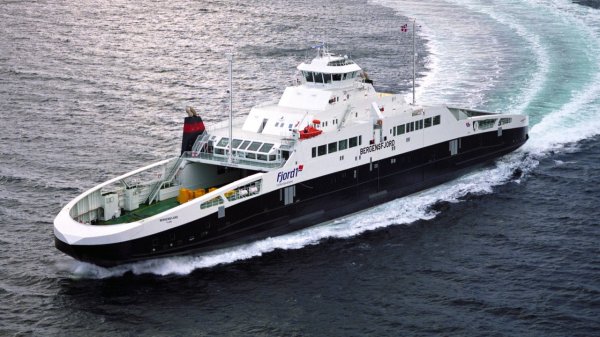
A European consortium has been successful in its bid to secure EU funding to support the construction of the world's first hydrogen-powered seagoing car and passenger ferry, where the vessel's fuel will be produced from emission-free renewable electricity.

The supported development is expected to cost around EUR 12.6m, of which EUR 9.3m has been awarded by the European Union's Horizon 2020 research and innovation fund.

The HySeas III project is jointly led by Scottish shipyard Ferguson Marine Engineering and the University of St. Andrews, and includes Orkney Islands Council; Kongsberg Maritime (Norway); Ballard Power Systems Europe (Denmark); McPhy (France); DLR - German Aerospace Center; and Interferry (Belgium/US) - the global trade association for ferry operators and suppliers.

Employing Ballard technology, the initial objective is to construct and prove the vessel's modular drive train onshore, testing for stress and durability under conditions employing real-world data from existing vessels.

Once the vessel has been tested and proven to be able to operate safely and efficiently around Scotland's challenging coast, the project is then set to move on to the construction phase.

The ferry is planned to operate in and around Orkney, which is already producing hydrogen in volume from constrained - and hence otherwise wasted - renewable energy.

Ferguson and St. Andrews

Joint project leader Ferguson previously launched the MV Hallaig - the world's first ever battery hybrid ferry.

The Glasgow-based firm also achieved another first in November 2017 when it launched the MV Glen Sannox - the first UK ferry build with dual-fuel capability (marine diesel & LNG). The Glen Sannox's sister vessel is currently under construction at the shipyard.

The University of St Andrews, the third-oldest university in the English-speaking world, performs research and development in hydrogen, battery and other energy technologies. A key part of the development aspect is the transferal of knowledge and expertise into real-world applications - not least in stretching the boundaries of what has previously been thought of and achieved.

Project coordinator Dr. Martin Smith from the University of St. Andrews, along with Jim Anderson at ferry operator Caledonian Maritime Assets Ltd (CMAL), initiated the HySeas programme in 2012. Support from Scottish Enterprise allowed the idea to be taken from an early feasibility study to the point where the focus can now shift into testing and delivery.

Dr. Smith previously played a leading role in the introduction of hydrogen buses into Scotland - a development which is now set to move beyond Aberdeen, with Dundee currently following and other Scottish cities considering fleets of their own.

Ferguson Marine Chief Executive, Gerry Marshall, remarked: "We now have one of the most innovative and competitive shipyards in Europe which is capable of delivering ground-breaking projects for Inverclyde, Scotland and beyond. HySeas III is a living example of how it can be possible to lead the world in marine technology."

Dr. Smith said: "This is a very exciting stage to be at now. This opens the real possibility of Scotland and her key European partners delivering another world-first, not simply in ship building but also in building sustainable local sources of fuelling in parallel."


EIB and Port of Rotterdam signing. Port of Rotterdam secures €90m EIB loan for shore power installations  

Financing will support shore power infrastructure at three container terminals, with an EU grant also approved.

IBIA logo. IBIA updates biofuels training module for 2026  

Updated online course covers latest regulatory developments and market trends in liquid and gaseous biofuels.

Brim Explorer’s fully electric passenger vessel concept render Bureau Veritas to class all-electric trimarans for Brim Explorer  

Two zero-emission passenger vessels will operate in Norwegian fjords after extensive Arctic testing.

Steel cutting ceremony for LNG fuel tank project. CIMC SOE starts construction on first 9,000-cbm LNG tank project  

South Korean shipowner SUNBO has commissioned the tanks for 18,000-cbm LNG bunkering vessels.

Rob Mortimer, CEO of FuelRe4m. Gulf tensions expose shipping’s continued reliance on fossil fuels, says Fuelre4m  

Dubai-based firm warns alternative fuel infrastructure remains fragile compared to established oil and gas systems.

Welcoming of CMA CGM Grand Palais vessel. CMA CGM adds 23,000-teu containership to Asia-Europe service  

CMA CGM Grand Palais will operate on the FAL3 route between Asia and Europe.

WinGD methanol and ethanol webinar invitation. WinGD to host webinar on methanol- and ethanol-flexible fuel engine technology  

Engine manufacturer will discuss market outlook, regulations and operational experience with alcohol-based marine fuels.

Peninsula graduate programme group photo. Peninsula opens applications for 2026 graduate programmes in marine fuels trading  

Two-year scheme offers positions across six global locations starting in September, combining hands-on experience with structured development.

Collin She, Oilmar DMCC. Oilmar DMCC promotes Collin She to key account manager role  

She will lead strategic customer relationships and drive growth opportunities in Singapore and the wider region.

Areion vessel. Dorian LPG takes delivery of dual-fuel VLGC capable of carrying ammonia  

The 93,000-cbm Areion can run on LPG or fuel oil and transport ammonia cargoes.