Bureau Veritas has announced that it has issued a number of approvals to membrane containment system and LNG technology specialist
Gaztransport & Technigaz (GTT), including the approval in principle (AIP) for a new bunker barge.
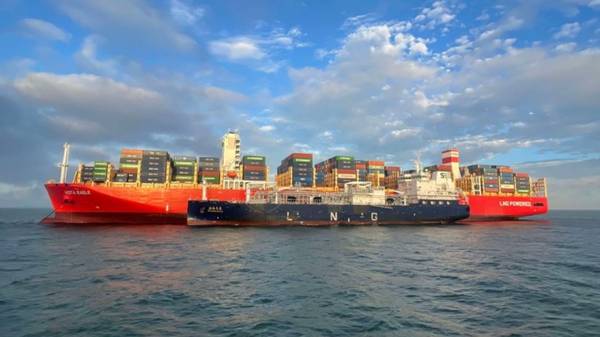
Demonstrating GTT's move beyond containment technology systems to full ship design, the AIP has been granted for a
6,500-cbm bunker barge, which has been jointly developed by GTT and Korean engineering firm
DSEC.
The latest development follows
GTT's announcement in December that it had signed a technical assistance and license agreement with DSEC for the construction of GTT membrane containment systems.
The previously revealed agreement with DSEC was designed to address the needs of clients wishing to fit membrane type LNG fuel tanks to all types of vessels, with shipyards no longer having to acquire the know-how required for the construction of GTT membranes and LNG handling systems.
Bureau Veritas also confirmed on Tuesday that it has been working with GTT to approve two new containment systems: the
Mark III Flex+ - an evolution of the Mark III but with a lower boil-off rate (BOR); and the
GTT MARS - a containment system developed for LPG carriers that is adaptable to any size of tank or ship.
Additional AIPs have been granted for:
- A solution for vapour pocket management allowing LNG carriers, in compliance with the revised IGC Code, to operate with an increased filling limit (above 98%).
- GTT's NO96 pressurization system evolution to provide enhanced maintenance flexibility and safety.
- Reduced cooling down features of both the NO96 and Mark III systems to improve cargo operations.
Philippe Berterottiere, chairman and CEO, GTT, remarked: "We are very pleased to be granted these approvals by Bureau Veritas with whom GTT has a very close partnership for decades. We have demonstrated the reliability of our latest developments and their ability to meet the owners' requirements. I believe these new systems and designs will help the shipping industry to move forward and reduce the ecological footprint."
Matthieu de Tugny, COO, Bureau Veritas Marine & Offshore, commented: "These approvals are helping GTT expand the range and depth of their technologies. The increasing sophistication of containment systems and expansion of their application - as in CMA CGM's breakthrough order for large containerships with membrane tanks - is driving the adoption and development of gas transportation and LNG as a marine fuel as well supporting the marine gas trades."