Wed 16 Dec 2015, 13:48 GMT

New incentive for ships that bunker LNG in Rotterdam


Ten percent discount on gross seaport dues is being offered to seagoing vessels that bunker LNG in Rotterdam.


The Port of Rotterdam is introducing a new incentive to companies that bunker liquefied natural gas (LNG) at the Dutch port. A total of EUR 1.5 million has been reserved by Port of Rotterdam Authority for this incentive, which is to run up until 2020.

The new scheme offers a 10 percent discount on gross seaport dues to seagoing vessels that bunker LNG in Rotterdam. The initiative was announced by Allard Castelein, CEO of Port of Rotterdam Authority, on December 15 during the second day of the 'LNG Masterplan Final Event'.

In addition, Port of Rotterdam Authority is also supporting the Environmental Ship Index and the Green Award by offering incentives to ships. In total, these measures mean that the port will be providing EUR 1.5 to 2 million per annum in incentives to encourage sustainable shipping.

"LNG is the cleanest fossil fuel. Encouraging the use of this fuel is in keeping with the Port Authority's aim to make Rotterdam's port the most sustainable in its class," Port of Rotterdam Authority said in a statement.

LNG Masterplan

The EU-supported LNG Masterplan Rhine-Main-Danube project is a series of studies and trials designed to assess the use of LNG as a shipping fuel in the European inland waterway sector.

The LNG Masterplan consists of a series of studies and pilot deployments for LNG as fuel for inland vessels, as well as cargo transported on waterways and distributed via inland ports along the Rhine, Main and Danube rivers. The objective has been to provide a platform for key public and private stakeholders to promote LNG uptake in the inland waterway sector and build the necessary regulatory framework for the safe transport and use of LNG as vessel fuel.

As part of the project, a series of inland waterway vessels have been retrofitted with LNG engines capable of substantially decreasing nitrogen oxide (NOx) and particulate emissions, the main pollutants from inland waterway transport, as well as improving local air quality alongside waterways and ports.

The Eiger-Nordwand was the first inland waterway vessel to be retrofitted with LNG engines as part of the LNG Masterplan project.

The LNG Masterplan Final Event, which has taken place this week from 14-16 December 2015, marks the end of the 3-year project. A total of 34 partners from 13 countries have worked together on the LNG Masterplan.

LNG suppliers in Rotterdam

Port of Rotterdam Authority said today that it intends to encourage LNG bunkering in Rotterdam and support companies such as supplier Shell and terminal operator Gate, which promote the use of LNG.

Shipping company Containerships has also stated that it will operate and bunker two LNG vessels in Rotterdam from 2017.

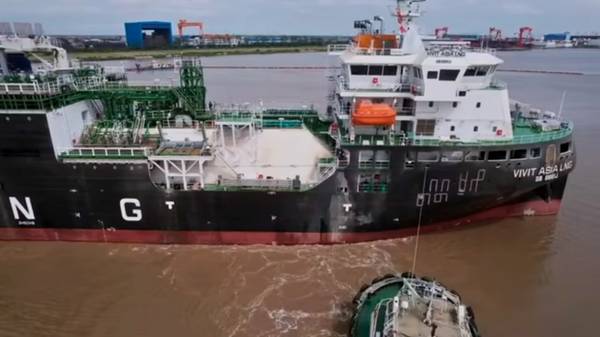
Earlier this month, South Korea's STX Offshore & Shipbuilding Company began construction of the LNG bunker vessel that Shell will operate in Rotterdam. The energy major is expected to begin operating the supply vessel in early 2017.


Container ship near a port. Ammonia emerges as most feasible alternative fuel for deep-sea shipping in 2050 emissions study  

Research combining expert survey and technical analysis ranks ammonia ahead of hydrogen and methanol.

Cargo vessel at sea. EMSA study examines biodiesel blend spill response as shipping adopts alternative fuels  

Research addresses knowledge gaps on biodiesel-conventional fuel blends as marine pollutants and response measures.

BIMCO ETS BARECON clause 2026 graphic. BIMCO adopts ETS clause for bareboat charters, delays biofuel provision  

BIMCO’s Documentary Committee has approved an emissions trading compliance clause while requesting further work on a biofuel charter provision.

SALEFORM 2025 standard form graphic. BIMCO and Norwegian Shipbrokers’ Association launch SALEFORM 2025 ship sale contract  

Updated agreement addresses banking changes, compliance requirements and environmental regulations affecting vessel transactions.

Everllence H2 test engine. Everllence develops hydrogen test bench for marine engines  

German engine maker upgrades Augsburg facility under HydroPoLEn project backed by federal maritime research funding.

CMA CGM Osmium vessel. CMA CGM names 13,000-teu methanol-fuelled containership in South Korea  

CMA CGM Osmium to operate on Asia–Mexico service as part of the carrier’s decarbonisation strategy.

NorthStandard logo. NorthStandard publishes biofuel guide as marine insurance claims emerge  

White paper addresses quality issues and compliance requirements as biofuel testing volumes surge twelvefold.

Clean Maritime Fuels Platform (CMFP) logo. Maritime fuel platform calls for EU shipping ETS revenues to fund clean fuel deployment  

Clean Maritime Fuels Platform urges earmarking of national emissions trading revenues for renewable fuel infrastructure.

Seatransport 73m SLV Lloyd’s Register grants approval for hybrid nuclear power design for amphibious vessels  

Classification society approves Seatransport’s concept integrating micro modular reactors with diesel-electric systems.

Everllence ME-LGIE engine. Everllence and Vale partner on ethanol-powered marine engine development  

Brazilian mining company to develop dual-fuel ethanol engines based on ME-LGI platform.