Fri 28 Aug 2015, 09:05 GMT

Two tri-fuel ships for Maran Nakilat


Joint venture firm increases its vessel ownership to thirteen.


Qatari shipping company Nakilat has expanded its joint venture with Greek shipping company Maran Ventures Inc. to include two new liquefied natural gas (LNG) vessels.

Maran Nakilat Co. Ltd. was established in 2005 with four jointly owned vessels, and the agreement has been expanded on three occasions. The latest agreement increases the number of vessels jointly owned by Nakilat and Maran Gas Maritime Inc. - the gas shipping unit of Angelicoussis Shipping Group, controlled by billionaire John Angelicoussis - to 13.

Nakilat's managing director, Abdullah Al Sulaiti, said: "Maran Gas is a highly reputed, quality operator and we are delighted in reconfirming our association with the company. This move strengthens ties between the two entities, and the current agreement allows for further expansion in the future."

He added: "Nakilat's strong financial performance has allowed us to increase our fleet size further. Selecting strong partners in the shipping industry has been fundamental to Nakilat's success, and our relationship with Maran continues to be reinforced since our first agreement in 2005."

The two new state-of-the-art vessels are currently under construction in South Korea and, upon delivery in the third and fourth quarters of 2015, will bring the total number of LNG and liquefied petroleum gas (LPG) ships partially or wholly owned by Nakilat to 67. The vessels are tri-fuel diesel electric (TFDE) propulsion models with capacities of 161,870 cubic metres and 174,000 cubic metres respectively.

"We are extremely pleased to strengthen our relationship with Nakilat by this further expansion of Maran Nakilat. We are very proud of our association with Nakilat and look forward to working closely together in the future with their highly professional team in order to explore and develop opportunities in the LNG space," remarked John Angelicoussis.

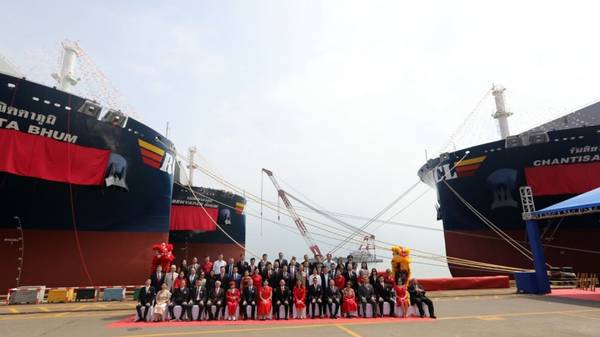
Image: Nakilat's managing director Abdullah Al Sulaiti (right), and John Angelicoussis (left), owner of Angelicoussis Shipping Group.

Caspar Gooren, Titan. Titan Clean Fuels signs e-methane supply deal with TURN2X for 2028 delivery  

Bunker supplier to receive e-methane from Spanish production plant for distribution across European ports.

Hydrogen-fuelled engine 6UEC35LSGH. Japan consortium achieves hydrogen co-firing in main engine for large commercial vessel  

Engine reaches over 95% hydrogen co-firing ratio, with installation planned for 2027.

BTB bunker truck. Belgian Trading & Bunkering expands DMA 0.89 truck deliveries in ARA region  

BTB extends marine fuel offerings with truck-based deliveries to meet maritime market demand.

Fuel pathway roundtable meeting participants. ABS convenes roundtable on offshore power barge for Great Lakes emissions reduction  

Meeting brought together ports, academia and industry to advance shore power solution under EPA programme.

Lego Ane Maersk video screenshot. Maersk marks 50-year Lego partnership with dual-fuel vessel model  

Shipping company displays an exhibition of Lego sets spanning five decades at Copenhagen headquarters.

Guo Yun Hai vessel. Cosco Shipping takes delivery of 80,000-dwt methanol-ready grain carrier  

Guo Yun Hai features box-shaped cargo hold and methanol-ready design with energy-saving devices.

CMA CGM Innovation ship-to-ship transfer. Algeciras reports record LNG bunkering volumes, claims European top-three position  

Spanish port says it supplied 333,833 cbm of LNG across 78 ship-to-ship operations in 2025.

Additional costs chart. T&E: Iran conflict costing shipping industry €340m a day in fuel costs  

Transport & Environment analysis shows marine fuel price surge has cost the industry €4.6bn since conflict began.

CF 3850 vessel render. Damen delivers second hybrid-ready combi freighter to German shipowner  

The vessel features biofuel capability and will be retrofitted with wind-assist technology with government funding.

Engine retrofit report 2026 graphic. Retrofit capability expands as regulatory uncertainty slows alternative-fuel conversions  

Lloyd’s Register warns delayed conversions could compress demand into a narrower, costlier timeframe as the fleet ages.