The keel for the second Commitment Class liquefied natural gas (LNG)-powered, combination container roll-on/roll-off (ConRo) ship for
Crowley Maritime Corp.'s liner services group was laid earlier this week during a ceremony at ship builder
VT Halter Marine, Inc.'s facility in Pascagoula, Mississippi.
The keel-laying ceremony marked the next step in the construction of Crowley's two Commitment Class ships, which are to serve the U.S. to Puerto Rico trade lane.
"The keel laying marks the ceremonial beginning of the construction and formation of the backbone of a ship," said Crowley's
Todd Busch, senior vice president and general manager, technical services. "Today's event symbolizes how far we've come in delivering on our commitments to our customers in Puerto Rico. We are very excited to continue the construction process for these technically advanced ships."
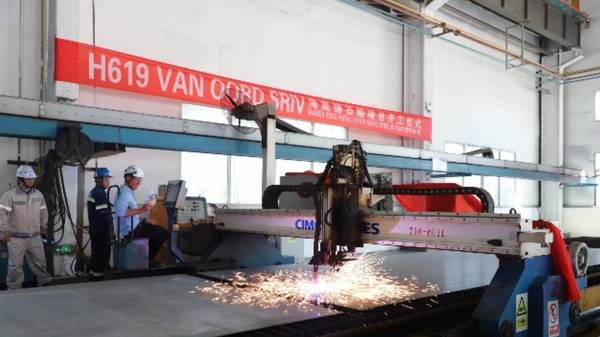
VT Halter Marine and Crowley entered into a contract for the pair of Jones Act vessels in November 2013 and construction of the second ship began with steel cutting in Pascagoula on May 27, 2015. With the first section set in place, the ship will now begin to take shape as it is built around the keel.
The first ship's keel laying took place in January 2015.
"Once again we are very proud to announce that another significant milestone has been met," said
Jack Prendergast, CEO, VT Halter Marine. "We are very pleased with the progress the team is making in the construction of this fine vessel. We are proud of our long association with Crowley and the commitments both companies are making toward the successful completion of this great project."
The Commitment Class ships have been designed to maximize the carriage of 53-foot, 102-inch-wide containers. The ships will be 219.5 metres long, 32.3 metres wide (beam), have a deep draft of 10 metres, and an approximate deadweight capacity of 26,500 metric tonnes. Cargo capacity will be approximately 2,400 TEUs (20-foot equivalent units) with additional space for nearly 400 vehicles in an enclosed roll-on/roll-off garage. The main propulsion and auxiliary engines are to be fuelled by environmentally friendly LNG.
The ships will replace Crowley's towed triple-deck barge fleet in the South Atlantic trade, which has served the trade since the early 1970s. The new vessels, which will be named
El Coquí and
Taíno, are scheduled for delivery during the second and fourth quarter 2017 respectively.
Powered by LNG, Crowley says the new ships "will set a new standard for environmentally responsible shipping". LNG provides a 100-percent reduction in sulphur oxide (SOx) and particulate matter (PM), and a 92-percent reduction in nitrogen oxide (NOx). LNG also has the ability to significantly reduce carbon dioxide (CO2), a contributor to greenhouse gas emissions, as compared with conventional fossil fuels.
The ship design is provided by
Wärtsilä Ship Design in conjunction with Crowley subsidiary
Jensen Maritime, a Seattle-based naval architecture and marine engineering firm. Designing, building and operating LNG-powered vessels is very much in line with Crowley's overall EcoStewardship positioning and growth strategy. The company formed an LNG services group in 2014 to bring together the company's resources to provide LNG vessel design and construction management; transportation; product sales and distribution, and full-scale, project management solutions.
Crowley has served the Puerto Rico market since 1954, longer than any other carrier in the trade. The company is also the leading ocean carrier between the island and the U.S. mainland with more weekly sailings and more cargo carried annually than any other shipping line.
Image: Crowley LNG-powered combination container roll-on/roll-off (ConRo) ship.