Horizon Lines, Inc., has today issued a report presenting the company's progress in pursuing environmental excellence through its ongoing green initiatives.
Entitled
The Horizon Lines Green Initiative Progress Report, the document describes the carrier's efforts to mitigate environmental impact from shipping operations and intermodal transport.
"Ensuring sustained environmental protection has always been a mission at Horizon Lines," said
Stephen H. Fraser, President and Chief Executive Officer. "Our approach emphasizes environmental excellence through conservation techniques, waste stream management, system upgrades and voluntary compliance."
The report outlines a number of initiatives the company has been pursuing. In the marine environment area, these initiatives include vessel management controls and low sulphur diesel fuel usage. The company has focused on reducing transportation emissions through improvements in vessel fuel consumption and truck efficiency, the use of alternative fuels and the development of more fuel-efficient transportation solutions.
"Environmental stewardship is a fundamental tenet at Horizon Lines," said
Andrew Phillips, the company's newly appointed Environmental Compliance Director. "In 2011, our company received recognition from the Chamber of Shipping of America for environmental excellence and we also were named a Top 75 Green supply chain partner by Inbound Logistics magazine. We remain ever vigilant and committed to continuous improvement when it comes to environmental stewardship and compliance."
Under Horizon Lines' Green Initiative, specific areas of focus include:
Management
Horizon Lines appointed Andrew Phillips as Environmental Compliance Director in November 2011. Mr. Phillips is responsible for leading the company's overall environmental compliance efforts moving forward, with particular focus on the carrier's marine operations. Mr. Phillips joined Horizon Lines with an extensive maritime career, including 15 years ashore in environmental and safety compliance and 20 years at sea, five of those serving as Ship Master.
Training
Horizon Lines has provided detailed MARPOL training in the form of mandatory CBT programs on its ships and mandatory senior officer seminars geared specifically towards understanding and conforming to the provisions of each MARPOL Annex. Training in 2011 addressed one of the key MARPOL Annexes - Annex I governing prevention of oil pollution.
Fuel Conservation & Emissions
Through the company's EDGE process optimization program, which includes enhanced communication between terminal and vessel teams, Horizon Lines has reduced overall fleet fuel consumption by 3.5% over the past six years. The company believes this effort has resulted in an estimated emissions reduction of 231,000 tons of CO2 during this period, through the end of 2011.
Low Sulphur Fuel
Horizon Lines has consistently purchased and consumed residual fuels with less than 2.5% sulphur content for diesel and steam plants since 1999. The carrier's Alaska Division has consumed fuels of 1.8% sulphur content since 1987. Horizon Lines says it is also in discussions with fuel suppliers to ensure it has adequate supply of 1.0% sulphur content fuel oil in 2012, ahead of its required use within 200 nautical miles of the U.S. coastline under provisions of the new North American ECA (Emission Control Area).
Oily Water Separator Upgrade Program
Improved technology oily water separators (OWS) were installed several years ago on a number of the company's vessels as a pre-treatment system to the ship's existing OWS. This upgrade is not required by any country, international organization or regulatory body.
The dual processing approach allows for improved management of oily water discharge through more efficient processing of problematic waste streams such as oil-water emulsions, resulting in an effluent oil content of significantly less than the allowable 15 ppm.
The dual approach incorporates a pre-treatment step before the contents of the bilge holding tank are processed through the existing OWS system and pumped overboard. Horizon Lines installed the improved technology OWS to further reduce the possibility of inadvertent discharge of oil into the sea.
National Pollution Discharge Elimination System (NPDES)
Horizon Lines has obtained general permits for all of its vessels and most facilities, ensuring that they are operating in strict compliance with the provisions of NPDES regulations. The company has provided detailed instructions to its vessel crews and terminal personnel, and it audits performance against these instructions to prevent pollutants from being discharged incidental to normal operations.
SNAME Environmental Survey
Horizon Lines sponsored an internship at The Society of Naval Architects & Marine Engineers (SNAME) for the analysis of data received from SNAME's EC-7 Environmental Survey. According to Horizon, the resulting report has helped guide efforts by SNAME to raise public awareness of environmental management efforts in the maritime industry and to improve knowledge of best practices.
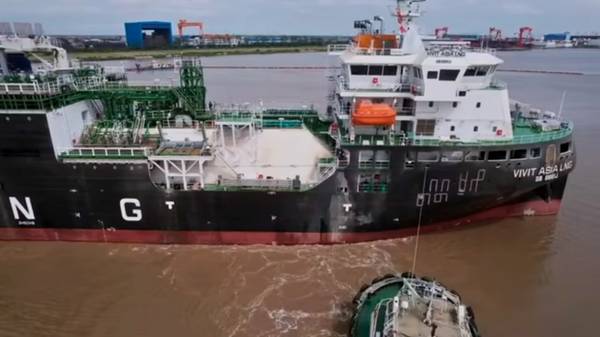
Image: Horizon Tiger