Thu 25 Oct 2018, 13:48 GMT

Balearia to build gas-powered, high-speed catamaran


Aluminium cutting scheduled for December; entry into service slated for the summer of 2020.


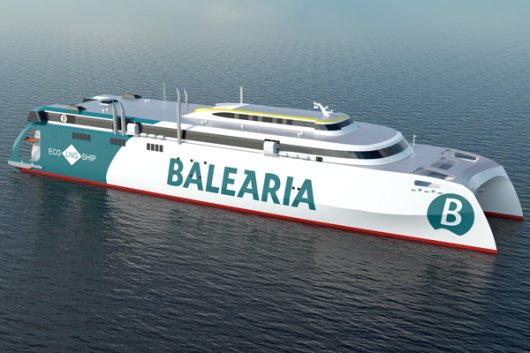
Rendering of Balearia's latest LNG-powered, high-speed catamaran, which will be equipped with two LNG storage tanks - enabling it to travel 400 nautical miles without refuelling.
Image credit: Balearia
Balearia has announced that it is shortly due to commence the construction of its first gas-powered, high-speed catamaran, which the company claims will also be the world's longest and highest-capacity fast ferry catamaran.

The 125-metre-long vessel is to be built at the Armon shipyard in Gijon, northern Spain, in a project costing EUR 90m, with aluminium cutting scheduled to commence in December and the ferry's entry into service slated for the summer of 2020.

According to Balearia, the vessel will be propelled by four Wartsila dual-fuel LNG/diesel engines each delivering 8,800 kilowatts (kW).

The catamaran will also be equipped with two LNG storage tanks, enabling it to travel 400 nautical miles without refuelling.

"The use of liquefied natural gas allows us to fulfil our commitment to the environment and energy efficiency, while also remaining one step ahead of the new pollutant gas reduction regulations scheduled for 2020," said Balearia president Adolfo Utor.

As previously reported, Balearia is also building two new, dual-fuel, gas-powered ferries at the Cantiere Navale Visentini shipyard in Italy. The first is expected to be operational from next February.

And the LNG-fuelled ferry that was ordered in 2016 from Construcciones Navales del Norte SL (LaNaval) shipyard in Sestao, Spain, is scheduled to enter into regular service in 2019.

Meanwhile, the first of a number of LNG retrofits is due to take place this autumn. Balearia had previously announced that the conversion programme would be for five of its existing vessels (Bahama Mama, Martin i Soler, Naples, Sicily and the previously retrofitted Abel Matutes), whilst on Thursday the company said that, in fact, six ships would now be converted to gas propulsion.

Balearia has also upped the estimated cost of the retrofit project from EUR 60m to EUR 72m. It follows the confirmation on October 10 that the European Union had awarded a grant of EUR 11.8m towards the project, which at the time was said to be 20 percent of the total cost.

Balearia notes that it plans to have at least half of its ferry fleet running on LNG within the next three years, and all of its ships using the gas fuel by 2028.

The Spanish ferry operator currently has 30 vessels in its fleet, 26 of which are owned.


Areion vessel. Dorian LPG takes delivery of dual-fuel VLGC capable of carrying ammonia  

The 93,000-cbm Areion can run on LPG or fuel oil and transport ammonia cargoes.

FSRU Toscana alongside Green Zeebrugge vessel. RINA awards ISCC EU certification to OLT Offshore LNG Toscana for bio-LNG supply  

Certification enables bio-LNG use in the EU as a renewable fuel under RED II and RED III directives.

World Shipping Council at IMO meeting. WSC calls for safe maritime corridor as 20,000 seafarers remain trapped in the Persian Gulf  

Industry body urges IMO member states to establish safe passage and supply access.

Graphic promoting Auramarine webinar titled 'Sustainable Fueling Part 3: Ammonia - next alternative fuel in marine'. Auramarine to host webinar on ammonia as marine fuel in April  

Finnish firm will explore ammonia’s role in maritime decarbonisation at its third spring webinar.

Front cover of study by WinGD and Envision Energy titled 'Renewable Fuel Economics: An OPEX illustration based on current costs'. Green ammonia could reach cost parity with VLSFO and LNG by 2050, study finds  

WinGD and Envision Energy study projects green ammonia operational costs competitive with conventional marine fuels.

Elenger Marine's LNG bunkering vessel Optimus alongside Brittany Ferries’ Saint-Malo. Bureau Veritas verifies methane emissions on Brittany Ferries’ LNG vessels  

Verification enables ferry operator to report measured methane slip instead of regulatory default values.

Map showing existing and planned Emission Control Areas (ECAs). Alliance calls for urgent black carbon action as new Arctic emission control areas take effect  

Canadian Arctic and Norwegian Sea ECAs now in force, with compliance deadline set for March 2027.

Artistic impression of battery-electric ferry for operation on Perth’s Swan River. Lloyd’s Register to class Western Australia’s first electric ferry fleet  

Echo Marine Group partners with Lloyd’s Register on five battery-electric ferries for Perth’s Swan River.

Thomas Kazakos, secretary general of The International Chamber of Shipping (ICS). ICS condemns Middle East shipping attacks as 20,000 seafarers remain trapped  

Industry body calls for urgent state action to resupply vessels and enable crew changes.

Molslinjen ferry illustration. Molslinjen order propels Australia to top of battery vessel production rankings  

Danish ferry operator’s three-catamaran order at Incat Tasmania shifts global manufacturing landscape, analysis shows.