Thu 7 Jun 2018, 12:18 GMT

Balearia launches ferry with scrubber system


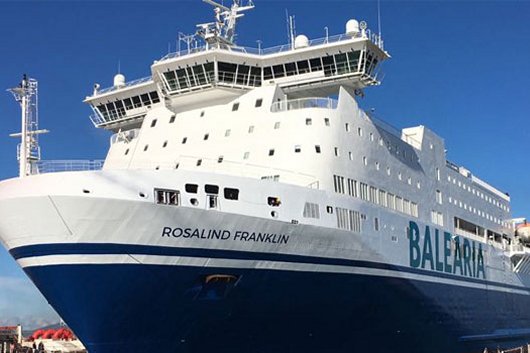
The Rosalind Franklin will operate between Barcelona and Palma de Mallorca.


Balearia's ferry, the Rosalind Franklin, is fitted with an exhaust gas cleaning (or 'scrubber') system.
Image credit: Balearia
Balearia has incorporated the ferry Rosalind Franklin to the Barcelona-Palma de Mallorca route. The vessel features an exhaust gas cleaning (or 'scrubber') system.

With the scrubber solution installed, the new ship will be able to reduce exhaust gas sulphur oxide emissions to below 0.1 percent, meeting both existing Emission Control Area (ECA) standards and those of the upcoming 0.5 percent global sulphur cap in January 2020.

The 188-metre-long ferry has a sailing speed of 22 knots and will be leaving from the port of Barcelona on a daily basis at 23:00 hours, and from Palma at 12:30 hours, with a journey time of around seven-and-a-half hours.

Last year, Balearia invested EUR 125 million in acquisitions, new vessel construction and repowering as the company continued to focus on improving the fuel efficiency of its fleet and in the development of LNG-powered ferries.

The first in a series of four eco fast ships, the Eco Aqua, started operating between the islands of Ibiza and Formentera last year. The second, Eco Lux, began transporting activities last month, whilst the remaining two ships - Eco Terra and Eco Aire - are expected to commence operations shortly.

The fuel-saving ships are powered by state-of-the-art engines designed to minimize emissions and feature a wave-piercing bow and photovoltaic solar panels, supplying energy on board.

In terms of LNG developments, last year, Balearia ordered two new, dual-fuel, gas-powered ferries to be built at the Cantiere Navale Visentini shipyard in Italy. The vessels are expected to be operational by the end of 2018.

In January 2017, the company's 2010-built Abel Matutes was refuelled with LNG in Barcelona for the first time after being retrofitted with a 30-cubic-metre LNG storage tank and an auxiliary natural gas engine built by Rolls-Royce.

Balearia's fourth LNG-fuelled ferry, which was ordered in 2016 from Construcciones Navales del Norte SL (LaNaval) shipyard in Sestao, Spain, is scheduled to enter into regular service in 2019.


A Maersk vessel, pictured from above. Maersk and Hapag-Lloyd suspend Strait of Hormuz transits amid Middle East security crisis  

Container carriers reroute services around the Cape of Good Hope as military conflict escalates.

Map of Middle East. Operations continue as normal at most Middle East ports  

Most facilities operating normally, with exceptions in Oman and Saudi Arabia.

Photograph of the 93,000-cbm very large ammonia carrier (VLAC) Gaz Ronin. Naftomar takes delivery of 93,000-cbm dual-fuel ammonia carrier  

Gaz Ronin features a MAN dual-fuel engine with high-pressure selective catalytic reduction technology.

Aurora Botnia leaving harbor. AYK Energy completes world’s largest marine battery retrofit on Wasaline ferry  

Aurora Botnia receives 10.4 MWh battery system, bringing total capacity to 12.6 MWh.

Steel cutting ceremony for an LNG dual-fuel 307,000-tonne crude oil tanker with builder's hull no. 113. Dalian Shipbuilding begins construction on LNG dual-fuel crude tanker  

Development is one of a number of milestones reported by parent company over the past few days.

Photograph of Sallaum Lines' Ocean Breeze vessel with 'Introducing The Blue Corridor' overlaid text. Sallaum Lines launches Blue Corridor sustainability initiative for Europe–Africa ro-ro trade  

Company deploys LNG-capable vessels with AI routing and eco-speed protocols on new green shipping corridor.

The platform supply vessel Viking Energy. Eidesvik Offshore signs yard contract for ammonia retrofit of PSV Viking Energy  

Halsnøy Dokk to convert platform supply vessel as part of EU-backed Apollo project.

Vanquish tanker alongside Jette Theresa oil/chemical tanker docked at terminal. North Sea Port completes risk analysis for alternative fuel bunkering operations  

Port authority says LNG, hydrogen, methanol and ammonia can be safely refuelled across its facilities.

Container ship near a port. Ammonia emerges as most feasible alternative fuel for deep-sea shipping in 2050 emissions study  

Research combining expert survey and technical analysis ranks ammonia ahead of hydrogen and methanol.

Cargo vessel at sea. EMSA study examines biodiesel blend spill response as shipping adopts alternative fuels  

Research addresses knowledge gaps on biodiesel-conventional fuel blends as marine pollutants and response measures.