Tue 5 Jun 2018, 13:22 GMT

Skuld issues bunker sample best practice guide


Guide includes advice on storage location and period, labels, log book and disposal of samples.


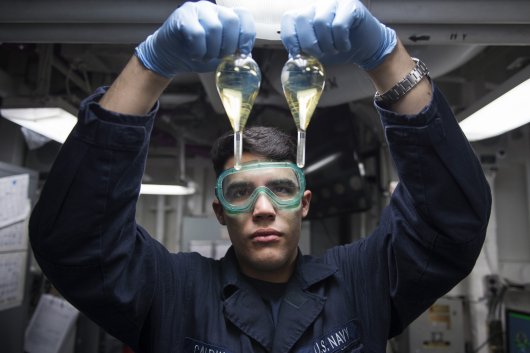
Fuel oil samples inspected for sediment and water in the oil lab aboard the amphibious assault ship USS Bonhomme Richard, on March 13, 2017.
Image credit: Flickr
P&I club Skuld has provided a best practice guide to its members for the storage, disposal and transfer of bunker samples.

Storage location

Skuld advises that samples should be kept in a safe storage location in a sheltered spot where they can be stored at a cool/ambient temperature and not exposed to direct sunlight, and where staff will not be exposed to vapours and the labels can be preserved.

The P&I club notes that the steering flat is a suitable storage location, but that the best place to store bunker samples is in the paint locker as the paint stores are protected by a fixed sprinkler system.

They should also be kept in a steel cupboard or a MARPOL sample storage cabinet, Skuld suggests.

On the issue of safety, Skuld notes that smoking and the carriage of smoking materials in the storage room are not permitted and that care should be exercised when entering a sample storage location.

Period to be kept on board

Commercial samples should be retained for evidential purpose for a period of six months after completing the consumption of the supply, Skuld says, as "by then you should know if you have any claims or not".

Regulation 18(6) of Annex VI of MARPOL 73/78 specifies that MARPOL samples must be retained on onboard until the fuel is substantially consumed, but in any event for a period of not less than 12 months from the time of delivery.

Testing companies usually specify in their agreements that they will retain the remains of samples tested for approximately three months.

Sample label

IMO Resolution MEPC 182 (59) requires sample bottles to have a tamper-proof security seal, a unique means of identification, and a label that includes:

- location at which, and the method by which, the sample was drawn;
- date of commencement of delivery;
- name of bunker tanker/bunker installation;
- name and IMO number of the receiving ship;
- signatures and names of the supplier's representative and the ship's representative;
- details of seal identification; and
- bunker grade.

Log book

Skuld notes that the ship's master should develop and maintain a system to keep track of the samples held on board via a Bunker Fuel Sample Log Book.

The log book should include information such as date of bunkering, source of sample (taken by crew or supplier), seal number and date/place of disposal.

Disposal of bunker samples

The disposal of samples and samples containers should be conducted in compliance with MARPOL and local environmental regulations.

The samples are normally disposed of at shore facilities by a sludge collection party or poured back into the fuel tank by crew.

Empty plastic bottles of fuel samples should be cleaned before disposal, Skuld says.

In addition to including the disposal date in the log book, Skuld also notes that local regulations may require recording the method of disposal.

Delivery of bunker samples to a laboratory

When a sample is delivered to a laboratory or Port State Control for analysis, Skuld says it is important to keep a record of the sample custody transfer in the sample log along with the bunker delivery note (BDN).

Details that should be recorded are:

- the sample label details and seal number;
- the port, date and time of handover of the sample;
- the identity of the person to whom the sample was handed, together with the name, signature and authority stamp as appropriate;
- contact details of those who will hold the sample.


Seaspan Lions (STS) LNG bunkering operation. Low-GHG methane could keep LNG-capable fleet compliant as regulations tighten, DNV paper argues  

Biomethane and e-methane offer a compliance pathway for LNG-capable ships, says DNV.

HaiSea Kermode and Valencia Knutsen vessel at sea. HaiSea's fleet of electric and dual-fuel tugboats completes 100th LNG carrier escort into Kitimat  

The Haisla Nation and Seaspan joint venture marks one year of LNG carrier escort operations in British Columbia.

Mount Vision naming ceremony. Naming ceremony held for LNG dual-fuel VLCC Mount Vision  

Crude oil tanker named in ceremony held in China.

Green Pearl and Cielo Ace ship-to-ship (STS) bio-LNG bunkering operation. MOL signs bio-LNG supply deals for car carriers across Northern Europe and Mediterranean  

Japanese shipping group expands bio-LNG bunkering to Spanish ports as part of its net-zero strategy.

Dan-Bunkering logo. Dan-Bunkering launches two-year trainee programme for aspiring marine fuel traders  

Bunker firm is recruiting trainees for an August 2026 start across its European offices.

Tower Bridge, London. Chevron hiring London-based marine fuels marketer with renewable fuels remit  

Applications open until 30 June for role involving the marketing of physical bunker fuels with a focus on Europe.

Burando Energies logo. Burando Energies seeks operator to support Rotterdam bunkering activities  

New hire will be responsible for planning, coordinating and monitoring operational activities across the firm's bunkering business.

Tommy Slette, Bart Vos and Koen Boerdijk. Corvus Energy to supply battery systems for two new Scylla Shipping river cruise vessels  

Norwegian battery supplier extends its partnership with Swiss river cruise operator Scylla Shipping.

Lucent Pathfinder vessel. NYK signs time-charter deal for two dual-fuel LPG-powered VLGCs  

Singapore subsidiary will provide gas carriers to carry Louisiana-produced ammonia to Japan.

Panos Mitrou and Yoshikazu Kondo. MOL wins LR technology award for wind-assisted propulsion on LNG carriers  

Lloyd’s Register honours Mitsui O.S.K. Lines for its Wind Challenger decarbonisation work.