Tue 21 Mar 2017, 08:15 GMT

BC Ferries' second LNG-fuelled vessel delivered in Canada


Salish Eagle is due to enter service at the end of June.


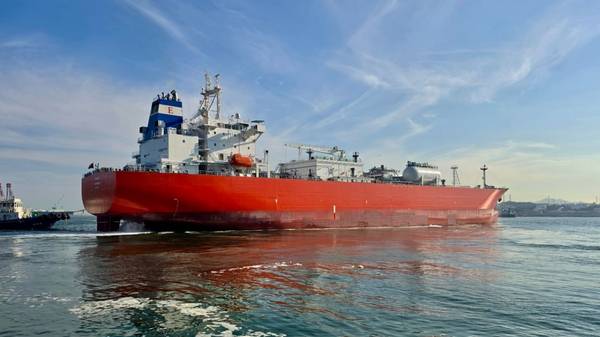
BC Ferries' Salish Eagle, the second of three new liquefied natural gas (LNG)-powered, Salish-class vessels, arrived at its new home in British Columbia, Canada, on 20th March.

The vessel reached British Canadian waters after a 38-day, 10,440-nautical-mile journey from Remontowa shipyard in Gdansk, Poland.

After the Salish Eagle cleared Canadian Customs and final inspections were complete, the vessel was officially handed over to BC Ferries.

On Tuesday 21st March, the ship will proceed to BC Ferries' refit facility in Richmond to prepare for operational service. The vessel will move to Tsawwassen terminal in mid-April for crew training and familiarization, and to continue to ready the ship for regular operation.

"We are proud to welcome Salish Eagle, our second natural gas-fuelled ship, home to B.C. and into our fleet," said Mark Wilson, BC Ferries' Vice President of Engineering. "The Salish Class are well built vessels that will help reduce our environmental footprint and our operating costs."

The Salish Eagle is due to enter service on the Tsawwassen - Southern Gulf Islands route at the end of June. Sister ship, the Salish Orca, is scheduled to start service on the Comox - Powell River route late next month. The Salish Raven, the third Salish-class vessel, is set to depart Poland for British Colombia in April and is due to enter operations in the Southern Gulf Islands later this year.

All three Salish-class ships - named in honour of the Coast Salish people and the Salish Sea where the ship is due to operate - have been built as dual-fuel, capable of running on LNG or ultra-low-sulphur diesel (ULSD).

The 107-metre-long vessels each have the capacity to carry 145 vehicles and up to 600 passengers and crew. The vessels feature two car decks and have a service speed of 15.5 knots. Each ship is powered by three Wartsila 8L20DF engines. The gross tonnage (grt) of each vessel is 8,728 tonnes.

Under contract to the Province of British Columbia, BC Ferries is the service provider responsible for the ferry service along coastal British Columbia.


Container ship near a port. Ammonia emerges as most feasible alternative fuel for deep-sea shipping in 2050 emissions study  

Research combining expert survey and technical analysis ranks ammonia ahead of hydrogen and methanol.

Cargo vessel at sea. EMSA study examines biodiesel blend spill response as shipping adopts alternative fuels  

Research addresses knowledge gaps on biodiesel-conventional fuel blends as marine pollutants and response measures.

BIMCO ETS BARECON clause 2026 graphic. BIMCO adopts ETS clause for bareboat charters, delays biofuel provision  

BIMCO’s Documentary Committee has approved an emissions trading compliance clause while requesting further work on a biofuel charter provision.

SALEFORM 2025 standard form graphic. BIMCO and Norwegian Shipbrokers’ Association launch SALEFORM 2025 ship sale contract  

Updated agreement addresses banking changes, compliance requirements and environmental regulations affecting vessel transactions.

Everllence H2 test engine. Everllence develops hydrogen test bench for marine engines  

German engine maker upgrades Augsburg facility under HydroPoLEn project backed by federal maritime research funding.

CMA CGM Osmium vessel. CMA CGM names 13,000-teu methanol-fuelled containership in South Korea  

CMA CGM Osmium to operate on Asia–Mexico service as part of the carrier’s decarbonisation strategy.

NorthStandard logo. NorthStandard publishes biofuel guide as marine insurance claims emerge  

White paper addresses quality issues and compliance requirements as biofuel testing volumes surge twelvefold.

Clean Maritime Fuels Platform (CMFP) logo. Maritime fuel platform calls for EU shipping ETS revenues to fund clean fuel deployment  

Clean Maritime Fuels Platform urges earmarking of national emissions trading revenues for renewable fuel infrastructure.

Seatransport 73m SLV Lloyd’s Register grants approval for hybrid nuclear power design for amphibious vessels  

Classification society approves Seatransport’s concept integrating micro modular reactors with diesel-electric systems.

Everllence ME-LGIE engine. Everllence and Vale partner on ethanol-powered marine engine development  

Brazilian mining company to develop dual-fuel ethanol engines based on ME-LGI platform.