Source: Dewey & LeBoeuf LLP
The amount of CO2 emitted by world shipping and its adverse impact on our climate are worse than previously thought, a new study suggests.
Commissioned by the International Maritime Organisation (IMO), the study on greenhouse gas emissions (GHGs) from ships concludes that a global maritime emissions trading scheme will most effectively address this critical issue.
Such conclusions are likely to strengthen the case being made by the European Commission and other interested parties for extension of the existing EU Emissions Trading Scheme (ETS) to cover the international shipping sector as soon as possible.
Background
The first IMO study on emission of GHGs from international shipping was commissioned in 1997 and was published in 2000.
An international consortium led by MARINTEK has now prepared a 2009 update to the 2000 study on behalf of the IMO. The study will form the basis for further consideration within the IMO in July this year focusing on the issue of greenhouse gas emissions from ships.
The IMO has been under pressure to come forward with a workable international solution to the perceived problem of growing shipping emissions.
The main objectives of the study were to assess: (i) present and future emissions from international shipping; (ii) the potential for reduction of these emissions through technology and policy; and (iii) impacts on climate from these emissions.
Conclusions
In summary, the 2009 study concludes as follows:
-Shipping is estimated to have emitted 1,046 million tonnes of CO2 in 2007, which corresponds to 3.3 percent of the global emissions during 2007. International shipping is estimated to have emitted 870 million tonnes, or about 2.7 percent of the global emissions of CO2 in 2007.
-Exhaust gases are the primary source of emissions from ships. Carbon dioxide is the most important GHG emitted by ships, both in terms of quantity and of global warming potential. The report finds that other GHG emissions from ships are less important.
-Emissions of CO 2 from shipping lead to positive 'radiative forcing' (a metric of climate change) and to long-lasting global warming.
-Mid-range emissions scenarios analysed in the study show that, by 2050, in the absence of policies, ship emissions may grow by 150 percent to 250 percent (compared to the emissions in 2007) as a result of the growth in shipping.
-Significant potential exists for reduction of GHG through technical and operational measures. Together, if implemented, these measures could increase efficiency and reduce the emissions rate by 25 percent to 75 percent below current levels. Many of these measures appear to be cost-effective, although non-financial barriers may discourage their implementation. The authors conclude that these measures may not be implemented unless policies are established to support their implementation.
A number of policies to reduce GHG emissions from ships are conceivable. These include in particular:
1. Mandatory limit on the Energy Efficiency Design Index (EEDI) for new ships.
This is found to be a cost-effective solution that can provide a strong incentive to improve the design efficiency of new ships. The main limitation of the EEDI is that it only addresses ship design; operational measures are not considered. This limits the environmental effectiveness. The effect is also limited, in the sense that it applies only to new ships;
2. Mandatory or voluntary reporting of the EEDI or the Energy Efficiency Operational Indicator (EEOI) for new ships. The study finds that neither of these policies would have any environmental effect in itself. Rather, environmental effectiveness and cost effectiveness would depend on incentive schemes being set up to make use of the information.
3. Mandatory or voluntary use of a Ship Efficiency Management Plan (SEMP).
According to the study, the SEMP appears to be a feasible approach to increase awareness of cost-effective measures to reduce emissions. However, since this instrument does not require a reduction of emissions, its effectiveness will depend on the availability of cost-effective measures to reduce emissions (i.e. measures for which the fuel savings exceed the capital and operational expenditures). Likewise, it will not incentivize innovation and R&D beyond 'business as usual'.
4. Mandatory limit on the EEOI value, combined with a penalty for non-compliance.
A mandatory limit on EEOI is found to be a cost-effective solution that can provide a strong incentive to reduce emissions from all ships that are engaged in transport work. It incentivizes both technical and operational measures.
However, this option is technically very challenging due to the difficulties in establishing and updating baselines for operational efficiency and in setting targets.
5. Maritime Emissions Trading Scheme (METS); and
6. So-called International Compensation Fund (ICF), to be financed by a levy on marine bunkers
Both the METS and the ICF are found by the study to be cost- effective policy instruments with high environmental effectiveness. They have the largest amount of emissions within their scope, allow all measures in the shipping sector to be used and can offset emissions in other sectors. These instruments, says the study, provide strong incentives to technological change, both in operational technologies and in ship design.
As between these market instruments, the authors appear to favor the METS. The study concludes that the environmental effect of the METS is an integral part of its design and will therefore be met. In contrast, part of the environmental effect of the ICF depends on decisions about the share of funds that will be spent on buying emission allowances from other sectors.
Meanwhile, with regard to cost effectiveness, incentives to technological change and feasibility of implementation, both policy instruments seem to be quite similar.
As previously reported, the European Commission has made clear on a number of occasions its intention to introduce legislation to bring international shipping into the EU ETS, the world's largest "cap-and- trade" emissions reduction scheme, if the IMO does not broker a solution itself.
The Commission is understood to be preparing such a proposal for release in early 2010 on the assumption that no deal will be reached within IMO when its marine environment protection committee meets this July.
Various commentators have estimated that an ETS for shipping could cost the industry billions of dollars and significantly alter the competitive dynamics of the sector.
Technological and operational options for reduction of emissions
The study identifies a wide range of options for increasing the energy efficiency and reducing emissions by changing ship design and ship operation. Since the primary gateway to reduction of CO 2 emissions is increased energy efficiency, the potential reduction is said to apply generally to all emissions of exhaust gases from ships.
The study finds that a considerable proportion of the potential abatement appears to be cost-effective at present. However, non- financial barriers may currently limit the adoption of certain measures.
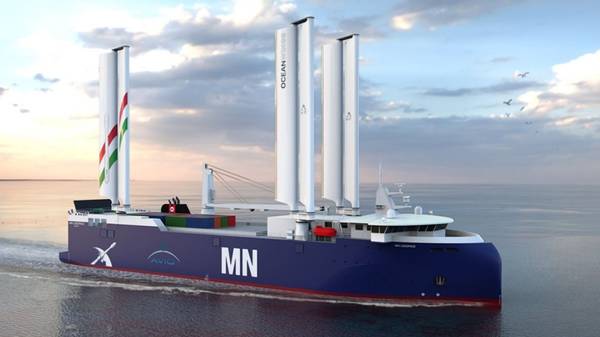
Renewable energy, in the form of electric power generated by solar cells and thrust generated by wind, is found to be technically feasible only as a partial source of replacement power, due to the variable intensity and the peak power of wind and sunlight.
Fuels with lower life-cycle CO 2 emissions include biofuels and liquefied natural gas (LNG). The use of biofuels on board ships is said by the study to be technically possible; however, the authors state that use of first generation biofuels poses some technical challenges and could also increase the risk of losing power (e.g., due to plugging of filters).
These challenges are, nevertheless, said to be overshadowed by limited availability and unattractive prices that make this option appear unlikely to be implemented on a large scale in the near future.
It is believed that LNG will become economically attractive, principally for ships in regional trades within Emission Control Areas (ECAs) where LNG is available.