Mon 26 Nov 2018, 13:17 GMT

Eagle LNG hails 'major milestone' in Florida project


'Encouraged' that the Draft Environmental Impact Statement was released ahead of schedule.


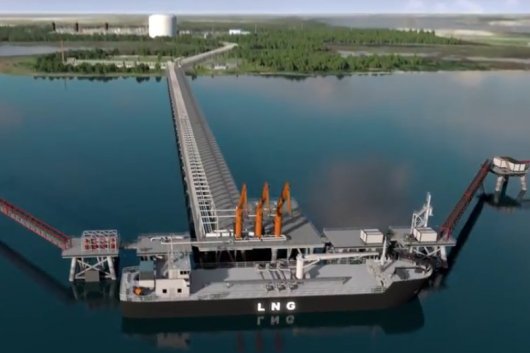
A rendering of Eagle LNG's bunkering facility at its proposed LNG liquefaction and distribution plant in Jacksonville, Florida.
Image credit: Eagle LNG Partners
Eagle LNG Partners has expressed its satisfaction regarding the Draft Environmental Impact Statement (DEIS) issued by the Federal Energy Regulatory Commission (FERC) for its proposed project in Jacksonville, where the company intends to develop an LNG liquefaction and distribution facility that will be able to process around 1.5m gallons of LNG per day, store up to 12m gallons and provide LNG bunkering for ships.

Eagle LNG is requesting authorization to construct and operate an LNG terminal and export facility on the north bank of the St. Johns River in Jacksonville. And based on research, analysis, information provided by Eagle LNG, and contacts with local agencies and members of the public, the FERC has concluded in the DEIS that the project would lead to "some limited adverse environmental impacts", but with proposed and recommended mitigation measures in place, these impacts "would not be significant".

Commenting on the DEIS, Eagle LNG said a "major milestone" had been reached.

The gas provider stated: "The draft EIS puts Eagle LNG on a clear path to FID [a final investment decision] on the Jacksonville Export Project and continues Eagle LNG's success in using small-scale LNG to supply bunkering to the marine industry and to provide small scale LNG cargoes to markets in the Caribbean."

Eagle LNG's president, Sean Lalani, noted that the company was also "encouraged" that the DEIS had been released ahead of schedule.

"It moves us considerably closer to meeting our goal of expanding clean burning, domestic, and affordable LNG supply for marine bunkering and for small-scale LNG projects in the Caribbean. Once completed, the Jacksonville Export Facility will be the lowest cost source of small-scale LNG available for our marine bunkering and power generation clients," Lalani remarked.

The draft EIS comment period closes on January 7, 2019, at which point the commissioners will take into account the FERC environmental staff's recommendations when a final decision on the project is made.

The Final Environmental Impact Statement is expected in April, and a final investment decision could be made in the second half of next year.

Construction is preliminarily scheduled for the second half of 2019, with start-up and commissioning in 2021.

Other LNG activities in Florida

As previously reported, in addition to the proposed LNG liquefaction and distribution facility, Eagle LNG and Crowley Maritime Corp have together constructed a dockside LNG fuel depot at Crowley's leased property at Jacksonville's Talleyrand Marine Terminal which is to be used for the bunkering of the transportation firm's two LNG-powered ConRo ships, El Coqui and Taino. El Coqui was supplied with LNG for the first time in May.

Additionally, Eagle LNG Partners recently opened a new liquefaction facility in Maxville, Florida, which features a one million-gallon storage tank and an LNG truck-loading system. The plant will exclusively support the fuel needs of both ConRo vessels.

Last year, Eagle LNG also signed a memorandum of understanding (MoU) agreement with ExxonMobil and Crowley to establish the storage and technical support necessary to provide LNG bunker deliveries for vessel operators in North America.

The companies plan to initially focus their efforts in Florida before expanding to other North American markets.

Project summary: Proposed LNG liquefaction and distribution facility in Jacksonville

Eagle LNG's proposed project would include:

- one LNG storage tank with a net capacity of 45,000 cubic meters (cbm);

- three LNG trains, each with a nominal capacity of 0.33m metric tonnes per year of LNG for export, resulting in a total nominal capacity of 1.0m tonnes per year;

- marine facilities with a concrete access trestle and loading platform, and two liquid loading arms capable of docking and mooring a range of LNG vessels with an LNG cargo capacity of up to 45,000 cbm;

- LNG truck loading facilities with a dual bay capable of loading 260 to 520 LNG trucks per year;

- a boil-off gas compression system;

- on-site refrigerant storage;

- ground flare and cold vent systems; and

- utilities and support facilities.


Areion vessel. Dorian LPG takes delivery of dual-fuel VLGC capable of carrying ammonia  

The 93,000-cbm Areion can run on LPG or fuel oil and transport ammonia cargoes.

FSRU Toscana alongside Green Zeebrugge vessel. RINA awards ISCC EU certification to OLT Offshore LNG Toscana for bio-LNG supply  

Certification enables bio-LNG use in the EU as a renewable fuel under RED II and RED III directives.

World Shipping Council at IMO meeting. WSC calls for safe maritime corridor as 20,000 seafarers remain trapped in the Persian Gulf  

Industry body urges IMO member states to establish safe passage and supply access.

Graphic promoting Auramarine webinar titled 'Sustainable Fueling Part 3: Ammonia - next alternative fuel in marine'. Auramarine to host webinar on ammonia as marine fuel in April  

Finnish firm will explore ammonia’s role in maritime decarbonisation at its third spring webinar.

Front cover of study by WinGD and Envision Energy titled 'Renewable Fuel Economics: An OPEX illustration based on current costs'. Green ammonia could reach cost parity with VLSFO and LNG by 2050, study finds  

WinGD and Envision Energy study projects green ammonia operational costs competitive with conventional marine fuels.

Elenger Marine's LNG bunkering vessel Optimus alongside Brittany Ferries’ Saint-Malo. Bureau Veritas verifies methane emissions on Brittany Ferries’ LNG vessels  

Verification enables ferry operator to report measured methane slip instead of regulatory default values.

Map showing existing and planned Emission Control Areas (ECAs). Alliance calls for urgent black carbon action as new Arctic emission control areas take effect  

Canadian Arctic and Norwegian Sea ECAs now in force, with compliance deadline set for March 2027.

Artistic impression of battery-electric ferry for operation on Perth’s Swan River. Lloyd’s Register to class Western Australia’s first electric ferry fleet  

Echo Marine Group partners with Lloyd’s Register on five battery-electric ferries for Perth’s Swan River.

Thomas Kazakos, secretary general of The International Chamber of Shipping (ICS). ICS condemns Middle East shipping attacks as 20,000 seafarers remain trapped  

Industry body calls for urgent state action to resupply vessels and enable crew changes.

Molslinjen ferry illustration. Molslinjen order propels Australia to top of battery vessel production rankings  

Danish ferry operator’s three-catamaran order at Incat Tasmania shifts global manufacturing landscape, analysis shows.