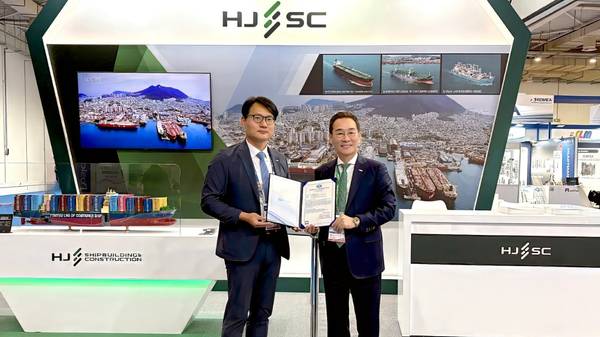
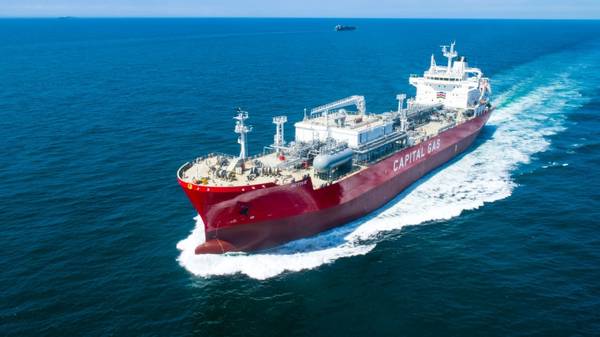
Hyundai Heavy Industries (HHI) has received an approval in principle (AiP) from
Lloyd's Register (LR) for a very large gas carrier (VLGC) designed to run on
LPG as fuel.
It is the first time the Korean shipyard has received an AiP for an LPG-as-a-fuel design, as per the new IGC code, and is the result of a collaboration between HHI, Hyundai Global Service (HGS), Lloyd's Register and MAN Energy Solutions.
During the collaboration with HHI, Lloyd's Register facilitated a hazard identification (HAZID) workshop for the LPG fuel supply system and associated ancillaries in accordance with its ShipRight Procedure Risk-Based Designs (RBD).
MAN Energy Solutions participated in the project as an engine designer. The company recently launched its two-stroke, dual-fuel MAN B&W ME-LGIP engine, which is designed for dual-fuel operation with LPG as a low-flashpoint fuel and is also said to be suitable as a retrofit solution.
HGS, meanwhile, has been working with shipping companies on the feasibility of converting LPG carriers (LPGCs) to include
LPG-fuelled propulsion systems in preparation for the upcoming changes in environmental regulations.
Kisun Chung, HHI's Deputy COO of Group Ship/Offshore Marketing and CEO of Hyundai Global Service, said: "We have focused on developing the safe design for LPG-fuelled propulsion system. We are pleased to introduce the reliable design of [a] VLGC with [an] LPG-burning system in the market for [newbuilds] and also conversion vessels so that VLGC players can have environmentally friendly vessels."
Jin-Tae Lee, Lloyd's Register's Korea Chief Representative & Marine Manager, commented: "We are very pleased with our role in this JDP to help the shipyard develop the reliable LPG-fuelled VLGC design free of latent risks due to the inherent LPG characteristics, and to enable the shipping industry to enjoy the commercial benefits with confidence in the safety and operability of the LPG burning system."
Rene Sejer Laursen, ME-GI/LGI Promotion Manager of MAN Energy Solutions, remarked: "In the future it will be difficult for some ship types to meet emission requirements without using gas as fuel, such as ethane, LNG and LPG. By using gas as fuel there is the potential to achieve 20 percent more power."