Dutch shipping company
Royal Wagenborg has confirmed that the first of two of its ro-ro vessels, the
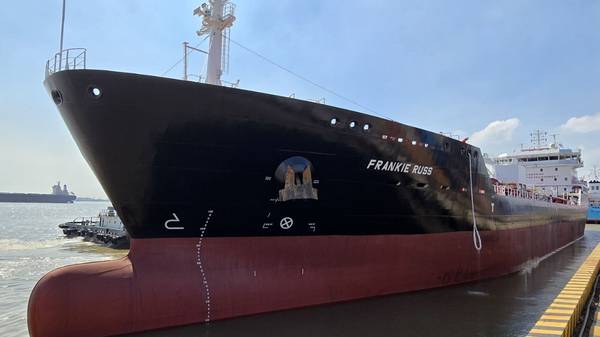
Bothniaborg [pictured], is to be fitted with
Wärtsilä scrubber systems during the month of September.
The company confirmed in May that it had ordered Wärtsilä scrubber systems for the Bothniaborg and
Balticborg. They will be Wärtsilä's first deliveries of its scrubber systems to Royal Wagenborg.
By installing Wärtsilä scrubber systems, the vessels will comply with the regulations covering emissions of sulphur oxides (SOx) while using conventional residual marine fuel.
The systems chosen for the two vessels are Wärtsilä Hybrid Scrubbers, which enable the use of either closed or open-loop technology to remove SOx from the exhaust. When operating in open-loop mode, exhaust gases enter the system and are sprayed with seawater. The sulphur oxides in the exhaust react with the water to form sulphuric acid. Chemicals are not required since the natural alkalinity of seawater neutralizes the acid. When operating in closed-loop mode, the natural alkalinity of seawater is boosted by an alkali. The hybrid approach enables operation in closed-loop mode when required, for instance whilst in port and during manoeuvring using sodium hydroxide (NaOH) as a buffer. When at sea, the switch can be made to open loop using only seawater.
The Balticborg and Bothniaborg are both powered by Wärtsilä 46 main engines. The vessels have 1A super Ice Class classification and are designed to operate in temperatures of up to minus 25 degrees centigrade. The ability to operate in these extreme conditions was also included in the specifications for the scrubber systems.
Commenting on the scrubber agreement with Royal Wagenborg earlier this year,
Juha Kytölä, Vice President, Environmental Solutions, Wärtsilä Ship Power, said: "Wärtsilä's experience in scrubber systems for marine applications is unmatched and our reference list is extensive. We have worked closely with Royal Wagenborg for many years, and have clearly demonstrated our capability to deliver a reliable technical solution that will enable these vessels to comply with the most stringent environmental legislation."
The Balticborg and Bothniaborg are currently employed on a long-term freight contract with
Smurfit Kappa for the weekly shipment of paper products between Haraholmen, Bremen, Sheerness and Terneuzen. The operating routes are located in the Baltic and North Sea Sulphur Emission Control Areas (SECA).
The retrofitting of the first ro-ro vessel, the Bothniaborg, is to take place at the Royal Niestern Sander shipyard, located in the Netherlands.
Image: Bothniaborg vessel - operated by Royal Wagenborg.