CMA CGM - the world’s third largest container shipping company - has this week reaffirmed its long-standing commitment to global environmental policy.
In a statement, the shipping firm said: "The battle against climate change, the preservation of the oceans, and the ecological solutions offered to customers are an essential part of the group's activity and organization,"
The company is due to take delivery of the
CMA CGM Alexander Von Humboldt and the
CMA CGM Jules Verne in May and June 2013 respectively. They follow the launch of the
CMA CGM Marco Polo - dubbed the largest containership in the world by capacity - towards the end of last year.
All three vessels include:
* An electronically controlled engine which significantly reduces CO2 emissions.
* An 'Exhaust Gas Bypass' system, which improves the energetic efficiency of the vessel when slow steaming, reducing CO2 emissions by 1.5% at low speeds.
* A twisted leading edge rudder, improving the hydrodynamics of the vessel (optimisation of the water flow), and significantly reducing energy expenditures as well as CO2 emissions.
* A Pre-Swirl Stator®, which straightens the water flow upstream from the propeller in order to improve its efficiency. Combined with the twisted leading edge rudder, this innovation optimizes the hydrodynamics of the vessel and makes it possible to reduce energy consumption by 2 to 4%.
* An optimized hull design, significantly improving the propulsion of the vessel into the water.
* A ballast water treatment system, to preserve the biodiversity of the oceans.
* A Fast Oil Recovery System - an innovative process for preventing marine pollution.
An alternative propulsion system for greener ships
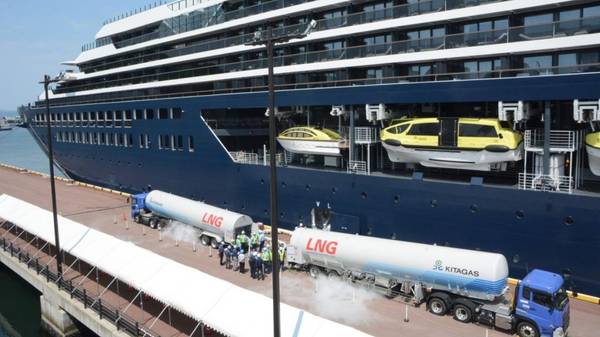
CMA CGM says that liquefied natural gas (LNG) is a 'promising fuel' for the maritime industry. The shipping group points out that LNG is a clean fuel, very low in sulphur and produces significantly less nitrogen oxide and CO2 than other fuels. Moreover, gas is in abundant supply and four-stroke engines, also known as dual-fuel engines, are now widespread in the industry.
"This is why the CMA CGM Group is working with shipyards and ranking agencies such as Bureau Veritas and DNV on several projects of LNG-fuelled containerships," the French company said.
Significant reduction of CO2 emissions
As part of its environmental policy, CMA CGM has said that it is committed to reducing emissions to limit the impact of its activities.
In 2012, the CO2 performance of the group improved by 6%. Since 2005, CMA CGM has already reduced its CO2 emissions by 37% per container transported and per kilometre and is aiming for a reduction of 50% by 2015.
In order to cut back its sulphur emissions, CMA CGM has chosen to use a fuel of a higher quality than required by the current regulation. Sulphur concentration levels are estimated at 2.57% (or lower in certain areas) instead of 3.5%.
The group also decided to improve the energy efficiency of its fleet by reducing the speed of its vessels, thus achieving both a reduction of carbon emissions and of fuel consumption.
Voluntary commitment to protect the environment
CMA CGM entered an ISO 14001 certification procedure for the management of its ships. It is an environmental management system based on continuous improvement of environmental performance, protection of the environment and prevention of pollution. CMA CGM says it is aiming for certification by the end of 2013.
CMA CGM is involved in landmark initiatives such as the '
Green Cargo Group', of which it has been a member since 2003, and whose goal is to draft measures to evaluate and improve freight transport.
CMA CGM is also a member of the '
Charte Bleue Armateurs de France'. By signing this charter, the group confirms its commitment to preventing and managing pollution risk, reducing greenhouse gas emissions and managing garbage and waste effectively.
In addition, CMA CGM is a member of the '
Hong Kong Liner Shipping Association', and has signed a charter on the use of fuel with low sulphur content for all ships calling at Hong Kong.
Ludovic Gérard, CMA Ships Vice President, remarked: "Ever cleaner ships will be a requirement in the near future for cargo transportation. All of our teams are committed to this process: both in the day-to-day management and continuous improvement process of the existing fleet, but also with the conception of tomorrow’s vessels. This qualitative approach is now acknowledged and appreciated by CMA CGM's clients. I am very proud of the work done by our teams, which will be, I am sure, soon rewarded by the ISO 14001 certificate."