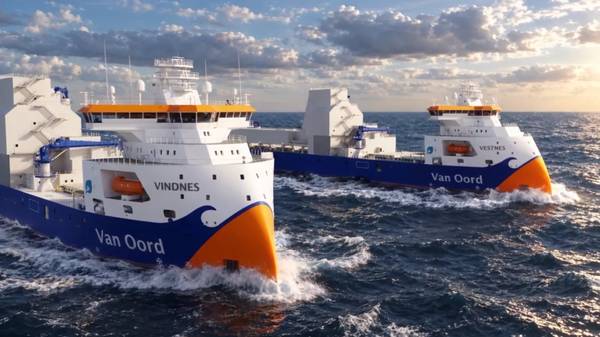
Boskalis, a leading dredging and marine expert, and
Wärtsilä, a leader in power solutions for the marine and oil and gas markets, have today announced their collaboration with
GoodFuels Marine, the first marine biofuel company focused on the global commercial fleet. The consortium is to collaborate in the development of sustainable 'drop-in' marine biofuels for the shipping industry.
Netherlands-based GoodFuels Marine and its partners are to spearhead a two-year pilot programme to accelerate the development of sustainable, scalable and affordable marine biofuels. The programme's focus will be on delivering and analysing a sustainable feedstock, securing industry certification, and preparing the building blocks for large-scale production.
Additionally, the consortium will initiate a global scalability study involving leading shipowners, universities, NGOs, ports, biofuel companies and other industry stakeholders. The aim will be to identify tangible opportunities for scaling supply to the world's commercial shipping fleet.
Theo Baartmans, COO, Boskalis commented: "We strongly believe in the need for sustainable 'drop-in' marine biofuels and their potential as part of the long term fuel mix, as we see them as an important means of improving the sustainability of the industry. Participating in this pilot and making our vessels available is in line with Boskalis' approach to seeking innovations that work hand in hand with sustainability."
Roger Holm, Senior Vice President, Engines, Wärtsilä Marine Solutions stated: "Wärtsilä, together with its customers, is highly committed to continuously finding better, more sustainable marine engine solutions. This is another great example of that commitment, whereby we support pioneering innovations that provide ship operators with greater flexibility and choice about how they can reduce emissions."
Dirk Kronemeijer, CEO, GoodFuels Marine, added: "We believe that the international shipping market is now ready and well-placed to embrace truly sustainable, long term alternative fuels that can meet all stringent technical, economical and sustainability standards, similar to the sustainable jet fuel market five years ago. As the shipping industry seeks means of contributing towards carbon and wider emissions reduction, we are excited to be part of such a strong consortium with the expertise and motivation needed to establish this new market."
The consortium will test several next generation biofuels at the Wärtsilä laboratory in Vaasa, Finland before sea trials are carried out on various vessels within Boskalis' global fleet.
With the objective of developing a fuel mix that is fully sustainable, the programme seeks to promote a lower carbon footprint for the maritime sector. The consortium believes that these biofuels will play a viable role in reducing emissions that no other fuel can currently achieve, without a capital-intensive fleet renewal or retrofitting.
In a joint statement, the CEO of the Port of Rotterdam,
Allard Castelein and CEO of the Port of Amsterdam,
Dertje Meijer, commented: "As ports with environmental excellence at our core, we embrace the vision of next generation biofuels supporting a more sustainable future for global marine transport. In addition we see marine biofuels as a potential building block to boost the bio-based production and economy in our respective ports."
GoodFuels Marine, which has been developed by a team boasting a successful track record in commercialising sustainable bio-fuels for the aviation industry, has also created a 'sustainability advisory board' consisting of leading NGOs and academics. This is to ensure that its products are 100% sustainable, and that the company bases itself on the leading Roundtable on Sustainable Biomaterials (RSB) standard and principles.