Skangas recently bunkered the
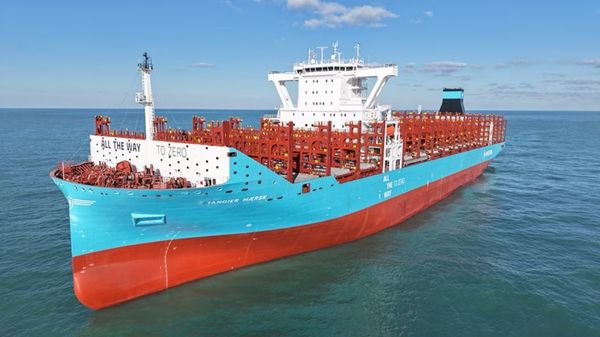
M.V. Greenland [pictured] with liquefied natural gas (LNG) for the first time in Westport Stavanger, Norway. The operation was carried out via a truck-to-ship delivery at the quay.
In a statement, the supplier said:
"Bunkering is a daily operation for Skangas, and it is always satisfactory to welcome a new ship into the 'LNG family'".
The M.V. Greenland is a dedicated cement carrier built in 2015 and operated by
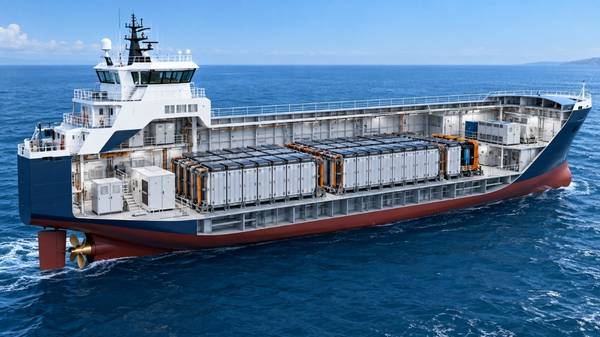
KGJ Cement. It is the first dry cargo vessel ever to be fitted with an LNG-fuelled propulsion system and the world's first LNG-powered cement tanker. It has a pressurized LNG tank incorporated inside the hull and is powered by Wärtsila dual-fuel technology.
When operating on natural gas, the M.V. Greenland is said to comply with the most stringent emission criteria and ready to meet potential future environmental restrictions.
The M.V. Greenland is due to be followed by a sister vessel, also powered by LNG, which is expected to be delivered in May 2016.
Norway-based Skangas carries out LNG supply deliveries in the Baltic Sea, North Sea and in the Amsterdam-Rotterdam-Antwerp (ARA) region via truck, barge and pipe. According to the company's website, it carried out 1,360 ship bunkering operations and 5,712 truck loading operations in 2014.
Ownership
Skangas is owned by Finnish firm
Gasum Oy (with a 51 percent shareholding) and Norway's
Lyse (with a 49 percent stake). Gasum acquired its majority stake from Lyse in May 2014.
Gasum is an integrated gas company that is owned by the Finnish Government (75%) and Gazprom (25%). The company imports natural gas to Finland and supplies it for energy production, industry, homes, and land and maritime transport. Its head office is based in Espoo, Finland.
Lyse operates in the field of electricity generation, distribution and telecommunication. It is owned by 16 municipalities in the Sør-Rogaland district of Norway, and has its head office in Stavanger, Norway.
LNG facilities
In October 2015, Gasum announced that plans to construct an LNG import terminal and gas pipeline in the south of Finland were being scrapped because the project was deemed to be "not commercially viable" because "there is not sufficient demand for them in the Finnish market".
Despite pulling out of the LNG import terminal project, Gasum remains active in the development of the Finnish gas market. Skangas is building an LNG terminal at the Port of
Tahkoluoto in
Pori, Finland, and is also a co-owner of an LNG terminal under construction in
Tornio, Finland.
The Pori terminal's LNG storage capacity is set to be 30,000 cubic metres (15,000 tonnes) once completed. The terminal area will include an LNG tank (height 35 metres, outer diameter 42 metres), loading docks, process units (compressor and vaporizers), flare torch (height less than 50 metres), three loading docks for road tankers, a transformer building and a heat production unit. There is also a connecting natural gas pipeline from the terminal to the local M20 Industrial Park.
The Pori LNG terminal is expected to be completed in the autumn of 2016. It will be the first of its kind in Finland.
Last year, Skangas also launched the first ever LNG bunkering station in the Nordics - located in
Risavika, Norway. The bunkering station is situated very close to the main trade route that runs along Norway's west coast.