Fri 23 Oct 2009, 07:15 GMT

Bunker boost for Charleston: Maersk to stay


Maersk Line in u-turn as deal is reached for carrier to stay in Charleston until 2014.


Almost a year after announcing that it would be pulling out of Charleston, Maersk Line has announced today that it has reached an agreement with the South Carolina State Ports Authority to maintain services in the Port of Charleston beyond the conclusion of the current 2010 contract in a decision which will also be a boost for future bunker sales volumes at the port.

The agreement brings a close to several months of negotiations and represents a reversal in Maersk Line’s decision to leave Charleston announced late last year.

The new deal establishes a new contract until December 31, 2014 and, according to Maersk Line, places the company's cost structure in Charleston on a level playing field with other ocean carriers who use the port.

Maersk, the world’s largest shipping line, has long been the Port of Charleston largest customer, accounting for around 20 percent of its container business. However, this came under threat when the container carrier could not reach a cost-saving agreement amenable to both the State Ports Authority (SPA) and the International Longshoremen's Association.

Maersk hoped to save money by moving into the "common-use" area of the Wando Welch Terminal, where SPA workers would carry out jobs that otherwise fall to pricier union labour. However, the three local maritime unions rejected Maersk's cost-cutting proposal in December, and the company responded by announcing it would strip all services from Charleston by the time its contract runs out at the end of 2010. By March, Maersk's calls to the Port of Charleston dropped by almost 50 percent.

“Under the new agreement, Maersk Line will maintain a competitive position within the Port of Charleston. This will allow us to continue to provide a reliable service for our valued customers in South Carolina, a benefit to the economy both in Charleston and throughout South Carolina,” said Dana Magliola, spokesman for Maersk Line.

"Working from a smaller, dedicated portion of the Wando Welch Terminal, Maersk Line will continue to offer our customers across the globe a reliable, committed service at the Port of Charleston," said Maersk Line.

“We have worked closely with the leadership of the South Carolina State Ports Authority since we initially voiced our concern about cost competitiveness for Maersk Line within the Port of Charleston. We are pleased to have reached an agreeable solution for both Maersk Line and the Port of Charleston,” said Gordon Dorsey, Senior Vice President of Operations for Maersk Line in North America.

“Overall, this agreement was achieved through the cooperation and hard work of many stakeholders, but we particularly appreciate the efforts of Jim Newsome and Paul McClintock of the South Carolina State Ports Authority, South Carolina State Senator Larry Grooms, who as Chairman of the Senate Transportation Committee, along with Senate President Pro Tempore Glenn McConnell and Senate Finance Committee Chairman Hugh Leatherman, played a crucial role in keeping the talks alive and fostering a second round of discussions that resulted in today’s agreement.

"This agreement will continue a long, successful relationship between Maersk Line and the South Carolina State Ports Authority. Combined with other regional Maersk Line services and port offerings, this agreement ensures that Maersk Line will continue to offer a broad portfolio of reliable, industry-leading transportation products to and from the United States Southeast region," Maersk Line said.


AiP handover ceremony for methane oxidation catalyst system. MHI Marine Machinery and Mitsubishi Shipbuilding receive AiP for methane oxidation catalyst system  

ClassNK approves basic design of LNG engine exhaust treatment system achieving over 90% methane oxidation.

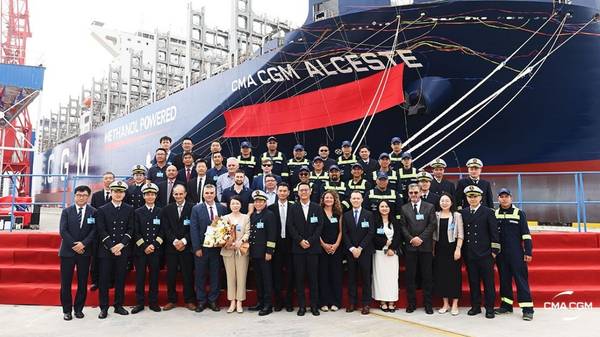
CMA CGM Esmeralda naming ceremony. CMA CGM names 15,000-teu methanol-powered containership in Shanghai  

The CMA CGM Esmeralda has been deployed on the REX2 service.

DNV and the Singapore Institute of Technology (SIT) signing. DNV and Singapore Institute of Technology partner on remote vessel operations research  

Agreement focuses on shore-based control centres for bunker vessels and autonomous maritime capabilities.

Grande Inghilterra naming ceremony. Grimaldi takes delivery of eleventh ammonia-ready car carrier  

Grande Inghilterra features solar panels, lithium batteries and cold ironing capability.

Launching ceremony of Bisan Maru vessel. Japanese tugboat to feature biofuel blender and ultrasonic anti-fouling system  

Seagate Corporation’s Bisan Maru is the first Japanese tugboat to feature both environmental technologies.

Hercules Elisabeth vessel. Hercules Tanker Management deploys second Ultra-Spec vessel to the Mediterranean  

HTM Elisabeth arrived in Gibraltar carrying biofuel cargo from Thailand bound for Barcelona operations.

Carrier deck view. Wärtsilä to supply ammonia fuel systems for Navigator Gas and Amon Maritime carriers  

Finnish technology group wins contract for cargo handling systems on two dual-fuel ammonia vessels.

Svitzer Balder vessel. Battery-methanol harbour tug completes sea trials ahead of Gothenburg deployment  

Svitzer Balder is claimed to be the most powerful electric escort tug in the world.

Launching ceremony of Nave Orbit vessel. Changhong International launches fourth LR2 tanker for Navios  

Chinese shipbuilder floats 115,000-tonne LR2/Aframax product tanker with methanol and LNG conversion capability.

Nippon Yuka Kogyo logo. Nippon Yuka Kogyo launches lubrication oil analysis service for ammonia-fuelled engines  

Japanese company offers condition monitoring service to support adoption of ammonia as a marine fuel.