Thu 23 Apr 2009, 09:44 GMT

CMA CGM focuses on cutting bunker costs


Shipping line introduces cost-saving measures to lower bunker fuel consumption.


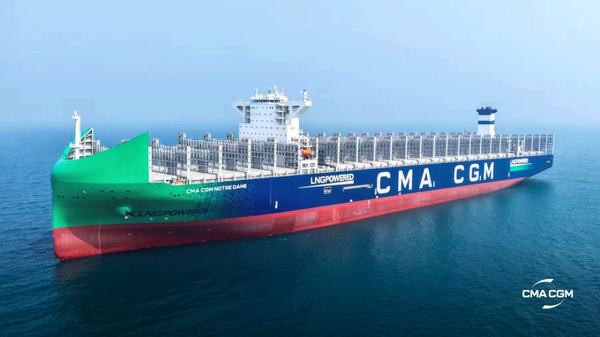
French container transportation and shipping company CMA CGM has announced that it is introducing new cost-saving measures which includes operating its ships at economical speed in order to lower bunker fuel consumption.

The new measures, which will be deployed in 2009, aim to reduce operating costs by approximately $600 million.

As part of the company's cost-cutting initiative, CMA CGM said it is continuing to rationalize its services in slowing markets, consolidating lines and strengthening partnerships to maintain service quality while reducing costs.

Because three-quarters of the fleet is chartered, CMA CGM said it has significant leeway to adjust to market demand. In 2009, more than 180 ships will come out of charter and will either be returned to their owners or renewed or replaced at attractive contract rates, leading to substantial cost savings for the Group.

In a commitment to revising its cost structure, CMA CGM said it is increasingly operating its ships at economical speed to lower bunker fuel consumption. The shipping line is campaigning for lower transit rates in the Suez and Panama canals and will continue to reroute part of the fleet via the Cape of Good Hope. It has also begun renegotiating contracts with terminals and shipyards to reduce costs.

At the end of 2008, CMA CGM reported revenue of $15.1 billion, up 28.2 percent compared with 2007. Freight volumes rose by 15.6 percent to 8.9 million TEU and the reefer fleet rose sharply during the year, making CMA CGM the world's second largest carrier of goods in refrigerated containers.

The company said it was able to maintain its growth trajectory in 2008 as a consequence of a number of strategic decisions which included (i) developing partnerships and space exchanges with comparable-sized shipping groups to share capacity and improve service quality; (ii) Launching new services in growing markets; (iii) Expanding the Group's presence in reefer transport, cargo projects and other niche markets; (iv) Investing in the acquisition of more productive vessels and in innovative, cost-effective and environmentally friendly technologies including electronic injection ship engines, reefers equipped with energy-efficient motors and light steel containers.

"Thanks to our forward-looking strategy, the flexibility of our systems and processes and our international expertise, we are quite confident in the ability of our company and our management team to successfully weather the current crisis," said Jacques R. Saadé, Chairman and Founder of the CMA CGM Group.

"Trade between Asia and especially Europe and the United States will remain unescapable and will unavoidably return to growth. 2009 will be a period of consolidation in the shipping sector and the major players will emerge stronger in the end," Saadé added.


Oriental Aquamarine vessel. HMM deploys Korea's first MR tanker with wing sail technology  

Oriental Aquamarine equipped with wind-assisted propulsion system expected to cut fuel consumption by up to 20%.

BC Ferries vessel render. ABB to supply hybrid-electric propulsion for BC Ferries' four new vessels  

Technology will enable ferries to run on biofuel or renewable diesel with battery storage.

Alternative marine fuels port graphic. LNG-fuelled boxships sustain alternative fuel orderbook share despite market slowdown  

Alternative fuels maintained 38% of gross tonnage orders in 2025, driven by container segment.

Conceptual diagram of the MOL–ITOCHU strategic alliance. MOL and ITOCHU sign MoU for cross-industry environmental attribute certificate partnership  

Japanese shipping and trading firms to promote EACs for reducing Scope 3 emissions in transport.

CPN as China's No. 1 marine biofuel supplier in 2025 graphic. Chimbusco Pan Nation delivers 170,000 tonnes of marine biofuel in China in 2025  

Supplier says volumes quadrupled year on year, with a 6,300-tonne B24 operation completed during the period.

V.Group and Njord logo side by side. V.Group acquires Njord to expand decarbonisation services for shipowners  

Maritime services provider buys Maersk Tankers-founded green technology business to offer integrated fuel-efficiency solutions.

Container vessel manoeuvring in port. Has Zhoushan just become the world's third-largest bunker port?  

With 2025 sales of 8.03m tonnes for the Chinese port, Q4 data for Antwerp-Bruges will decide which location takes third place.

Monjasa Oil & Shipping Trainee (MOST) trainees. Monjasa opens applications for global trainee programme  

Marine fuel supplier seeks candidates for MOST scheme spanning offices from Singapore to New York.

Singapore's first fully electric harbour tug. Singapore's first fully electric tug completes commissioning ahead of April deployment  

PaxOcean and ABB’s 50-tonne bollard-pull vessel represents an early step in harbour craft electrification.

Fuel for thought: Hydrogen report cover. Lloyd's Register report examines hydrogen's potential and challenges for decarbonisation  

Classification society highlights fuel's promise alongside safety, infrastructure, and cost barriers limiting maritime adoption.


 Recommended