Thu 7 Jun 2018, 12:18 GMT

Balearia launches ferry with scrubber system


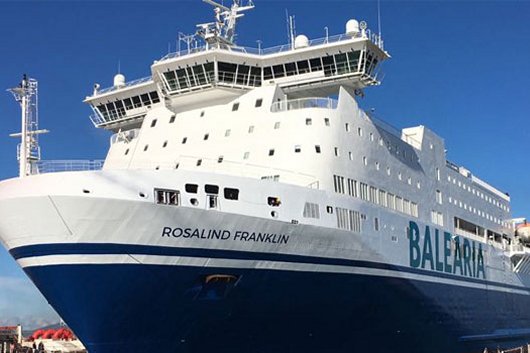
The Rosalind Franklin will operate between Barcelona and Palma de Mallorca.


Balearia's ferry, the Rosalind Franklin, is fitted with an exhaust gas cleaning (or 'scrubber') system.
Image: Balearia
Balearia has incorporated the ferry Rosalind Franklin to the Barcelona-Palma de Mallorca route. The vessel features an exhaust gas cleaning (or 'scrubber') system.

With the scrubber solution installed, the new ship will be able to reduce exhaust gas sulphur oxide emissions to below 0.1 percent, meeting both existing Emission Control Area (ECA) standards and those of the upcoming 0.5 percent global sulphur cap in January 2020.

The 188-metre-long ferry has a sailing speed of 22 knots and will be leaving from the port of Barcelona on a daily basis at 23:00 hours, and from Palma at 12:30 hours, with a journey time of around seven-and-a-half hours.

Last year, Balearia invested EUR 125 million in acquisitions, new vessel construction and repowering as the company continued to focus on improving the fuel efficiency of its fleet and in the development of LNG-powered ferries.

The first in a series of four eco fast ships, the Eco Aqua, started operating between the islands of Ibiza and Formentera last year. The second, Eco Lux, began transporting activities last month, whilst the remaining two ships - Eco Terra and Eco Aire - are expected to commence operations shortly.

The fuel-saving ships are powered by state-of-the-art engines designed to minimize emissions and feature a wave-piercing bow and photovoltaic solar panels, supplying energy on board.

In terms of LNG developments, last year, Balearia ordered two new, dual-fuel, gas-powered ferries to be built at the Cantiere Navale Visentini shipyard in Italy. The vessels are expected to be operational by the end of 2018.

In January 2017, the company's 2010-built Abel Matutes was refuelled with LNG in Barcelona for the first time after being retrofitted with a 30-cubic-metre LNG storage tank and an auxiliary natural gas engine built by Rolls-Royce.

Balearia's fourth LNG-fuelled ferry, which was ordered in 2016 from Construcciones Navales del Norte SL (LaNaval) shipyard in Sestao, Spain, is scheduled to enter into regular service in 2019.

<i>Maya Cosulich</i> vessel. Landmark methanol-powered bunkering vessel departs shipyard  

World's first methanol-powered IMO II chemical bunker tanker begins operations after completion of construction phase.

Paul Pappaceno, Monjasa. Monjasa mourns death of senior trader Paul Pappaceno  

Marine fuel supplier to hold celebration of life for 39-year industry veteran.

<i>One Synergy</i> vessel. Imabari delivers 13,900-teu container ship with future-fuel readiness  

Japanese shipbuilder hands over One Synergy with methanol and ammonia conversion designs approved.

Cosco Shipping North America Sustainability Report 2024 cover. Cosco Shipping reports ongoing efforts to advance use of low-sulphur fuels  

Company achieves near-total compliance with vessel speed reduction programs and 100% shore power use in Oakland.

VPS: From Regulation to Reality. From Regulation to Reality: Fuel Assessment Update of the Mediterranean Emission Control Area | Steve Bee, VPS  


<i>CMA CGM Krypton</i> naming ceremony. CMA CGM names 13,000-teu methanol-fuelled containership in South Korea  

Dual-fuel vessel will operate on Asia-Mediterranean-Middle East service connecting three regions.

Charlotte Nonnemann, ABB. Shipping industry pivots to fuel efficiency amid regulatory uncertainty on decarbonisation  

ABB says pragmatism prevails as shipowners focus on adaptable technologies following IMO net-zero framework delay.

<i>Laura Mærsk</i> vessel. Maersk to trial 50% ethanol blend on dual-fuel methanol vessel  

Shipping line plans higher-ethanol-content tests following initial 10% blend trial on Laura Maersk.

Solomon Islands National Action Plan launch. Solomon Islands unveils plan to reduce reliance on fossil fuels  

Maritime authority develops roadmap with IMO support to modernise vessels and port infrastructure.

<i>SG Lagoon</i> vessel. Japanese shipbuilder delivers LNG-fuelled Capesize bulk carrier  

Imabari Shipbuilding completes 209,000-dwt vessel with dual-fuel capability and enhanced environmental performance.