Tue 26 Jul 2016, 08:14 GMT

EU urged to strengthen its sustainability rules for biofuels


Recently published EU report found 'a number of gaps in the European Commission's existing biofuels sustainability certification framework'.


A European Court of Auditors report published last week has found that "there are a number of gaps in the European Commission's existing biofuels sustainability certification framework".

In response to the EU report, the Brussels-based European renewable ethanol association ePURE has said the sustainability regime for biofuels in Europe can and should be strengthened further to ensure that only the most sustainable biofuels are promoted by EU policy after 2020.

ePURE believes that the existing biofuels sustainability framework does not adequately safeguard against "conflict over land ownership, forced or child labour, poor working conditions for farmers and dangers to health and safety", and that biofuels found to have been produced under such circumstances should be totally prohibited in Europe.

In its recent 'Roadmap to 2030', ePURE calls for a number of measures to strengthen the sustainability of biofuels used in Europe, including:

- The existing sustainability rules for biofuels should be maintained and strengthened to ensure robust and fraud proof certification.

- Full sustainability criteria and traceability requirements should be applied for all advanced biofuels and other bioenergy options, as they currently are for conventional biofuels.

- The same sustainability criteria applied to biofuels should be applied to all transport fuels, including petrol and diesel, to ensure that there is a level playing field for transport fuels.

- Allow biofuels with low indirect land use change (ILUC) risks to contribute to the EU 2030 climate targets.

- The use of palm oil, which has high land use impacts, should be prohibited in Europe, particularly in the biofuel sector.

- EU agricultural cross-compliance obligations should be extended to biofuels produced from non-EU crops and feedstock.

"There are a number of good biofuels, including European ethanol, that are entirely sustainable and the Commission should fully back these biofuels in its post-2020 policies. European ethanol has 63% GHG savings, low land use impacts and no negative social consequences or effects on food prices - it is the type of good biofuel that Europe should support," remarked Robert Wright, Secretary-General of ePURE.


FincoEnergies Logo. Glencore to acquire majority stake in Dutch marine fuel supplier FincoEnergies  

Transaction expected to complete in Q2 2026, subject to EU anti-trust approval.

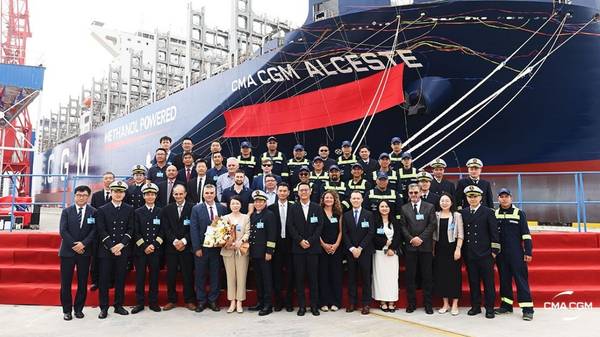
CMA CGM Eugenie naming ceremony. CMA CGM names 15,000-teu methanol-fuelled containership CMA CGM Eugenie  

Vessel to operate on Phoenician Express service linking Asia, Middle East, and Mediterranean.

Christian Larsen, Island Oil. Island Oil appoints Christian Larsen as senior trader in Denmark expansion  

Marine fuel supplier establishes operations in Denmark as part of expansion strategy.

HIF Global and Government of Uruguay MoU signing. HIF Global signs Uruguay agreement to advance US$5.3bn e-fuels facility in Paysandú  

Memorandum sets roadmap for final investment decision on plant targeting 880,000 tonnes annual production.

CMAL vessel. Corvus Energy wins largest-ever contract for seven electric Scottish ferries  

Battery systems supplier secures record order from Remontowa Shipbuilding for CMAL's Small Vessel Replacement Program.

HiMSEN H32CDF-LA engine classification approval test. HHI-EMD secures type approval for 5.4MW ammonia engine  

Lloyd's Register approves H32CDF-LA dual-fuel engine following three-day testing programme in Korea.

Atticus vessel. Global Fuel Supply acquires first bunker tanker  

Company transitions from chartering vessels to ship ownership with asset to be renamed MV Blue Alliance.

ABB Generations 2025 publication on smartphone. ABB publishes 2025 maritime insights on decarbonisation and digitalization  

Technology firm compiles annual articles exploring energy efficiency, automation, and alternative fuels for the shipping industry.

ClassNK AiP handover ceremony for bulk carrier design. ClassNK grants approval for multi-fuel ready bulk carrier design by Oshima Shipbuilding  

Vessel design accommodates future conversion to ammonia, methanol, or LNG with carbon capture capability.

The Arctic and black carbon graphic. Four countries propose Arctic fuel measure to cut black carbon from shipping  

Proposal to IMO's PPR 13 meeting aims to establish fuel regulations under MARPOL Annex VI.