Fri 29 Jan 2016, 10:23 GMT

Fuel-saving rotor sail business gets EUR 3m funding


Norsepower says analytics and third-party verification has helped it evolve its rotor sail from an innovative system for trial to a marketable technology.


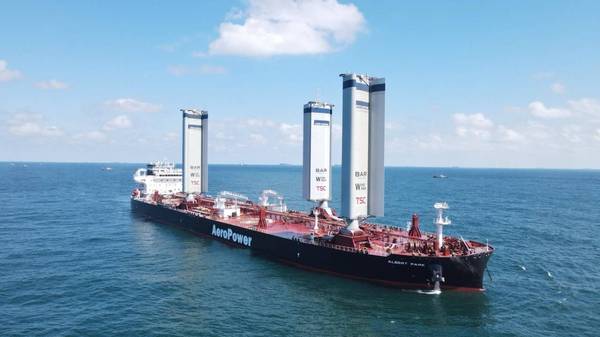
Finnish engineering company Norsepower Oy Ltd has today announced that it has received a EUR 3 million investment from a syndicate led by venture capital fund Power Fund III, and has installed a second rotor sail on Bore's ro-ro vessel, MS Estraden [pictured].

The Norsepower Rotor Sail Solution is a modernised version of the Flettner rotor - a spinning cylinder that uses the Magnus effect to harness wind power to propel a ship. When the wind conditions are favourable, Norsepower Rotor Sails allow the main engines to be throttled back, thus saving fuel and reducing emissions while providing the power needed to maintain speed and voyage time. Rotor sails can be used with new vessels or can be retrofitted on existing ships without off-hire costs.

A single Norsepower Rotor Sail was installed on the 9,700-deadweight-tonne (dwt) ro-ro carrier MS Estraden in early 2015. Although the weather conditions were largely calm over the three-month trial, data analysis from vessel performance monitoring and verification software, ClassNK-NAPA GREEN, is said to have shown that the rotor sail delivered "clear and significant savings of 2.5 percent".

Based on this evidence, Bore has ordered a second installation - the first commercial order for a Flettner rotor in shipping. Doubling the rotor sails has now proven to double fuel savings; NAPA - the maritime data analysis, software and services provider - recorded a 6.1 percent reduction in fuel consumption, avoiding 1,200 tonnes of CO2 emissions annually.

Norsepower says that measurement, analytics and third-party verification has helped it evolve its rotor sail from an innovative system for trial, to a marketable fuel efficiency technology with a clear business case.

The Finnish firm says that this has also helped increase its enterprise value and secure its future with the EUR 3 million investment from Power Fund III - a clean tech venture fund managed by VNT Management - which is intended to be used support Norsepower's growth and market expansion.

Tuomas Riski, CEO, Norsepower commented: "Since delivering our first proven application with Bore last year, our business has grown from strength to strength. With this significant investment from VNT and our first commercial installation, we have now cemented our position as leaders in the growing wind technology market. Objective data and impartial verification of the fuel savings delivered by the technology has been absolutely critical to this evolution and will remain central to the way in which we work with shipowners and operators."

Jouni Salo, Product Manager, Shipping Solutions, NAPA, remarked: "Independent verification of Norsepower's technology has required a significant and complex analysis process. The operating route of the vessel posed many challenges from differing wind conditions to varying sea depths, all of which impact fuel consumption and had to be accounted for with randomised trialling, robust data collection and advanced statistical modelling. The results, however, have made it all worthwhile. The two-sail installation is delivering the largest fuel saving of any efficiency technology NAPA has measured. We talk figures of Rotor Sails being effective 80% of sailing time, 460kW average propulsion boost and 1.5MW peaking for 10% of time. The fact that NAPA has not only proven this eco-efficiency technology, but also boosted Norsepower's enterprise value through orders and investment really shows the power of big data when applied correctly."

Victoria Stulgis, Senior Associate, Carbon War Room, said: "It is great to see Norsepower, Bore and NAPA collaborating to pilot this technology and conduct rigorous data analysis. These first movers are key to demonstrating that efficiency technologies such as wind have proven savings, which can unlock new sources of investment for Flettner rotors and other technologies that can deliver significant efficiency gains."


Malama vessel dock mounting ceremony. Hanwha Philly Shipyard advances construction on two LNG-fuelled container ships for Matson  

Dock mounting completed for Malama while steel cutting begins on sister vessel Makena.

Bow of the Explora V vessel. Fincantieri launches bow section of LNG-powered Explora V at Palermo yard  

Fifth ship in Explora Journeys’ six-vessel series is scheduled to enter service in 2027.

Steel cutting ceremony of vessel with builder's hull no. H5187. Wah Kwong marks steel-cutting for third dual-fuel LNG carrier at Dalian Shipyard  

Hong Kong shipowner’s 175,000 cbm newbuild is scheduled for delivery as fleet expansion continues.

Yu Neng Jiao Long vessel. Cosco Shipping takes delivery of 64,900-dwt Panamax crude tanker  

Yu Neng Jiao Long features dual-fuel capability and meets IMO Tier III emission standards.

Fuel for Thought: LNG report. LNG fleet reaches 1,665 vessels as methane slip technology advances  

Lloyd’s Register report highlights economic viability and emissions reduction progress for marine fuel.

Aerial view of Piraeus Harbour in Greece. Bureau Veritas seeks emissions compliance verifier in Piraeus  

Classification society advertises for specialist to verify shipping emissions data under IMO and EU regulations.

We are hiring graphic message with a handshake gesture. Trafigura seeks financial controller for shipping and bunkering operations in Athens  

Role involves accounting and controlling activities for shipping and bunkering entities, reporting to regional controller.

Port in Mauritania. Minerva Bunkering launches Mauritania operation after securing regulatory licence  

Company to supply marine fuels from Nouadhibou and Nouakchott to commercial vessels and offshore installations.

Mercedes Pinto vessel. Baleària's third dual-fuel fast ferry Mercedes Pinto hits 38 knots in sea trials  

The 123-metre vessel is destined for the Canary Islands and can run on biomethane.

TFG Marine and DBS USD 300 million working capital facility graphic. TFG Marine secures $300m DBS facility backed by electronic bunker delivery notices  

Marine fuel supplier’s working capital facility leverages digital documentation to enhance transparency and efficiency.