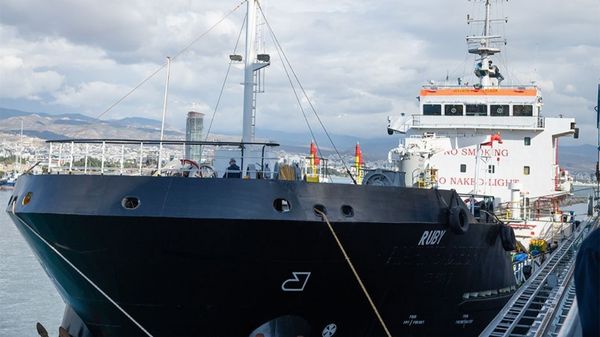
Source: Lloyd's Register
Seaborne ethane and demand for a new ship type: very large ethane carriers (VLECs)
Lloyd's Register report looks at the commercial landscape, regulatory issues and technical realities of a new trade in ethane emerging as a result of increased US gas production - and the technology required for large ethane carriers.
US ethane production capability, as a by-product of total increased US gas production, is under-utilised. The potential exists for annual exports of 1 million tonnes of ethane to provide employment for 0.18 million cubic metres of shipping capacity if shipped to North Europe, a further 0.32 million cubic metres if shipped to South Asia and a similar amount to China through the Panama Canal. Projects are now underway to produce and move this ethane.
'Seaborne ethane: A report into the commercial need and technical requirements for very large ethane carriers', released by Lloyd's Register today (26 August), looks at the risks and challenges in developing a safe and efficient trade in ethane using larger ships and requiring ethane specific technical solutions.
"The window of opportunity to tie up ethane exports and secure tonnage to serve this trade is now open to feed potential markets in Europe and Asia," said
Tim Protheroe, President,
Lloyd's Register North America Inc. "Lloyd's Register has identified the technical risks and best technical pathways to help ensure that near term demand for large VLECs can be met by shipyards and gas containment system suppliers. Our job is to help anyone looking at trading ethane to make the best commercial decisions based on the best technical insight as well as working with regulatory bodies such as the US Coast Guard and flag administrations to ensure that the risks are understood."
One of the critical factors to be addressed is the containment technology used in VLECs as traders look for the most efficient shipping options.
Leonidas Karistios, Global Gas Technology Manager, Lloyd's Register, said: "We have been studying the potential for ethane for over a year and we asked the question, 'What would a safe and efficient 80,000-cubic-metre ethane carrier look like?'. The answer is that to transport larger quantities in a single hull will almost certainly require the adoption of alternatives to Type 'C' gas containment systems."
Historically ethane has been transported in small liquefied ethane/ethylene carriers (LECs) designed and constructed to carry ethylene (boiling point -104°C) as well as ethane and other 'normal' liquefied petroleum gas (LPG) cargoes. All these vessels have Type ‘C’ containment systems and it is estimated that the maximum feasible size of a ships with Type ‘C’ cargo tanks is around 40,000 cubic metres. "It's not impossible that Type 'C' tanks could work, and it is important to keep reviewing the technology being developed," said Karistios.
The study evaluates all tank technology options and identifies that, for ethane carriers of 80,000 cubic metres and over, the adoption of either prismatic type 'B' tanks or membrane systems would provide the likely best technical design pathways - based on a ship with three to four tanks.
Lloyd's Register has been working with major shipyards on variations of tank technology options and with containment designers, such as
GTT, to identify technical solutions for large ethane carriers. For example, the report states that the suitability of GTT systems for multi-gas applications has been demonstrated. And that the methodology to assess GTT’s containment systems under the specific, and different - compared to liquefied natural gas (LNG), for which GTT’s tank technologies were originally developed - constraints required for ethane, has been agreed by Lloyd’s Register. First evaluations with multigas loadings have been performed while GTT’s Mark III, Mark III Flex, NO96 and NO96-L03 systems are also being considered for suitability.
Ethane as bunker fuel
A benefit of ethane is that, as with LNG, the cargo can be used to power an ethane carrier's engine. But this requires that specific risks be addressed.
Lloyd's Register and
MAN Diesel have together worked on an ethane engine project and Lloyd's Register has already issued an approval in principle (AIP) for the
ME-GI engine combusting ethane.
MAN Diesel has agreed to make the necessary design modifications to the methane version of the ME-GI and be able to supply the engines for Q4 2015, for an anticipated ship delivery in June 2016, and has submitted the documentation required for an approval in principle.
Some of the changes required to accommodate the higher pressure required for ethane include redesigned fuel valves, control block and piping along with some material changes. However, whilst these are not insignificant the conceptual engine design and the risk management philosophy will have a very high degree of commonality with the LPG fuelled ME-LGI engine which is already approved by Lloyd's Register.
Lloyd's Register is therefore ideally placed to advice on the underlying assumptions and experience underpinning an effective project risk management strategy. Furthermore, as ethane is not included within the International Gas Code, Lloyd's Register is also seeking the agreement of flag administrations for the use of ethane as a fuel.
Karistios concluded: "We qualify the application of existing technology for new purposes and the introduction of new technologies. Our goal is to help ensure that all involved in the ethane transportation chain have assurance that their investments are as safe as possible and do what is expected of them."
The full report is available now at www.lr.org/ethane