Thu 10 Jun 2010, 08:12 GMT

LNG guidelines issued


Guidelines will aim to help shipowners prepare for the introduction of LNG.


Germanischer Lloyd (GL) has issued guidelines for gas as a ship fuel on the application of IMO regulations. The guidelines, which are in force since May 1st, apply to all ships excluding liquefied gas tankers.

The internal combustion engine installations subject to the IMO interim guidelines may be single-fuel (i.e. natural gas) or dual-fuel (gas and fuel oil) machines, and the natural gas may be stored in gaseous or liquid state.

The guidelines are to be applied in conjunction with the relevant provisions of the International Convention for the Safety of Life at Sea (SOLAS), 1974, and the Protocol of 1988 relating thereto, as amended.

"With new emission control regulations taking effect, gas as a ship fuel, once banned, is now re-emerging as an environmentally and economically attractive option," Dr Hermann J. Klein, Member of the Executive Board Germanischer Lloyd, said at a press conference in Athens this week.

Compared to oil, natural gas has two key advantages: high efficiency and a lower environmental impact. Risks associated with conventional ship fuels include bunker quality issues, poor ignition and combustion, and uneven heat and pressure distribution on pistons, piston rings and cylinder liners.

"Engine problems and damage caused by low-quality heavy fuel oils will be a thing of the past for owners switching to gas as a ship fuel," GL said in a statement.

In early June 2009, the IMO Committee on Maritime Safety (MSC) lifted the ban on natural gas as a ship fuel by adopting Resolution MSC 285(86), called "Interim Guidelines on Safety for Natural Gas-Fuelled Engine Installations in Ships".

Developed by the IMO subcommittee on Bulk Liquid and Gases (BLG) with GL assistance over the past few years, the Interim Guidelines are the first step towards the envisioned general code for gas as a ship fuel, the so-called IGF Code, which is currently under development by IMO and is expected to enter into force conjointly with the revision of SOLAS 2014.

Criteria for Construction

The GL guidelines will aim to help shipowners and yards prepare for the introduction of gas as a ship fuel in the near future. The new guidelines provide criteria for the design arrangements and installation of propulsion and auxiliary machinery powered by natural gas to ensure a level of integrity, safety, reliability and dependability equivalent to that of comparable, state-of-the-art machinery burning conventional fuel oil.

Environment- and Budget-Friendly

Liquefied natural gas (LNG) is gas (predominantly methane, CH4) that has been converted temporarily to liquid form for ease of storage or transport. It is odourless, colourless, non-toxic and non-corrosive. The reduction in volume makes it much more cost-efficient to transport over long distances. The energy density of LNG is 60% of that of diesel fuel. Therefore, one also has to take into account a doubling of tank capacity.

Increasing numbers of new LNG carriers are equipped with high-efficiency dual fuel engines. This new trend, which originated in commercial shipping around the millennium, has encouraged the introduction of LNG as a ship fuel. An appropriate infrastructure supplying LNG fuel in ports has yet to be established.

"GL believes LNG as a ship fuel may be just the solution the shipping industry has been looking for to cope with the emissions challenges of our time," underlined Dr Klein.

LNG Usage is Rising

For a long period of time, LNG was a fuel for users who needed natural gas but had no or difficult access to pipelines. Additionally, LNG carriers were driven partly using the LNG cargo as fuel in steam turbines of low efficiency.

Today, an increasing number of LNG carriers are driven by high-efficiency dual fuel engines. This development, which began at the start of the millennium, has supported the introduction of LNG as a ship fuel. However, the concept of LNG as fuel for shipping also requires the availability of LNG in ports.

The limitations of fossil fuel resources is expected to drive the tendency towards lower carbon content fuel and higher efficiencies through new technologies.

"The long-term future of heavy fuel oil as bunkers is questionable, both in terms of dependency on oil and not least with regards to emissions. Natural gas, in contrast, gives a more environmentally friendly combustion and in addition there appear to be greater reserves available than oil. Thus, natural gas in liquid form (LNG) as marine bunkers has the potential to be the solution for the shipping industry to cope with its emission challenges in the years to come," GL concluded.


Global Ethanol Association (GEA) and Vale logo side by side. Vale joins Global Ethanol Association as founding member  

Brazilian mining company becomes founding member of association focused on ethanol use in maritime sector.

KPI OceanConnect Logo. KPI OceanConnect seeks marine fuel trading intern in Singapore  

Bunker supplier advertises role offering exposure to commercial and operational aspects of marine fuel business.

Frank Dahan, CSL Group. CSL Group's Frank Dahan appointed chair of IBIA's Americas regional board  

Dahan brings 29 years of marine transportation and energy experience to the role.

IMO Member States, Belgium delegation. Lloyd's Register, EXMAR, and Belgium’s Federal Public Service develop interim guidelines for ammonia cargo as fuel  

Guidelines expected to receive formal IMO approval in May 2026, enabling ammonia use on gas carriers.

Knut Ørbeck-Nilssen, DNV. DNV to lead Nordic roadmap Phase 2 for zero-carbon shipping transition  

Programme will identify green corridors and tackle cost barriers through new financing approaches.

Monjasa logo. Monjasa seeks trader for Dubai operations  

Marine fuel supplier recruiting for trading role covering sales, purchasing, and logistics in UAE.

IBIA Board Elections 2026 – Call for Nominations announcement. IBIA calls for board election nominations ahead of Friday deadline  

Association seeks candidates for 2026 board positions with submissions closing 12 December.

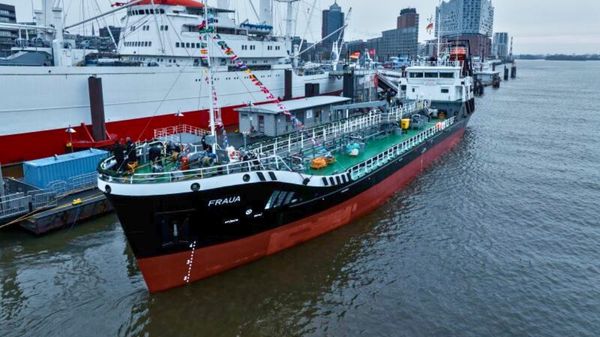
Fraua vessel. BMT Bunker adds tanker MT Fraua to fleet  

BMT Bunker und Mineralöltransport has expanded its fleet with a new vessel.

Ruby bunkering vessel. Island Oil expands Cyprus bunkering fleet with vessel Ruby  

Island Oil adds second bunkering vessel to strengthen marine fuel supply operations in Cyprus.

Wärtsilä and Aalto University partnership signing. Wärtsilä and Aalto University extend R&D partnership to accelerate marine decarbonisation  

Five-year agreement expands international collaboration on alternative fuels and clean energy technologies.


 Recommended