Mon 4 Jun 2018, 12:06 GMT

Gothenburg set to launch LNG bunker facility in August


Port prepares for growth in LNG bunker demand and the industry's transition to renewable gas.


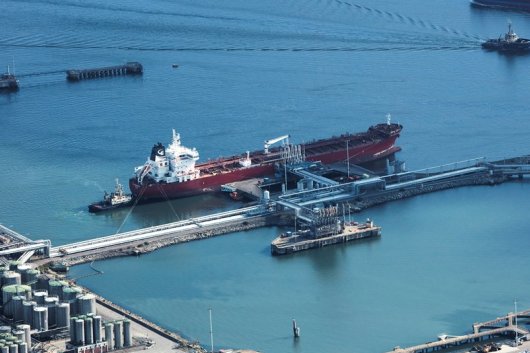
At berth 519 (where the red ship in the picture is located), LNG bunkering is possible via pipeline (pipe-to-jetty) directly to ships.
Image credit: Port of Gothenburg
Swedegas's new LNG bunkering facility in Gothenburg is set to become operational in August, Port of Gothenburg reports.

With the launch of the new facility, customers calling at the port will be able to bunker LNG either ship-to-ship, directly from a road truck or pipe-to-jetty.

All three methods will be possible whilst vessels are loading or unloading.

Scalable biogas facility

The Swedegas facility will be supplied with LNG via trailers or tank containers, which will be unloaded at a discharge station. The gas will then be distributed via pipeline to the vessels at the quayside.

The facility is scalable and can be expanded to meet the needs of the market. It also has the capability to receive liquefied biogas (LBG).

"We always build infrastructure that can handle both natural gas and renewable gas. It must be simple for shipping to gradually increase the mix of renewable gas as the transition progresses," said Johan Zettergren, Swedegas chief executive.

Skangas and Barents NaturGass

LNG supplier Skangas is already operating in Gothenburg, supplying ships with LNG using the ship-to-ship delivery method.

And Port of Gothenburg last week confirmed that it had entered into an agreement with Norway's Barents NaturGass for the supply of LNG via ISO containers from key European terminals.

Building for growth

In terms of LNG bunkering statistics, Gothenburg has recorded positive growth since the first LNG bunkering operation in the autumn of 2016. In the first full year, 111 LNG-fuelled ships called at the port. This year, meanwhile, LNG was bunkered on 44 occasions between January and April.

Jill Soderwall, Head of Commercial Operations at the Energy Port, remarked: "We can see that the demand for LNG will increase at the Port of Gothenburg, and it is vital that the number of alternatives continues to grow. With the Swedegas facility, the port will have more LNG choices than previously on a competitive market with several gas suppliers, whilst at the same time there will be a larger range of bunkering methods. This will offer greater flexibility, more stable access, and better service for LNG purchasers."

Iceberg floating in Arctic waters. IMO members urged to back mandatory Arctic fuel standards to cut black carbon emissions  

Clean Arctic Alliance calls for polar fuel measure requiring cleaner fuels in Arctic waters.

AET’s hybrid electric vessel render. AET adds hybrid-electric shuttle tanker to fleet with dual-fuel capability  

Tanker operator brings first hybrid-electric DPST into service on long-term charter with lower-emissions technology.

Methanol ship-to-ship bunkering operation at anchorage in Yokohama. Japan completes first ship-to-ship methanol bunkering at anchorage in Yokohama  

Five-way partnership delivers methanol fuel transfer between vessels at Keihin Port using domestically produced biomethanol.

Anna Cosulich vessel. Cosulich launches first methanol-ready bunker tanker in China  

Anna Cosulich is first of four sister vessels in fleet expansion programme.

Keel-laying ceremony of Natalia Cosulich. Cosulich begins construction of fourth methanol-ready bunker tanker in China  

Steel cutting for Natalia Cosulich marks completion of the group’s new alternative fuel-capable vessel series.

AiP award ceremony for cubic tank concept. Lloyd’s Register grants approval in principle to GTT’s CUBIQ LNG fuel tank design  

Classification society approves CUBIQ system designed to expand membrane-type LNG fuel tanks into commercial shipping.

International Chamber of Shipping nuclear webinar. ICS to host webinar on regulatory framework for nuclear merchant ships  

International Chamber of Shipping event on 26 February will examine regulatory pathways for nuclear vessels.

Cosco Shipping Libra vessel. World’s first full methanol dual-fuel retrofit completes maiden voyage  

Cosco Shipping Libra covered 27,800 nautical miles on a 106-day voyage after main and auxiliary engine conversion.

PetroChina Petroineos Trading logo. PetroChina International seeks bunker trader for Rotterdam as it expands ARA marine fuel operations  

Chinese energy trader aims to boost alternative fuels portfolio and market share in Europe.

MyStar vessel truck-to-ship bunkering. Tallink Group moves towards 100% renewable fuel on Helsinki–Tallinn route  

Megastar and MyStar ferries to run entirely on liquefied biomethane supplied by Elenger.