Tue 27 Oct 2009, 12:47 GMT

Denmark: 91% drop in SO2 emissions by 2020


SO2 emissions fom ships are predicted to fall significantly despite a 15% rise in fuel consumption.


A report compiled by the National Environmental Research Institute (NERI) at Aarhus University on behalf of the Danish Environmental Protection Agency has concluded that sulphur dioxide (SO2) emissions in Danish waters will be reduced by 91 percent by 2020 and that shipping's contribution to the nation's SO2 emissions is lower than initially thought.

Entitled "Ship emissions and air pollution in Denmark: Present Situation and Future Scenarios", the 134-page report was put together by Helge Rørdam Olesen, Morten Winther, Thomas Ellermann, Jesper Christensen and Marlene Plejdrup at the NERI.

The purpose of the project was to calculate the contribution of ship traffic to air pollution in Denmark based on the Automatic Identification System (AIS), which was introduced in 2006.

The NERI has previously provided estimates for air pollution from ships (e.g. Olesen et al., 2008), but the estimates were subject to a high degree of uncertainty, according to the NERI, as they were based on emission inventories with a low geographical resolution (50 km x 50 km). Furthermore, "they were based on simplifying assumptions, which do not necessarily reflect the actual patterns of ship traffic," the NERI said.

However, since 2006 the Automatic Identification System (AIS) has registered ship activities in Danish marine waters. All ships larger than 300 GT (Gross Tonnage) are required to carry a transponder, which transmits information on the ship’s identity and position to land-based receiving stations. This information has therefore made it possible to map ship emissions in much greater detail than previously feasible and a new emission inventory for ships in Danish waters has been put together.

In the study, both new (NERI) and old (EMEP, 2008) emission inventories were used for model calculations of air quality in Denmark, thus allowing an assessment of the effect of the revised inventory. In addition, scenario calculations for 2011 and 2020 were carried out in order to evaluate the effect of the new IMO regulations.

The scenario calculations have been based on expected reductions in ship emissions and an estimate for land-based emissions in 2020.

Finally, the contribution to local air pollution from ships at ports was assessed in various ways, based on updates from previous studies.

Main Conclusions

The report concludes that between 2007 and 2020 an emission reduction as large as 91% is envisaged in the marine waters around Denmark, in respect to sulphur dioxide from ship traffic. This is despite an increase in traffic during this period and said to be mainly due to IMO regulations.

Based on scenario calculations the SO2 concentration level as an average for Denmark will decrease considerably in the period up to 2020. In 2020 it is expected to be only 6% of what it was in 1990, and 1.5% of the EU limit values. In 2007 around 33% of the SO2 concentration level in Denmark was due to ship emissions, this number is expected to be reduced to about 11% in 2020.

The calculations predict a 15% increase in fuel consumption from 2007 to 2020 as a result of increased traffic (36% increase for freight ships and unchanged passenger traffic), combined with increased efficiency for ship engines.

Based on these calculations, a reduction of 91% in sulphur dioxide (SO2) emissions is envisaged between 2007 and 2020, while for primary particulate matter the reduction is 54%. Primary particles account for only a minor fraction of the total amount of particles found in ambient air.

Concentrations of sulphur dioxide

New calculations have been used to work out the relative contribution of shipping to the nation's total SO2 emissions.

The new inventory differs from the old in several respects: it assumes that sulphur content in fuel is 1.5 %, while the old refers to the situation before 2007 and uses 2.7 %; the new has a higher geographical resolution; it is based on "more correct" ship routes than the old; it uses "more realistic" data for the load of ship engines.

The combined effect of all of these factors is that whereas the calculations based on the previous inventory from EMEP said shipping accounted for 68% of the nation's emissions, calculations based on the new inventory conclude that the figure is 37%.

The full report can be found by clicking on the following link below:

NERI Study: Ship emissions and air pollution in Denmark


TMS Tankers logo. Lloyd’s Register delivers fleet-wide energy transition roadmap for TMS Tankers  

LR Advisory maps vessel-level compliance risk and decarbonisation pathways across the Greek owner’s tanker fleet.

Dr Prapisala Thepsithar, GCMD. GCMD shares biofuel assurance and green finance insights at Hong Kong shipping decarbonisation forum  

The Global Centre for Maritime Decarbonisation presented pilot findings on biofuels and energy efficiency financing.

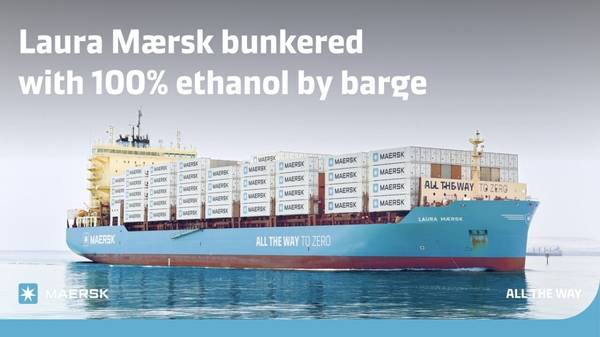
Laura Maersk ethanol bunkering graphic. Maersk conducts large-scale ethanol bunkering trial on Laura Maersk in Rotterdam  

A.P. Moller – Maersk has conducted a barge-delivered ethanol bunkering operation as part of ongoing fuel trials.

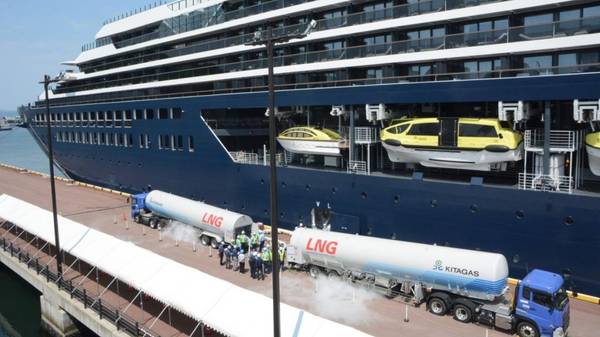
Luminara vessel truck-to-ship bunkering. MOL Techno-Trade completes first LNG bunkering for international cruise ship in Hokkaido  

Truck-to-ship LNG operation at Hakodate marks first such supply to an international cruise vessel in Hokkaido.

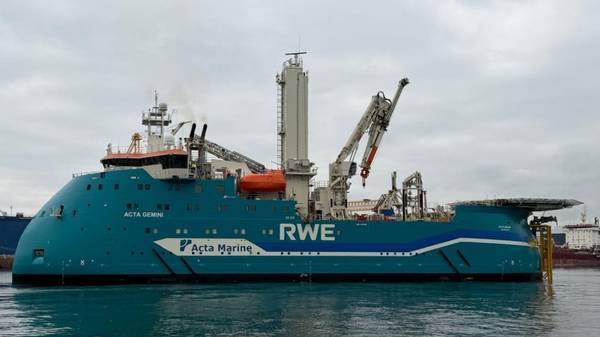
Acta Gemini vessel. Acta Marine takes delivery of methanol dual-fuel CSOV Acta Gemini for RWE wind farm charter  

The vessel will support operations at the Sofia Offshore Wind Farm at Dogger Bank.

Yeva Wood and Kirsten Møller Jørgensen. Malik Supply expands Danish team with bunker trader and finance hire  

Danish bunker supplier Malik Supply adds two new staff across its Fredericia and Aalborg offices.

AiP award ceremony for a 10,000-teu biofuel-powered container ship. HJSC wins AiP for 10,000-teu biofuel-powered container ship design  

South Korean shipbuilder HJ Shipbuilding & Construction receives classification society approval for its biofuel vessel design at Posidonia.

Active vessel. Capital Clean Energy Carriers takes delivery of LNG carrier and dual-fuel gas carrier, secures five new charters  

Athens-based CCEC expands its fleet and pushes contracted revenue backlog to $3.1bn.

VPS logo. Fuel quality management for vessels in extended idle: Arabian Gulf, Gulf of Oman and adjacent anchorages | Rahul Choudhuri, VPS  

Managing fuel quality deterioration following the closure of the Strait of Hormuz.

Person signing a document. Agastya Green Fuels signs 250,000 t/yr e-methanol offtake deal with Sri Lanka’s SAR Group  

Indian producer and Sri Lankan maritime firm agree long-term green methanol supply partnership.