Thu 21 Feb 2013, 15:55 GMT

Global Vision Market Report


Oil fell to a three-week low below $114 a barrel on Thursday, hit by weak euro zone economic data dampening the prospect of an early recovery and concern the U.S. Federal Reserve might end its stimulus programme sooner than thought. The drop extended Brent crude's largest one-day drop in 2013 on Wednesday, alongside declines in other commodities and equities. Rumours that a hedge fund was liquidating positions also had helped pressure prices, although there was no evidence of liquidation by any specific fund. Brent crude fell as low as $113.69, the lowest intra-day price since Jan. 29, and as of 1305 GMT was down $1.47 at $114.13 a barrel. U.S. crude slipped by $1.43 to $93.79.

Oil prices at ICE and NYMEX started little changed Wednesday morning. Due to thin news, traders were somewhat reserved in the first part of the day. Thus, the oil market consolidated at a high level. At this stage, G.Oil stayed within its technical range between 1,000.50 USD and 1,004.75 USD. The crude benchmarks, Brent and WTI, were trading with a strong tendency until afternoon. The U.S. economic data also failed to make a considerable impact on oil prices. As the euro edged lower in the afternoon, oil futures slipped. However, the sharp correction that followed in the early evening rather was a technical reaction. A combination of enhanced trading interest, front month change of WTI and the recent raise in net long positions lead to a series of profit-taking, which spread from the American crude to the rest of the oil market. WTI had been trading within a range of 95 USD to 98 USD since mid-January but in the course of yesterday’s downside, the American benchmark slipped to around 94 USD. G.Oil also fell below 1,000.00 USD. But the resistances at 990.00 USD and 115.00 USD proved to be strong for G.Oil and Brent, respectively.

ICE Gasoil contract for March delivery settled at 996.00 USD on Wednesday. This was 3.75 USD below Tuesday's settlement. With some 73,300 deals the traded volume was well above average.

The stochastic oscillator is bearish at ICE after the indicator has slipped below the 50%-line in the course of yesterday’s downward correction. The selling signal, however, triggered when its lines crossed, already dates a few days back. Moreover, the RSI indicates a slightly overbought market situation, which balances out the bearish effect. The Stochastic at the WTI chart is still neutral as its lines are still converging. Yesterday’s lows will be decisive for more downward potential today. If these marks were breached, the bearish effect of the technical constellation will take effect, favouring another downward correction. If oil prices, however, bounce off these lows, it might result in some traders covering their short positions.

U.S.

Nymex losing: Oil futures at ICE and NYMEX could not help but trade at yesterday’s lows in early Asian trading. When news leaked this morning that Saudi Arabia was to increase its production again, prices slumped, hitting some supports. Rumor has it that the Arabian kingdom wants to raise its output in the forthcoming month, which has a bearish effect on prices and prevents them to correct upwards after yesterday’s losses. According to Sanjeev Gupta, analyst for oil and gas with Ernst & Young, scaling up its production is Saudi-Arabia's reaction to increasing demand from emerging countries and China. Another bearish factor this morning is the UN’s “substantial offer” to Teheran to be made next week when negotiations regarding Iran’s controversial nuclear programme are to be resumed. According to a British newspaper, the P5+1 group wants to suggest a compromise to make Teheran give in. As the risk premium for oil is so high due to the continuing tensions with Iran, any kind of compromise would reduce the oil price. The traded volume at the NYMEX is clearly above average. Market participants are waiting for the European markets to open, for signals from forex trading as well as for economic data and DoE report to be released today.

Houston (ex-wharf indications 20-02)

380cst $642
180cst $705
MGO $1053

New Orleans (ex-wharf indications 20-02)
380cst $637
180cst $703
MGO $1050

Singapore (correct as of 1430hrs LT - delivered indications)

WTI is turning bearish, losing with -$3.29. Paper for Mar is starting to turn as well, losing with 180cst -$11.75 and for 380cst -$12.30, and Apr contracts with 180cst -$11.75, 380st -$12.30. The cargo market is not yet responding, gaining with 180cst +$1.07, 380cst +$1.38 and MGO +$0.56.

The Singapore fuel oil markets rose by around $1.0 during the morning Platts window yesterday tracking crude movement. The Asian crack strengthened yesterday as strong buying interest supported the fuel oil swaps especially after the window. The delivered bunker premiums were seen app. $4.0 above cargo prices. This morning the markets are trading down.

High premiums for prompt deliveries.
380 cst $641
180 cst $645
MDO $980

ARA (Amsterdam - Rotterdam - Antwerp)

No operational delay is reported in Rotterdam and Antwerp, so no problems are to be expected for prompt deliveries.

Indications for delivered bunkers:
380cst : $ 620
(1.0 %) :$ 662
180cst: $ 650
(1.0 %):$ 692
MGO 0.1%S: $ 975

MGO  

VPS logo. Fuel quality management for vessels in extended idle: Arabian Gulf, Gulf of Oman and adjacent anchorages | Rahul Choudhuri, VPS  

Managing fuel quality deterioration following the closure of the Strait of Hormuz.

Person signing a document. Agastya Green Fuels signs 250,000 t/yr e-methanol offtake deal with Sri Lanka’s SAR Group  

Indian producer and Sri Lankan maritime firm agree long-term green methanol supply partnership.

Bunker Holding logo. Bunker Holding seeks risk specialist for Copenhagen internal pricing desk  

Danish bunker group is expanding its internal pricing team to meet growing demand for fixed-price solutions.

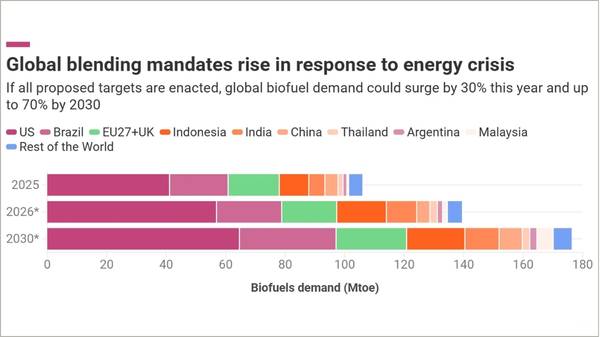
Global biofuels demand chart. Biofuel demand could surge 70% by 2030 as food price fears mount  

T&E warns governments risk trading an oil crisis for a food crisis as biofuel targets strain vegetable oil and fertiliser markets.

Shore power illustration. Shore power shifts from voluntary measure to compliance requirement, DNV white paper finds  

Shore power is moving from an optional emissions tool to a regulatory obligation for shipowners in key trades.

Giosuè Vezzuto and Ahmed Eldemerdash. Baker Hughes’ NovaLT 16 gas turbine receives RINA type approval for marine propulsion on hydrogen and natural gas  

Certification covers operation on natural gas and blends up to 100% hydrogen for marine use.

AiP award ceremony for nuclear reactor integration in cargo vessel design. ABS grants approval in principle for nuclear reactor integration in cargo vessel design  

ABS, HD KSOE, Capital Maritime Group and MIT have received approval in principle for a nuclear-powered cargo vessel propulsion system.

Green e-fuel export corridor consortium partners logos. Green e-fuel export corridor between Brazil and Belgium advances to feasibility stage  

A consortium has been formed to develop a green e-fuel corridor linking Porto do Açu to Antwerp-Bruges.

Naming ceremony of Ocean Express and Ocean Navigator vessels. Sallaum Lines takes delivery of two LNG-fuelled PCTCs in simultaneous handover ceremony  

RoRo carrier receives MV Ocean Express and MV Ocean Navigator from Chinese shipyard.

Person signing a document. Agastya Group signs MoU with Andhra Pradesh government for 1 MTPA green methanol hub at Mulapeta Port  

India-based Agastya Group plans a $6.5bn green methanol export facility on the country's east coast.