This is a legacy page. Please click here to view the latest version.
Mon 30 Jan 2012, 12:32 GMT

European refiners face further turmoil


Energy consultant predicts tougher times ahead for refiners in Europe.


Frost & Sullivan: Refineries in Europe Face Further Turmoil
by Frost & Sullivan Energy Consultant Enguerran Ripert

Petroplus, the Swiss refiner filing for bankruptcy, is only the tip of a continuing issue for refiners in Europe. Across the 104 EU27 refineries, roughly 40% require refurbishment in order to continue refining profitably.

Demand for crude oil products is increasingly volatile, and many refineries do not have the flexibility to accommodate this more rapidly changing demand. Beyond the structural issues, many owners need access to credit lines, which in the case of Petroplus amounted to €2.4 billion, to carry on doing business in the short term.

Since the midpoint of the last decade, European refineries' capacity utilisation consistently decreased from an average of 90% in 2005 to less than 75% in January 2012, reflecting the much tougher competitive environment, but also a trend toward flexible demand/supply of crude oil products. Road transport fuel, and in particular gasoline which Europe has a lot of capacity for, is being replaced by diesel and kerosene. Heavy oils, bitumen, waxes and petroleum coke are no longer in such high demand, making way for liquefied petroleum gas, naphtha and other smaller chains alkanes. The misalignment between demand and supply capabilities leads Europe to be a net exporter of gasoline to the US, and a net importer of diesel from Russia.

Although this movement of refined goods is not an issue in itself, it does reflect the inability of refineries to adapt to local demand quickly and profitably in their current state. This growing requirement for diesel and kerosene despite the latest economic turmoil cannot be met profitably due to cost and capacity reasons intrinsic to the current fleet of refineries. Since any investments (in hydro cracking units to increase diesel production for example) need bank funding due to the high cost, the ability to make these investments lies with the banks which hold much of the debt. But with higher capital ratios imposed on banks, and attractive spreads between ECB lending rates and local government bonds, banks prefer to avoid lending to the refining sector, or any other relatively high risk sector. Because of these factors combined with the increasing probability of another European recession, the uncertainty around ETS and carbon taxes, the rigid and costly labour laws, and tightening regulation on sulphur content, refineries will have tougher times ahead of them still.

The average size of refineries in Europe is less than 140,000 barrels per day, with slightly over 50% of them dealing with less than 100,000 barrels per day. The majority of these refineries were built more than 20 years ago when the demand dynamic was more stable and crude oil prices were less than half their 2012 levels. In a context where demand patterns change more rapidly, a lower number of much larger refineries is needed to offer both flexibility in product output, and lower costs. In the real world, where labour flexibility is limited, and the relocation of physical assets is extremely difficult, many more refiners will be sure to sell assets at highly discounted prices in the coming years or slowly erode their assets. Building a new facility will have a shorter payback period than the purchase of a cheap old one.

Debt stricken economies of Italy, Greece and Spain also represent a disproportionately high amount of refining capacity. With 16 refineries, Italy has more refining capacity than either the UK, France or Germany, and previously planned to upgrade Sannazzaro, Sarroch, Venice and Priolo. However, with the current economic outlook, the recently imposed sanctions on Iranian oil imports, and the carbon taxes, these planned upgrades, along with those of Spain and Greece, may not go ahead so rapidly.

In all, despite the need for an increase in crude oil processing capacity in Europe, a large portion of the existing capacity needs to be replaced, and this readjustment comes at a time when the banking support structure is not ready to support it fully. The larger groups with a high involvement in exploration will be the ones able to weather the continuing losses, but many will either decide to sell downstream assets, otherwise they will continue to make losses, weighing down further on future P&Ls if they don’t breach banking covenants first.

Image: Coryton Refinery, United Kingdom


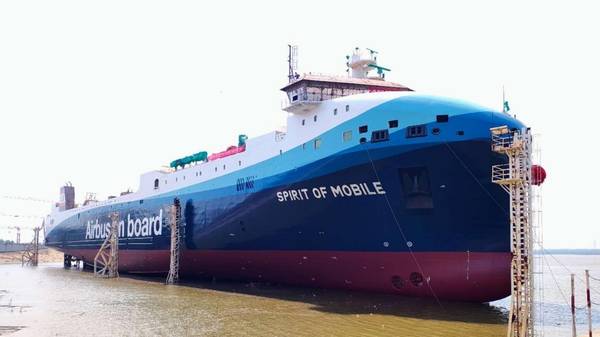
Spirit of Mobile vessel. LD Armateurs launches second low-emission ro-ro vessel for Airbus charter fleet  

French shipowner LD Armateurs has launched its second methanol-capable, rotor sail-equipped ro-ro vessel at a Chinese shipyard.

Verde Marine Energy (VME) logo. Verde Marine Energy renews ISCC EU certification and achieves RED III compliance  

Dutch bunker supplier Verde Marine Energy says it is now fully compliant with the EU's updated renewable energy rules.

bound4blue receives DNV Type Approval. Bound4blue wins DNV type approval for its largest installed eSAIL suction sail  

DNV certification of the Model 3-24 eSAIL is said to support wider adoption of wind-assisted propulsion.

BGN and HD HHI signing ceremony. BGN expands owned LPG fleet with two additional VLGCs from HD HHI  

BGN signs a new shipbuilding contract, bringing its owned VLGC fleet to 19 vessels.

Medium-range (MR) tanker with Rotor Sails render. Anemoi and partners win DNV approval in principle for rotor sail integration on MR tankers  

DNV issues approval in principle for EX-rated rotor sail design on medium-range product tankers.

TMS Tankers logo. Lloyd’s Register delivers fleet-wide energy transition roadmap for TMS Tankers  

LR Advisory maps vessel-level compliance risk and decarbonisation pathways across the Greek owner’s tanker fleet.

Dr Prapisala Thepsithar, GCMD. GCMD shares biofuel assurance and green finance insights at Hong Kong shipping decarbonisation forum  

The Global Centre for Maritime Decarbonisation presented pilot findings on biofuels and energy efficiency financing.

Laura Maersk ethanol bunkering graphic. Maersk conducts large-scale ethanol bunkering trial on Laura Maersk in Rotterdam  

A.P. Moller – Maersk has conducted a barge-delivered ethanol bunkering operation as part of ongoing fuel trials.

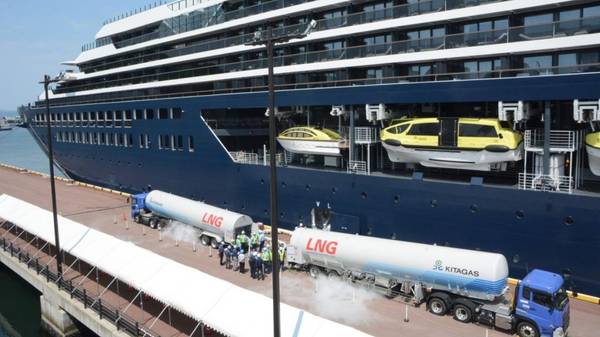
Luminara vessel truck-to-ship bunkering. MOL Techno-Trade completes first LNG bunkering for international cruise ship in Hokkaido  

Truck-to-ship LNG operation at Hakodate marks first such supply to an international cruise vessel in Hokkaido.

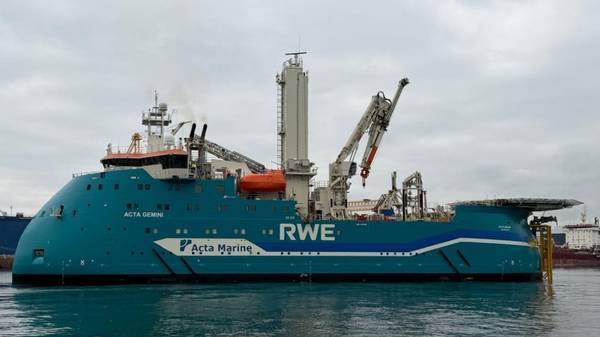
Acta Gemini vessel. Acta Marine takes delivery of methanol dual-fuel CSOV Acta Gemini for RWE wind farm charter  

The vessel will support operations at the Sofia Offshore Wind Farm at Dogger Bank.


↑  Back to Top


 Recommended