Det Norske Veritas AS (DNV) has announced that it is launching an
ECA Survival Kit, which aims to prepare shipowners for the stricter emission requirements for vessels operating in Emission Control Areas (ECAs).
The leading classification society and risk management foundation says that by understanding and managing the business risks involved, the emission reduction requirements can be turned into business benefits.
“Many operators will face tough times when the new emission reduction requirements come into force in the Emission Control Areas (ECAs). I advise operators to start preparing now to get on the front foot when the upcoming 2015 and 2016 legislation become reality,” said DNV’s principal consultant
Henning Mohn.
Emission Control Areas (ECAs) have already been established in the Baltic Sea and the North Sea, and will soon be enforced along the North American coastlines. Other areas, such as the Mediterranean Sea, are expected to follow in the near future.
The emission reduction requirements applicable within the ECAs will gradually be stepped up. The fuel sulphur content of any ship in an ECA after 2015 will not be able to exceed 0.1%, or the exhaust gas will need to be purified to an equivalent level. After 2016, NOx emissions from newbuilds will have to be reduced by approximately 75 percent.
"The emission reduction requirements will have severe implications for shipowners and charterers as well as for entire supply chains within the ECAs. Many possible actions can be taken, but the consequence of choosing a sub-optimal strategy may be costly. However, there are opportunities for smart navigation within the ECA regime. DNV advises operators to start preparing now to turn the upcoming 2015 and 2016 legislation into business benefits," DNV said.
When seeking cost-effective emission reduction measures, DNV says operators should consider every technical, regulatory and operational requirement. Access to DNV’s repository of maritime expertise and a range of services is included in its new ECA compliance 'toolkit'.
By following a process phase scheme, DNV says shipowners will be well prepared for the forthcoming ECA requirements. The schemes four phases are:
1. Opportunity and risk identification
2. Strategy and planning
3. Implementation
4. Validation and documentation
Liquefied Natural Gas (LNG)
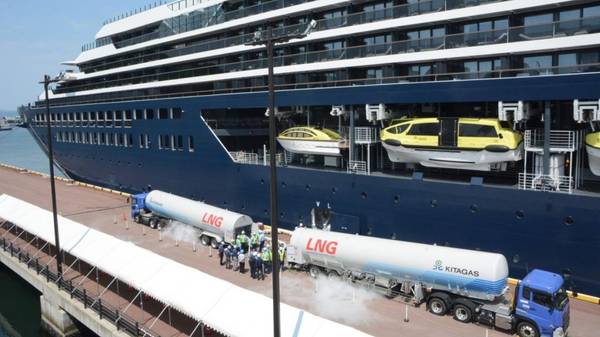
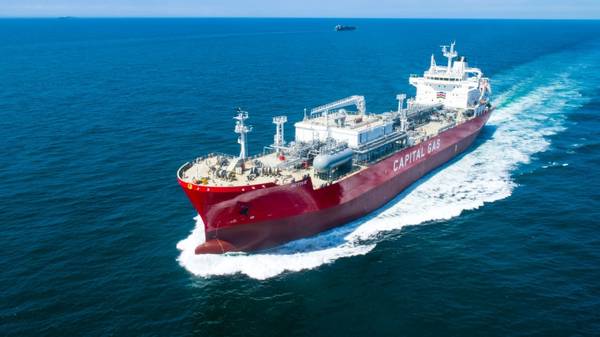
On the technical side, DNV says there are three main solutions for ECA compliance; low sulphur fuel, scrubbers for exhaust gas purification or the ship can be fuelled by LNG.
"LNG as fuel is now a mature technology representing no technical obstacles. It is often more economical than the alternatives and is an environmental winner," DNV said.
DNV was the first class society to introduce rules for LNG-fuelled ships back in 2001.
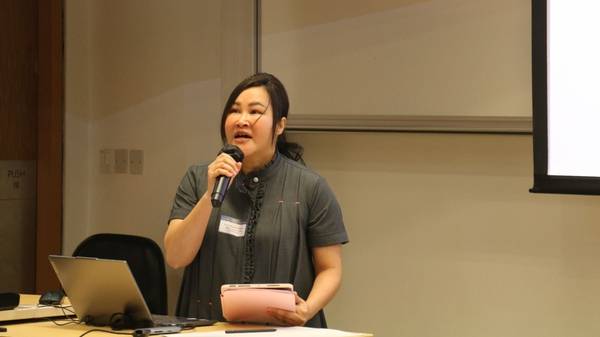
[Pictured: DNV's principal consultant Henning Mohn and segment director for special ships Arnstein Eknes presents DNV's new toolkit for ECA compliance onboard Hurtigruten.]