This is a legacy page. Please click here to view the latest version.
Thu 20 May 2010, 07:44 GMT

Bureau Veritas backs natural gas propulsion


Classification society says natural gas-powered propulsion will be a major contributor to greener shipping.


Leading international classification society Bureau Veritas says natural gas-powered propulsion will be one of the major contributors to greener shipping.

“Using natural gas to power ships offers substantial advantages in reducing emissions,” said Bernard Anne, managing director of the Bureau Veritas Marine Division.

“It is also abundant in supply and will be price-competitive with low-sulphur fuel. We are already working with shipowners and yards on a number of projects involving gas or dual gas/fuel projects involving a range of containerships, cruise vessels, ferries, ro-pax and ro-ros, as well as inland and coastal navigation ships. We are also engaged in projects to assess the viability of refitting existing ships.

“Bureau Veritas was the first to class dual fuel vessels - for LNG carriers with dual fuel diesel engines - and recently classed a smaller vessel which can also use LNG to power auxiliaries. We have a major development programme now to extend the benefits of NG power to a wider range of ships,” added Anne.

Ships at berth in EU ports are now required to use marine fuels with a sulphur content not exceeding 0.1 per cent by mass, with the result that shipowners and shipyards will need to be more imaginative and to find new ways to reduce air pollution.

Natural gas power for ships is said to reduce NOx emissions by 80-90 per cent, eliminates SOx emissions, reduces particulate matters close to zero and cuts CO2 by 20-25 per cent.

“Technical solutions to install gas fuel engines in various types of vessels are already in place, demonstrating the feasibility of this alternative to liquid fuels,” explained Anne.

“The hurdles we now have to overcome involve the bunkering, storage and supply of NG to non-LNG carriers. Finding space for LNG tanks, for heating and cooling equipment, and for protection against spillage are all tasks we have in hand. The result will be a step-change in the cleanliness of shipping. Today’s ships burn the dirtiest fuel that is available. Gas-powered ships will burn the cleanest. That is worth working for.”

Anne told BV’s Nordic Committee meeting in Klaipeda, Lithuania in May, which was chaired by Viktoras Cepys of the Lithuanian Shipping Company, that BV will shortly publish a new edition of the BV Rules Note on Safety Rules for gas-fuelled engine installation on ships, and update BV Rule Note NR 529 to address the use of containerised storage tanks and connection with ships’ gas fuel piping systems and the location of gas fuel tanks.

[Image: Natural gas molecule]


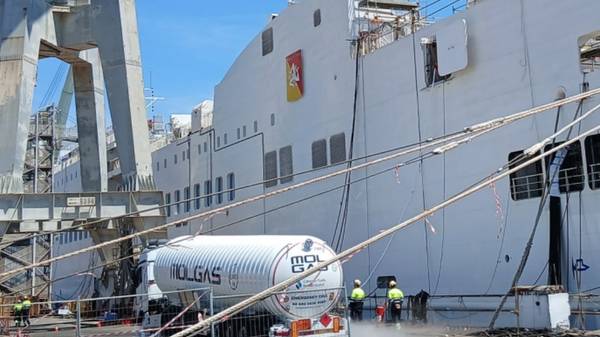
Truck-to-ship (TTS) LNG bunkering at Port of Palermo. Molgas completes first LNG bunkering operation at Palermo  

Spanish energy firm carries out maiden LNG delivery at Sicilian port.

Maersk 5,900-teu vessel. Tsuneishi China delivers third methanol dual-fuel boxship in series  

Zhoushan shipbuilder hands over another 5,900-teu Maersk container vessel.

Type approval test (TAT) for ME-LGIA ammonia engine. Everllence completes type approval test for ammonia engine ahead of sea trials  

Eight classification societies oversee testing of ME-LGIA ammonia engine at Copenhagen research centre.

Zhong Ran 23 vessel. CPN bunker barge becomes first vessel listed under Hong Kong’s new quality bunkering scheme  

Zhong Ran 23 achieves listing under the Marine Department’s voluntary mass flow metering initiative.

Peder Moller, Bunker Holding. Bunker Holding posts $73m pre-tax profit amid geopolitical headwinds and board overhaul  

Marine fuels exceeds its own expectations despite 4% revenue decline.

Oilmar Board of Directors graphic. Oilmar formalises governance structure with establishment of board of directors  

Dubai-based marine fuels trader Oilmar appoints three-member board.

Henrik Andersen, Vestas Wind Systems A/S. Vestas Wind Systems CEO appointed vice chair of Bunker Holding  

Henrik Andersen joins the board of the marine fuels group with more than two decades of international business experience.

Tina Revsbech, Maersk Tankers. Maersk Tankers CEO Tina Revsbech joins Bunker Holding board  

Danish USTC Group appoints shipping veteran to subsidiary’s board of directors.

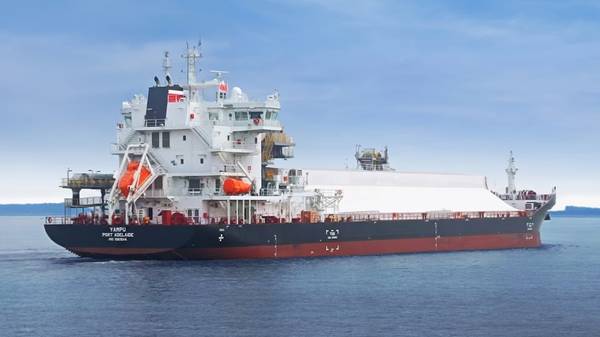
Yampu vessel. CSL delivers world’s first battery-powered self-unloading bulk carrier  

MV Yampu will transport limestone for Adbri in Australia, with full electric operation targeted by 2031.

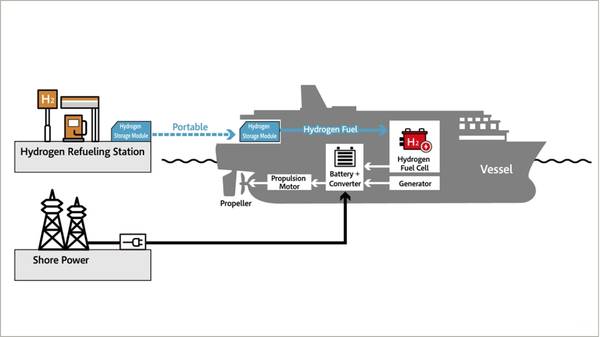
Illustration of hydrogen fuel cell system. NYK, Yanmar and Eneos to install hydrogen fuel cell system on new Tokyo dining cruise vessel  

Three Japanese companies are collaborating to bring hydrogen propulsion to a dining cruise ship due to enter service in 2027.


↑  Back to Top