This is a legacy page. Please click here to view the latest version.
Mon 29 Mar 2010, 09:26 GMT

Amendments to MARPOL Convention adopted


MEPC adopts amendments to establish North American ECA and Antarctic fuel ban.


The Marine Environment Protection Committee (MEPC) of the IMO has concluded that more work needs to be done before it completes its consideration of the proposed mandatory application of technical and operational measures designed to regulate and reduce emissions of greenhouse gases (GHGs) from international shipping.

Meeting at the Organization’s London headquarters, the Committee’s 60th session agreed to establish an intersessional Working Group to build on the significant progress that had been made during the meeting on technical and operational measures to increase the energy efficiency of ships. The Working Group will report back to the Committee’s next session (MEPC 61), in September 2010.

Although the meeting was able to prepare draft text on mandatory requirements for the Energy Efficiency Design Index (EEDI) for new vessels and on the Ship Energy Efficiency Management Plan (SEEMP) for all ships in operation, the Committee noted in particular, that, among other things, issues concerning ship size, target dates and reduction rate in relation to the EEDI requirements all required finalization.

The Committee agreed on the basic concept that a vessel’s attained EEDI shall be equal or less (e.g. more efficient) than the required EEDI, and that the required EEDI shall be drawn up based on EEDI baselines and reduction rates yet to be agreed. The Committee noted guidelines for calculating the EEDI baselines using data from existing ships in the Lloyd’s Register Fairplay database.

With regard to market-based measures, the Committee agreed to establish an Expert Group on the subject to undertake a feasibility study and impact assessment of the various proposals submitted for a market-based instrument for international maritime transport – again, reporting back to MEPC 61.

Amendments to the MARPOL Convention

Among other items on a full agenda, the Committee adopted amendments to the MARPOL Convention to formally establish a North American Emission Control Area, in which emissions of sulphur oxides (SOx), nitrogen oxides (NOx) and particulate matter from ships will be subject to more stringent controls than the limits that apply globally.

Another new MARPOL regulation, to protect the Antarctic from pollution by heavy grade oils, was also adopted. The new regulation prohibits the carriage, in bulk as cargo, or carriage and use as fuel, of: crude oils having a density, at 15°C, higher than 900 kg/m3; oils, other than crude oils, having a density, at 15°C, higher than 900 kg/m3 or a kinematic viscosity, at 50°C, higher than 180 mm2/s; or bitumen, tar and their emulsions.

These amendments are expected to enter into force on 1 August 2011.

Secretary-General’s closing remarks

In his closing remarks to the meeting, IMO Secretary-General Efthimios E. Mitropoulos focused on the progress made in dealing with GHG emissions from ships and the challenges that still remain.

Placing the Committee’s work in its wider context, he said, “Global issues demand global solutions. Let the world learn from the lessons of Copenhagen so that the same mistakes are not repeated in Cancun. At the same time, let us build on the undeniable successes Copenhagen has scored, by providing a forum for Heads of State and Government to listen to and understand each other’s problems, concerns, worries and sensitivities and, thus, pave the way for a more successful next round of consultations.”

The shipping world, he added, should proceed, “not in a fragmented manner, but as responsible members of a community that has a role to play in this effort.”


TMS Tankers logo. Lloyd’s Register delivers fleet-wide energy transition roadmap for TMS Tankers  

LR Advisory maps vessel-level compliance risk and decarbonisation pathways across the Greek owner’s tanker fleet.

Dr Prapisala Thepsithar, GCMD. GCMD shares biofuel assurance and green finance insights at Hong Kong shipping decarbonisation forum  

The Global Centre for Maritime Decarbonisation presented pilot findings on biofuels and energy efficiency financing.

Laura Maersk ethanol bunkering graphic. Maersk conducts large-scale ethanol bunkering trial on Laura Maersk in Rotterdam  

A.P. Moller – Maersk has conducted a barge-delivered ethanol bunkering operation as part of ongoing fuel trials.

Luminara vessel truck-to-ship bunkering. MOL Techno-Trade completes first LNG bunkering for international cruise ship in Hokkaido  

Truck-to-ship LNG operation at Hakodate marks first such supply to an international cruise vessel in Hokkaido.

Acta Gemini vessel. Acta Marine takes delivery of methanol dual-fuel CSOV Acta Gemini for RWE wind farm charter  

The vessel will support operations at the Sofia Offshore Wind Farm at Dogger Bank.

Yeva Wood and Kirsten Møller Jørgensen. Malik Supply expands Danish team with bunker trader and finance hire  

Danish bunker supplier Malik Supply adds two new staff across its Fredericia and Aalborg offices.

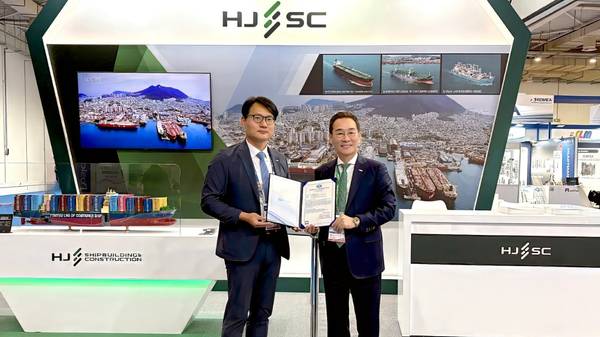
AiP award ceremony for a 10,000-teu biofuel-powered container ship. HJSC wins AiP for 10,000-teu biofuel-powered container ship design  

South Korean shipbuilder HJ Shipbuilding & Construction receives classification society approval for its biofuel vessel design at Posidonia.

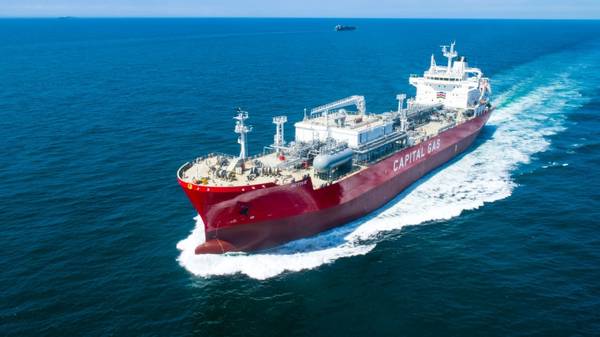
Active vessel. Capital Clean Energy Carriers takes delivery of LNG carrier and dual-fuel gas carrier, secures five new charters  

Athens-based CCEC expands its fleet and pushes contracted revenue backlog to $3.1bn.

VPS logo. Fuel quality management for vessels in extended idle: Arabian Gulf, Gulf of Oman and adjacent anchorages | Rahul Choudhuri, VPS  

Managing fuel quality deterioration following the closure of the Strait of Hormuz.

Person signing a document. Agastya Green Fuels signs 250,000 t/yr e-methanol offtake deal with Sri Lanka’s SAR Group  

Indian producer and Sri Lankan maritime firm agree long-term green methanol supply partnership.


↑  Back to Top