This is a legacy page. Please click here to view the latest version.
Fri 19 Mar 2010, 13:04 GMT

Gas as ship fuel - a clean alternative to heavy fuel oil


Event held to address aspects related to using LNG as an alternative ship fuel.


"Gas as ship fuel" was the topic of yesterday's GL First Class Exchange Forum, which highlighted classification society Germanischer Lloyd's (GL) approach towards the environmental concerns of the maritime industry. The forum addressed aspects related to LNG as an alternative ship fuel.

Invited speakers presented the LNG supply chain development from a ship owner's and gas terminal operator's view. Regulatory developments at IMO were explained by a representative of the Federal Ministry of Transport, Building and Urban Affairs, Germany.

Details about a joint industry project on a gas-fuelled container feeder vessel were discussed by representatives of Germanischer Lloyd (GL), MAN Diesel and TGE Marine Gas Engineering, a specialist in the design and construction of cargo handling systems for ships and offshore units carrying liquefied cryogenic gases.

Flensburger Schiffbaugesellschaft (FSG) evaluated the first results of the research project GasPax while the issue of gas bunkering was addressed by GL.

In his introduction Torsten Schramm, COO of GL's Maritime Services, raised the question of how the maritime industry could reduce its environmental impact while remaining competitive, or even better, save costs.

"In the end, emissions boil down to the quality of fuel. We all know that heavy fuel oil has its merits cost-wise but contributes to a rather negative image of shipping," Schramm said.

Dr. Pierre C. Sames, GL's Senior Vice President Strategic Research and Development, mentioned that there appears to be general consensus on developing gas engines that can be used on vessels operating regular or shorter routes. Coastal shipping, which accounts for more than 33% of the world's fleet, will be subject to more stringent controls than liner container vessels.

"LNG fuel is a viable alternative to heavy fuel oil. Coastal traffic can benefit from LNG fuel, especially as regional emission control areas are tightened or coming into force," Sames said.

The environmental benefits of LNG as a fuel are well documented, with zero sulphur-oxide emissions and much lower CO2 as well as significantly reduced nitrogen-oxide and particle emissions compared to standard marine fuels.

More than 140 experts from all over Europe gathered at GL's new head office in Hamburg to discuss the status and trends of using gas as ship fuel. The opportunity to analyse the implication of LNG as ship fuel correlates with discussions at IMO. Its sub-committee on Bulk Liquids and Gases (BLG) is working on new regulations to meet present demands for safety standards in the use of natural gas as a marine fuel.

Interim guidelines by IMO will be available in June 2010 and the IGF-Code is planned to enter into force with the SOLAS 2014 revision.

GL will publish its own guideline on using gas as a fuel in the beginning of April 2010 to complement IMO interim guidelines.

The next GL First Class Exchange Forum will deal with the topic of safety and design aspects of passenger vessels and is planned for the end of April 2010.


World Fuel logo. World Fuel seeks marine lube operations and sales executive in Greece  

US firm is recruiting for a commercial role focused on marine lubricants, based out of its Glyfada office.

ECSA Parliamentary Breakfast event. European shipowners call for fuel supplier mandates and ETS revenue investment ahead of policy revision  

Industry body urges EU policymakers to redirect carbon revenues into clean marine fuel production.

Coral Energy vessel at Klaipeda LNG terminal. Gasum secures LNG terminal capacity at Klaipėda through 2040  

Nordic energy company locks in long-term LNG supply access to serve northwestern European markets.

Torm Corrido vessel. Chimbusco Pan Nation extends B100 biodiesel bunkering to oil tankers as quarterly volumes triple  

Hong Kong bunker supplier CPN says Q2 B100 deliveries have exceeded Q1 totals by more than 300%.

TMD Energy Limited logo. TMD Energy extends bioenergy MOA with Double Corporate by two years  

Malaysian bunkering firm seeks to advance waste-to-energy marine fuel collaboration in EU and Asian markets.

Antwerpen vessel. Exmar takes delivery of world’s first dual-fuel ammonia oceangoing vessel  

Belgian shipowner Exmar has taken delivery of what it says is the first oceangoing vessel powered by a dual-fuel ammonia engine.

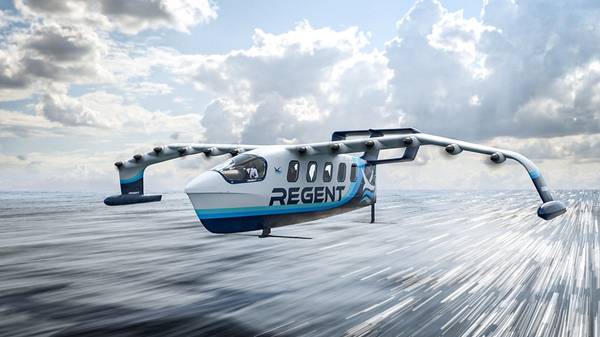
Seaglider vessel render. MOL and JAL partner with Lloyd’s Register and REGENT to advance Seaglider certification in Japan  

Four organisations join forces to establish regulatory pathways for electric wing-in-ground craft ahead of a targeted 2030 commercial launch.

Geoff Wagner and Byung-Hun Kwon. ABS and HD Hyundai entities secure battery hybrid approval for 16,000-teu container vessel  

Approval in principle issued for electrical design of ultra-large container ship at Posidonia.

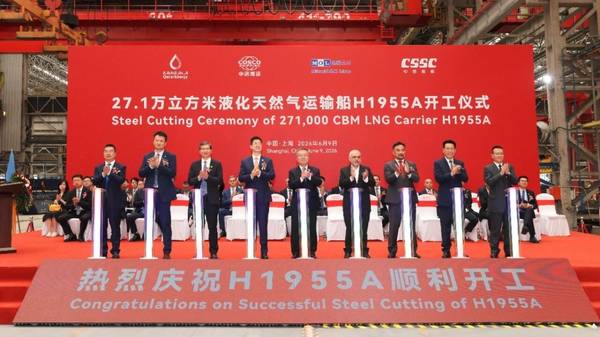
Steel cutting ceremony of vessel with builder's hull no. H1955A. Keel laid for world’s largest LNG carrier at China’s Hudong-Zhonghua shipyard  

Construction begins on a 271,000-cbm QC-Max vessel, the largest LNG carrier ever built.

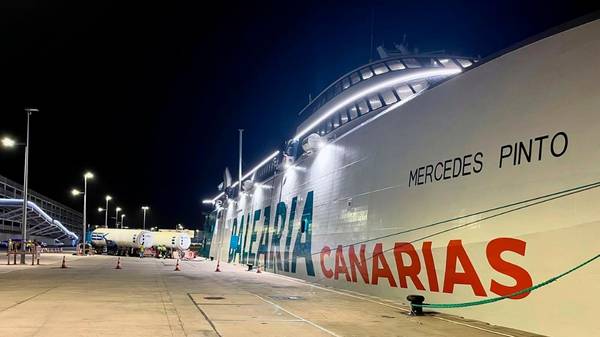
Mercedes Pinto vessel truck-to-ship (TTS) bunkering. Port of Las Palmas completes first LNG bunkering operation  

Baleària Canarias’ new fast ferry receives LNG via tanker truck in milestone delivery.


↑  Back to Top