This is a legacy page. Please click here to view the latest version.
Mon 21 Dec 2009, 14:11 GMT

Association warns of 'risk' of unilateral measures


Warning that unilateral regulation would result in 'serious market distortions'.


The International Chamber of Shipping (ICS) has today said it is 'disappointed' over the outcome of the United Nations Climate Change Conference (COP15) in Copenhagen and has warned of the 'risk' of individual countries and regions developing unilateral measures to regulate CO2 emissions.

In a statement the trade association commented: "The International Chamber of Shipping (ICS) has said that it acknowledges the progress made by governments, reflected in the 'Copenhagen Accord', at the recent UN Conference in Copenhagen. However, ICS is disappointed that the text of the Accord is silent on the treatment of international shipping in the delivery of further CO2 emission reductions, to which the industry remains firmly committed.

"For the moment at least, UNFCCC has been unable to agree a clear mandate for the industry's regulator, the United Nation's International Maritime Organization (IMO), on how to build upon the considerable work already undertaken by IMO on a package of technical, operational and economic measures for reducing shipping's emissions on a global basis - a mandate strongly advocated by the shipping industry.

"In particular, it remains unclear how the Kyoto Protocol principle of 'Common But Differentiated Responsibility' (CBDR) should be reconciled with the important need for global rules on CO2 reductions for the carriage of world trade," the association commented.

The ICS added that shipping is a uniquely international industry that can only work efficiently when operating within a framework of uniform global regulation that applies equally to all ships regardless of flag.

"CBDR, at least at ship or company level, will simply not work without the possibility of 'carbon leakage', given that around 65% of the world fleet is currently registered with ‘Non-Annex I’ nations under the existing Kyoto Protocol, " the ICS said.

The ICS stressed that the shipping industry was still firmly committed to helping IMO develop a global solution for shipping on CO2 at the next meeting of the IMO Marine Environment Protection Committee in March 2010, but warned of the 'risk' of individual countires and regions taking the matter into their own hands.

"It is vital for all governments to understand that, in the absence of a global package agreed by IMO, there is a serious risk that some countries will develop unilateral measures to regulate at national or regional level the CO2 emissions of ships trading internationally. Such unilateral measures would likely result in serious market distortions and - most importantly - be far less effective in ensuring the reduction of CO2 emissions by the global shipping sector as a whole," the ICS said.

The International Chamber of Shipping (ICS) is the principal international trade association for the merchant shipping industry with member national shipowners' associations in 33 countries representing all sectors and trades and 75% of the world merchant fleet. ICS represented the international shipping industry at the UN Climate Change Conference in Copenhagen.


VPS logo. Fuel quality management for vessels in extended idle: Arabian Gulf, Gulf of Oman and adjacent anchorages | Rahul Choudhuri, VPS  

Managing fuel quality deterioration following the closure of the Strait of Hormuz.

Person signing a document. Agastya Green Fuels signs 250,000 t/yr e-methanol offtake deal with Sri Lanka’s SAR Group  

Indian producer and Sri Lankan maritime firm agree long-term green methanol supply partnership.

Bunker Holding logo. Bunker Holding seeks risk specialist for Copenhagen internal pricing desk  

Danish bunker group is expanding its internal pricing team to meet growing demand for fixed-price solutions.

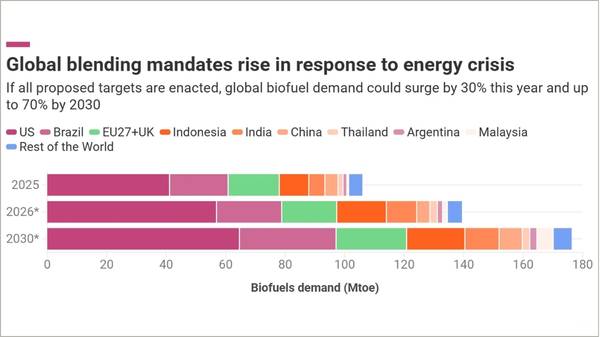
Global biofuels demand chart. Biofuel demand could surge 70% by 2030 as food price fears mount  

T&E warns governments risk trading an oil crisis for a food crisis as biofuel targets strain vegetable oil and fertiliser markets.

Shore power illustration. Shore power shifts from voluntary measure to compliance requirement, DNV white paper finds  

Shore power is moving from an optional emissions tool to a regulatory obligation for shipowners in key trades.

Giosuè Vezzuto and Ahmed Eldemerdash. Baker Hughes’ NovaLT 16 gas turbine receives RINA type approval for marine propulsion on hydrogen and natural gas  

Certification covers operation on natural gas and blends up to 100% hydrogen for marine use.

AiP award ceremony for nuclear reactor integration in cargo vessel design. ABS grants approval in principle for nuclear reactor integration in cargo vessel design  

ABS, HD KSOE, Capital Maritime Group and MIT have received approval in principle for a nuclear-powered cargo vessel propulsion system.

Green e-fuel export corridor consortium partners logos. Green e-fuel export corridor between Brazil and Belgium advances to feasibility stage  

A consortium has been formed to develop a green e-fuel corridor linking Porto do Açu to Antwerp-Bruges.

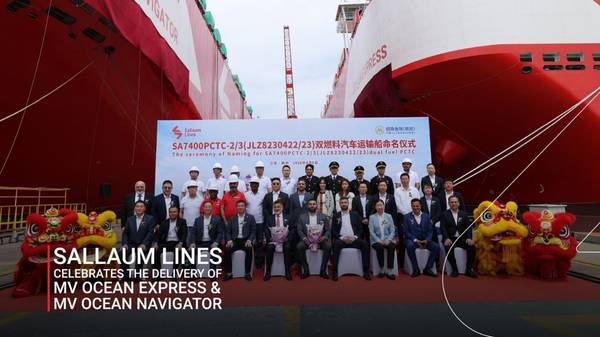
Naming ceremony of Ocean Express and Ocean Navigator vessels. Sallaum Lines takes delivery of two LNG-fuelled PCTCs in simultaneous handover ceremony  

RoRo carrier receives MV Ocean Express and MV Ocean Navigator from Chinese shipyard.

Person signing a document. Agastya Group signs MoU with Andhra Pradesh government for 1 MTPA green methanol hub at Mulapeta Port  

India-based Agastya Group plans a $6.5bn green methanol export facility on the country's east coast.


↑  Back to Top