This is a legacy page. Please click here to view the latest version.
Wed 2 Dec 2009, 07:13 GMT

CSCL aims to cut fuel consumption


Low fuel consumption said to be the 'key technical reason' for selecting 2-stroke engine for its container vessels.


China Shipping Container Lines Co., Ltd. (CSCL), part of the China Shipping Group (CSG), says that it has chosen main engines from manufacturer Wärtsilä for eight of its container vessels primarily because it enables them to lower fuel consumption.

Wärtsilä, the marine industry's leading ship power system integrator, will supply a package of support services for this order, which was placed in October 2009. The ships are to be built at the Jiangnan Changxing shipyard in Shanghai.

Commenting on the energy efficiency benefits of the Wärtsilä engines, Mr Li Xueqiang, deputy GM of CSCL said "The low fuel consumption across many load parameters was the key technical reason to select the Wärtsilä common rail 2-stroke engine. "This is a partnership with Wärtsilä forever. Service quality and engine performance are the most important facts for a successful partnership."

The CSG fleet is largely powered by Wärtsilä engines, and currently has more than 310 Wärtsilä engines in service, including close to 100 low speed main engines and more than 210 four-stroke engines. About 75 Wärtsilä engines are contracted to be delivered during 2010-2012, including more than 20 low speed main engines and 55 four-stroke engines.

This latest order, however, marks the first order for Wärtsilä main engines for CSG's container vessel fleet, which is ranked amongst the world's leaders in terms of operating capacity.

The order calls for Wärtsilä to supply its 7-cylinder RT-flex68TD common rail 2-stroke engines for the eight 4700 teu container vessels. The selection of this particular engine type came after CSG scaled down the original speed specified in the design, in line with the downturn in the shipping market, to a maximum of 18 knots.

Wärtsilä's support services for this order will include RT-flex engine training at the Wärtsilä Services facilities in Shanghai using an RT-flex electronic simulator. Additionally, a single RT-flex rail unit will be specially manufactured to enhance the hands-on basic operational training courses. These courses will primarily target the Chinese crew who will operate common rail 2-stroke engines in the future.

Long-standing relationship

CSG continues to develop its partnership with Wärtsilä, adopting many different products and services into its various business areas. For example, CSG's Tanker division, the largest sea-borne tanker fleet in China, has recently taken possession of six product tankers fitted with Wärtsilä RT-flex50 and RT-flex58TB main engines, Wärtsilä Auxpac 20 auxiliary engines, as well as Wärtsilä fixed pitch propellers and thrusters. In total, 80 Wärtsilä Auxpac 20 auxiliary engines have been ordered, including 33 engines already in service.

Currently, four VLCC projects and eight VLOC projects with Wärtsilä RTA84TB main engines and Wärtsilä Auxpac 20 auxiliary engines are under construction. Similarly, four Ropax projects with Wärtsilä 32 four-stroke engines and Wärtsilä 20 Auxpac auxiliary engines are also ongoing. During the past three years, Wärtsilä Services in China has supported CSCL's operation of almost 130 sets of Wärtsilä 32 auxiliary engines via a service agreement. Under this agreement, equipment and parts are continually rolled-over on an exchange basis from one vessel to another. This greatly reduces the overhaul time onboard since preparations can be made in the workshops to be ready for the next CSG ship. It has been a particularly successful model.

"Our long-standing relationship with China Shipping Group is based on mutual respect for each others' expertise and professionalism. We at Wärtsilä are committed to supplying propulsion units that meet today's needs in the areas of fuel savings and emissions reduction, and to supporting our customers with flexible and efficient service and technical assistance," commented Mr Andrew Stump, Sales Director, Ship Power Merchant, Wärtsilä in China.

Since CSG was founded in 1997, it has developed five specialized shipping fleets of oil tankers, tramps, passenger ships, container vessels and special cargo ships, comprising more than 440 vessels with an aggregated deadweight of 18 million tonnes, and an annual traffic volume of over 390 million tonnes.


VPS logo. Fuel quality management for vessels in extended idle: Arabian Gulf, Gulf of Oman and adjacent anchorages | Rahul Choudhuri, VPS  

Managing fuel quality deterioration following the closure of the Strait of Hormuz.

Person signing a document. Agastya Green Fuels signs 250,000 t/yr e-methanol offtake deal with Sri Lanka’s SAR Group  

Indian producer and Sri Lankan maritime firm agree long-term green methanol supply partnership.

Bunker Holding logo. Bunker Holding seeks risk specialist for Copenhagen internal pricing desk  

Danish bunker group is expanding its internal pricing team to meet growing demand for fixed-price solutions.

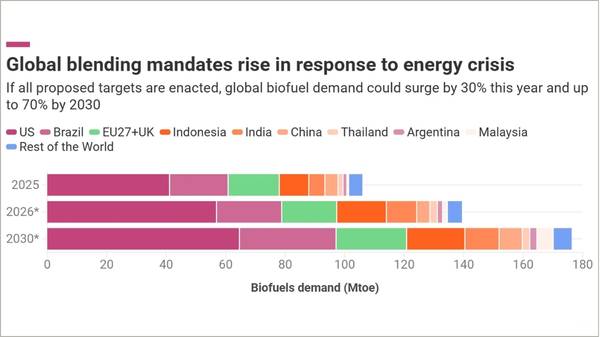
Global biofuels demand chart. Biofuel demand could surge 70% by 2030 as food price fears mount  

T&E warns governments risk trading an oil crisis for a food crisis as biofuel targets strain vegetable oil and fertiliser markets.

Shore power illustration. Shore power shifts from voluntary measure to compliance requirement, DNV white paper finds  

Shore power is moving from an optional emissions tool to a regulatory obligation for shipowners in key trades.

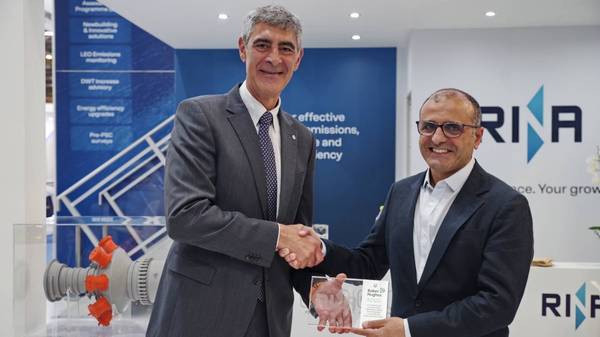
Giosuè Vezzuto and Ahmed Eldemerdash. Baker Hughes’ NovaLT 16 gas turbine receives RINA type approval for marine propulsion on hydrogen and natural gas  

Certification covers operation on natural gas and blends up to 100% hydrogen for marine use.

AiP award ceremony for nuclear reactor integration in cargo vessel design. ABS grants approval in principle for nuclear reactor integration in cargo vessel design  

ABS, HD KSOE, Capital Maritime Group and MIT have received approval in principle for a nuclear-powered cargo vessel propulsion system.

Green e-fuel export corridor consortium partners logos. Green e-fuel export corridor between Brazil and Belgium advances to feasibility stage  

A consortium has been formed to develop a green e-fuel corridor linking Porto do Açu to Antwerp-Bruges.

Naming ceremony of Ocean Express and Ocean Navigator vessels. Sallaum Lines takes delivery of two LNG-fuelled PCTCs in simultaneous handover ceremony  

RoRo carrier receives MV Ocean Express and MV Ocean Navigator from Chinese shipyard.

Person signing a document. Agastya Group signs MoU with Andhra Pradesh government for 1 MTPA green methanol hub at Mulapeta Port  

India-based Agastya Group plans a $6.5bn green methanol export facility on the country's east coast.


↑  Back to Top