This is a legacy page. Please click here to view the latest version.
Tue 15 Sep 2009, 07:11 GMT

Bunker measuring system passes field testing


US supplier tests new bunkering system to measure and report marine fuel transfers.


Nautical Control Solutions (NCS) has announced that Buffalo Marine Service of Houston successfully tested its FuelTrax bunkering system on a delivery of 1500 metric tons of IFO 500 to Maersk Wyoming, a 292-meter container ship operated by Maersk Line.

The test took place on August 26, 2009 at Barbours Cut terminal at the Port of Houston. The crew of Buffalo 401k pumped at the rate of 250 metric tons per hour, with accuracy measured to less than 0.1% between the barge and the ship. Accuracy was verified by Maersk Wyoming’s own in-line mass flow meter.

“This is an industry changing event,” said Anthony George, CEO of NCS. “This highly accurate way of measuring and reporting fuel transfers takes away the uncertainty in selling and purchasing marine fuels. As consumers, we expect accuracy when fueling our automobiles, but the marine industry has had to make do with manual dipping of tanks and volume-to-mass conversion calculations that introduce error. Not anymore. Ship owners can now expect to receive what they pay for at the pump”.

The FuelTrax-based system provides real-time measurement of bunker deliveries irrespective of product type, viscosity, or temperature. More importantly, the system will accurately measure barrels and tons regardless of whether there is air, fuel, or both in the piping system.

Utilizing a Micro Motion Coriolis-type meter from Emerson, mass, volume, density, and temperature readings were displayed simultaneously on a user-friendly touch-screen monitor aboard Buffalo Marine’s San Joaquin, a 75-foot (23 meter) tug that pushes Buffalo 401k.

When all the fuel had been delivered, the crew of San Joaquin touched the “print” button on the screen, the bunker delivery receipt was printed, and the event was completed.

Pat Studdert, President, Buffalo Marine Service, said “FuelTrax has eliminated delivery gaps in the bunkering business. Buffalo Marine crews now possess a reliable metering system that permits them to deliver multiple bunker orders without the uncertainty of stop-gauges, repeated loadings at the storage facility, and disputes over viscosity and quantity adjustments.

“FuelTrax also bolsters our “Go Green” philosophy of protecting the environment,” continued Mr. Studdert. “Specifically, fewer loadings at the terminal reduce the probability of spills and decrease the amount of fuel burned by the tows in order to make these transits. Thus, we reduce our overhead while substantially lowering our emissions.

“Of course, as the region’s leader in the delivery of bunkers, FuelTrax pays vast dividends for our customers. They are provided with real-time bunker delivery tickets from an extremely accurate metering system. This removes any doubts on who received what. The precise measurement in barrels and metric tons, top-notch record keeping, and ease of operation complements Buffalo Marine’s goal of exceeding our customer’s expectations.”

Mr. George added, “Version 2.0 of the system will provide customers a 24-hour, seven day per week Web-based portal to access their bunkers worldwide. Coupled with a fuel product digital signature, terminals, transporters, and vessel owners will have the ability to reconcile purchases online once the delivery is completed. It will move the business transaction part of bunkering from the deck to the office where it belongs.”


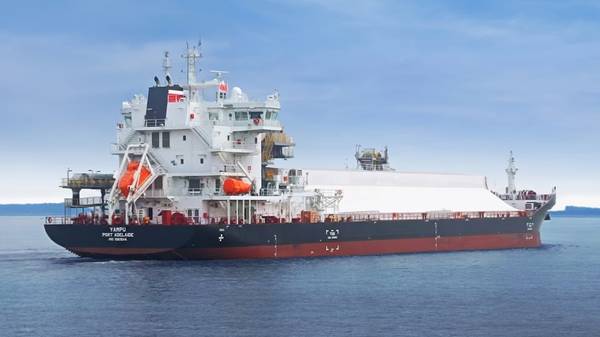
Yampu vessel. CSL delivers world’s first battery-powered self-unloading bulk carrier  

MV Yampu will transport limestone for Adbri in Australia, with full electric operation targeted by 2031.

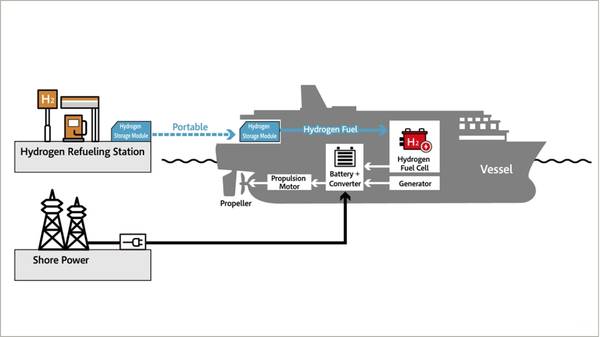
Illustration of hydrogen fuel cell system. NYK, Yanmar and Eneos to install hydrogen fuel cell system on new Tokyo dining cruise vessel  

Three Japanese companies are collaborating to bring hydrogen propulsion to a dining cruise ship due to enter service in 2027.

Signing ceremony for 8,600-ceu dual-fuel PCTCs. Sallaum Lines orders four 8,600-ceu dual-fuel PCTCs from Chinese yard — its largest vessels to date  

Ammonia-ready car carriers ordered from XSI mark the next phase of Sallaum Lines’ fleet renewal.

Factory acceptance test (FAT) for X72DF-A ammonia engine. WinGD completes factory acceptance test on X72DF-A ammonia engine destined for CMB.Tech bulker  

Swiss engine maker WinGD has completed factory acceptance testing of its ammonia-fuelled X72DF-A engine in China.

Everllence B&W S60ME-C10.5-GI-EcoEGR engine render. Everllence secures world’s first order for ME-GI Mk10.7 dual-fuel engine  

Norwegian car-carrier operator GCC selects next-generation methane engine for four newbuilds.

Capital Clean Energy Carriers Corp. (CCEC) and CMA CGM logos. Capital Clean Energy Carriers and CMA CGM form joint venture to build $82.8m LNG bunkering vessel  

The 20,000-cbm dual-fuel vessel is due for delivery in the third quarter of 2028.

Hong Kong flag. Hong Kong launches port dues and vessel registration incentives to boost green fuel bunkering  

Two new schemes offer financial concessions to attract green fuel vessels and grow the Hong Kong fleet.

Mein Schiff Flow vessel. Fincantieri delivers LNG-ready cruise ship Mein Schiff Flow to TUI Cruises  

The 160,000 gross-tonne vessel is the second of two InTUItion-class dual-fuel ships.

Monjasa logo. Monjasa seeks trader for Fredericia-based Northwest Europe desk  

Bunker firm is recruiting a trader to join its Northwest Europe team.

Port of Barcelona and Port of Shanghai signing ceremony. Barcelona and Shanghai sign strategic port cooperation agreement targeting green fuels and digital corridors  

Ports formalise a 'sister ports' relationship covering green shipping, digitalisation and intermodality.


↑  Back to Top